Most amaryllis care guides explain how to keep the bulb alive, and paperwhite guides do the same. The part people actually get wrong is when to start them.
Amaryllis and paperwhites sit side by side on the bench every November, they both promise holiday flowers, and they run on completely different clocks. An amaryllis needs 6 to 8 weeks. Paperwhites need 4 to 6. Buy both on the same trip, plant both the same afternoon, and your paperwhites will peak around Thanksgiving while the amaryllis is still a green spike on Christmas morning.
So this guide starts with the calendar, then covers how to plant each one, how to keep paperwhites from toppling into your centerpiece, and which of the two is worth saving for next year. Everything here applies anywhere in the Tri-State, whether you are in Newburgh, across the river in Kentucky, or over in Illinois, because all of it happens inside your house.
When to Plant Amaryllis and Paperwhites
Count backward from the date you want flowers: 6 to 8 weeks for an amaryllis, 4 to 6 weeks for paperwhites. University of Wisconsin Horticulture puts amaryllis at "generally blooming 6 to 8 weeks after planting," and Iowa State Extension gives the same 6 to 8 weeks for a newly potted bulb. For paperwhites, University of Vermont Extension says they "will bloom within 4-6 weeks after potting."
For the 2026 holidays, that gives you these windows:
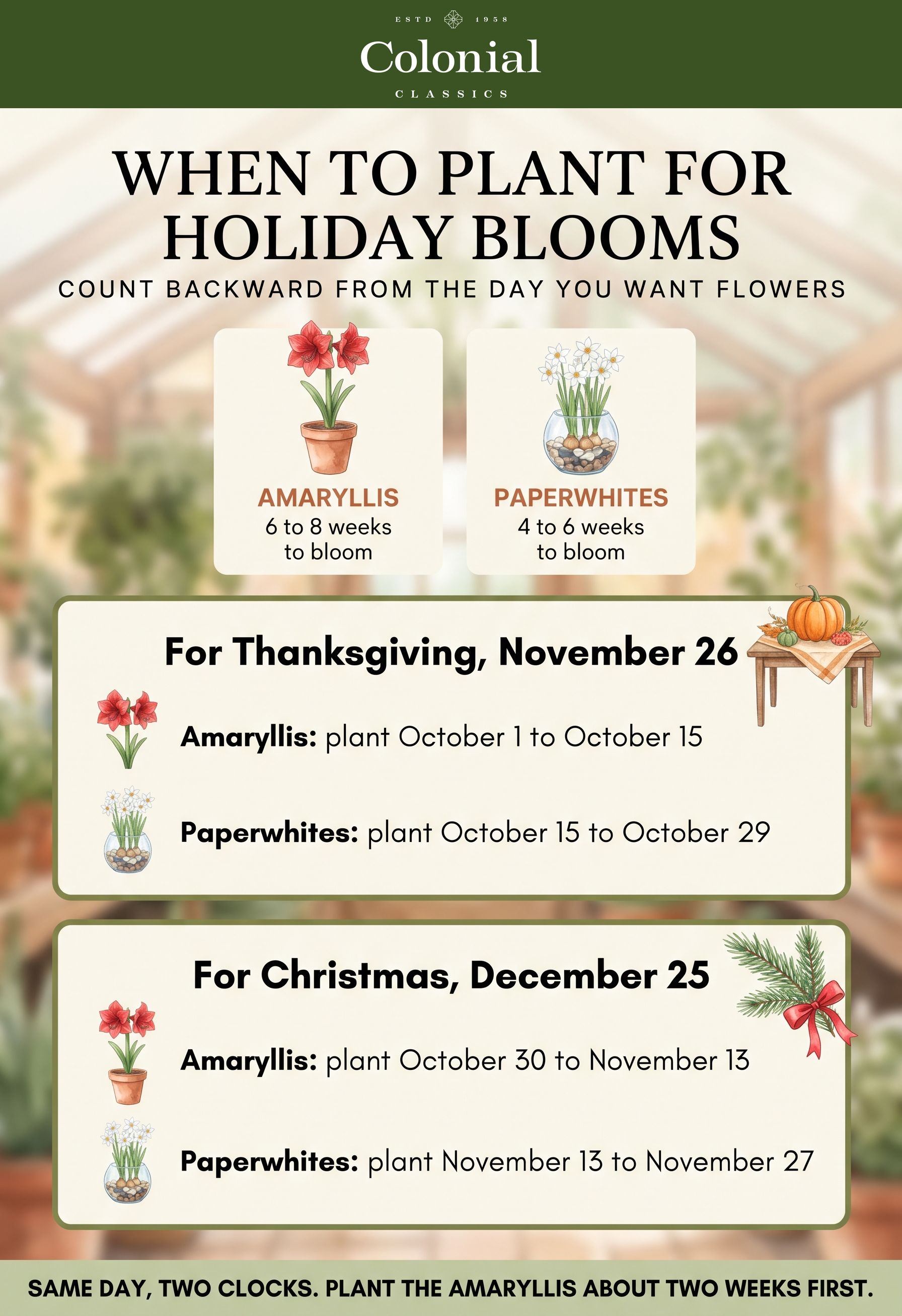
Two practical notes. First, these are windows, not deadlines, and a week either side is normal. Temperature moves both bulbs: a cool room slows everything down, and a warm one speeds it up. Second, if you want flowers on the table from Thanksgiving through New Year's rather than on one specific day, plant in batches about ten days apart instead of all at once. Three pots of paperwhites started on three different weekends will carry you through the whole stretch.
Beyond timing, here is how the two compare:
| Amaryllis | Paperwhites | |
|---|---|---|
| Grown in | Potting mix | Pebbles and water, or mix |
| Needs chilling first | No | No |
| Fragrance | Almost none | Strong, polarizing |
| Worth keeping after | Yes | No |
If you are reading this in late October, you are in the sweet spot for an amaryllis and slightly early for paperwhites. Pot the amaryllis now and keep the paperwhite bulbs in a cool, dry, dark spot for another two or three weeks.
What You Are Actually Buying
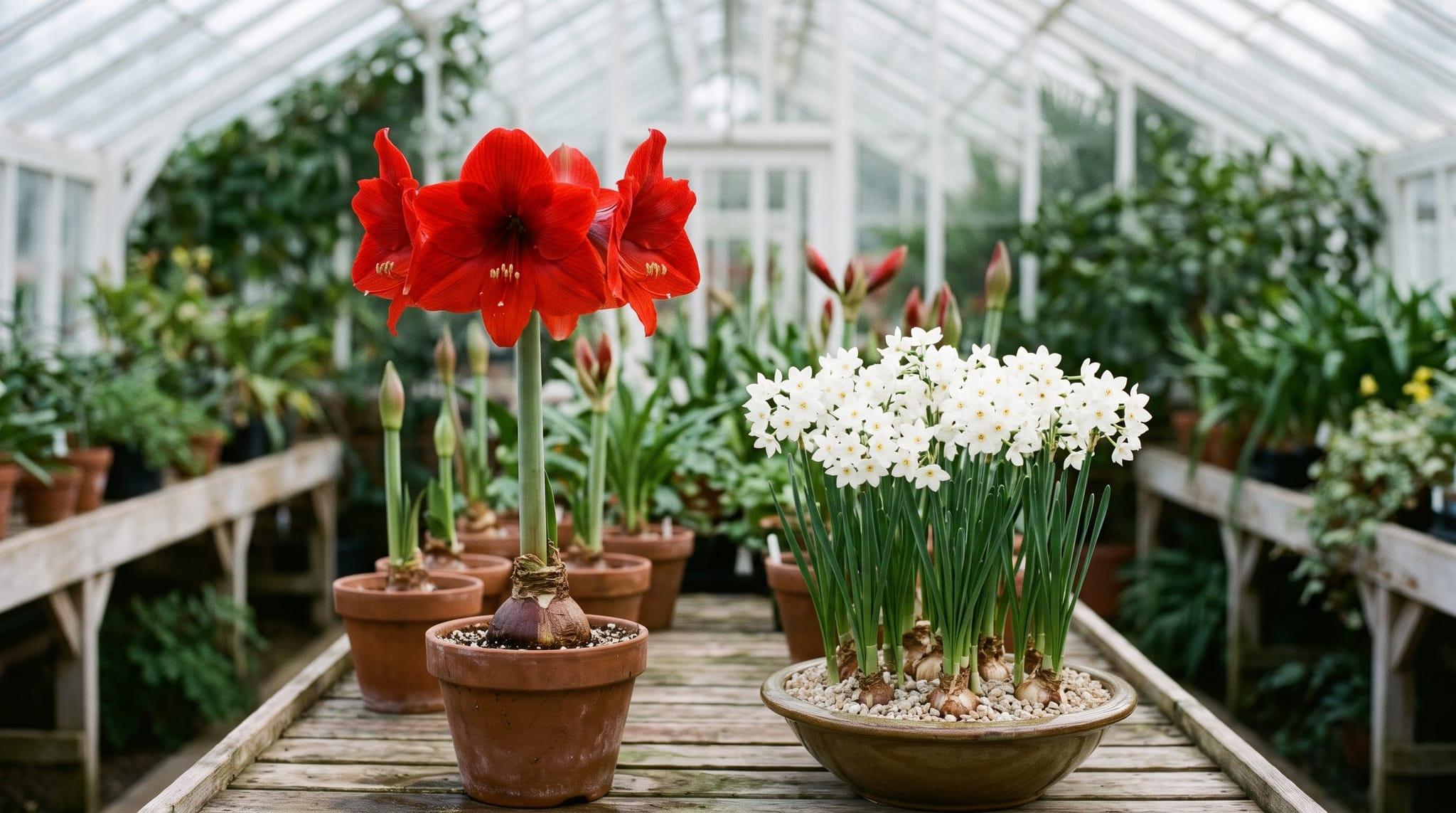
The holiday "amaryllis" is a Hippeastrum, not a true Amaryllis. This sounds like trivia until you go looking for care advice and find pages about a South African bulb that blooms outdoors in late summer. Both get called amaryllis. The big hollow-stemmed bulb sold in a box in November is Hippeastrum, and that is what this guide covers.
Paperwhites are Narcissus tazetta, a tender cousin of the daffodil. They are the same genus as the daffodils you plant outside in the fall, which is why the leaves look familiar, but they come from the Mediterranean and they do not survive an Indiana winter.
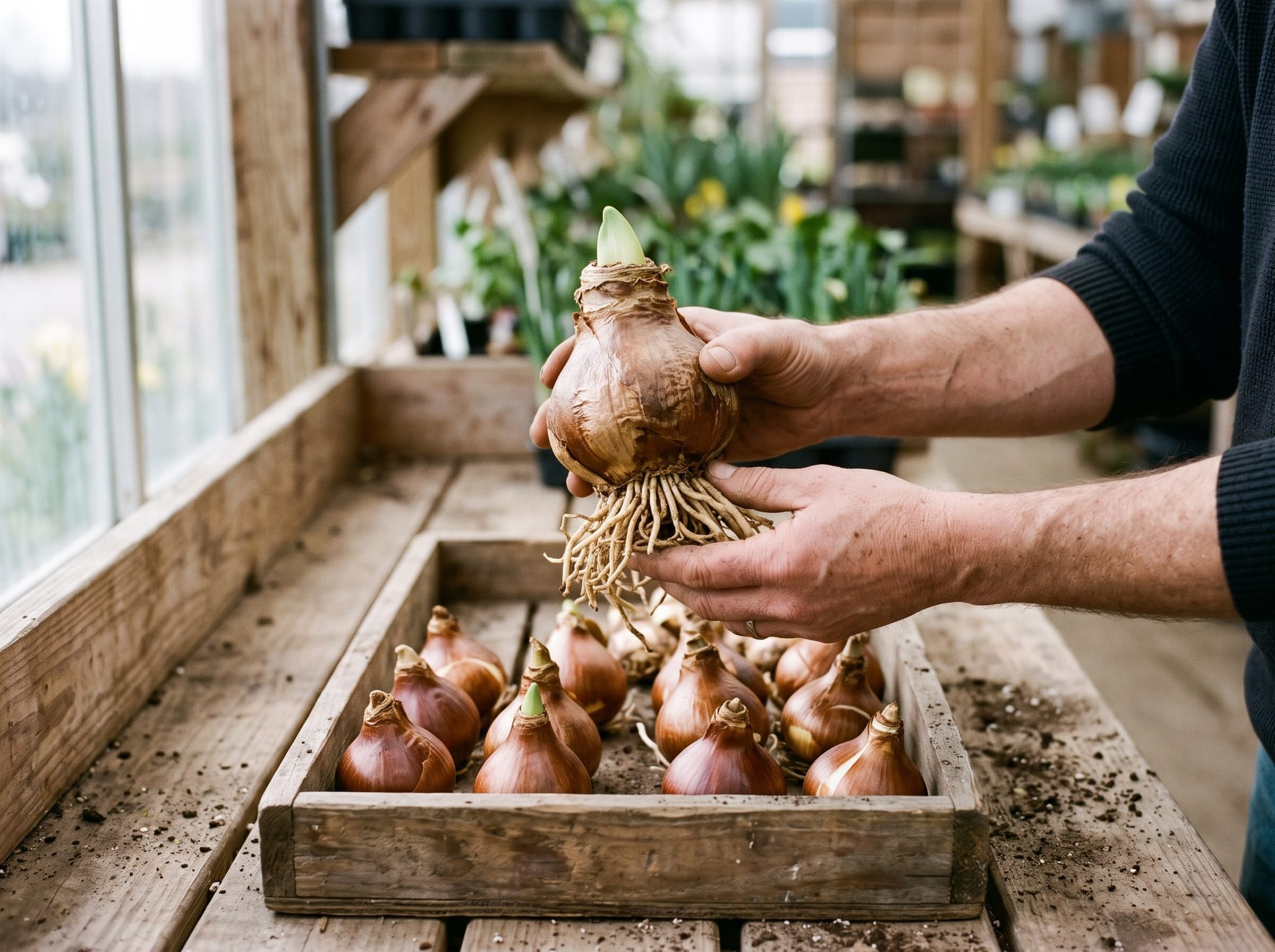
With an amaryllis, size genuinely matters. Illinois Extension puts it plainly: "size matters." Larger bulbs hold more stored energy, so they produce more flowers on thicker, stronger stems, and it is the one place where paying for the premium bulb clearly pays off.
Paperwhite bulbs are more forgiving. Buy firm bulbs with no mold and plant the lot of them.
How to Plant an Amaryllis
Plant it in a pot barely wider than the bulb, with the top third of the bulb above the soil line. Illinois Extension specifies a pot with drainage holes about an inch wider than the bulb and roughly twice its height, with at least the top one third of the bulb sticking out of the potting mix.
That exposed-shoulders rule is the one to remember. Burying an amaryllis to the neck the way you would a tulip is the most common mistake we see, and it leads to rot right where the bulb is most vulnerable.
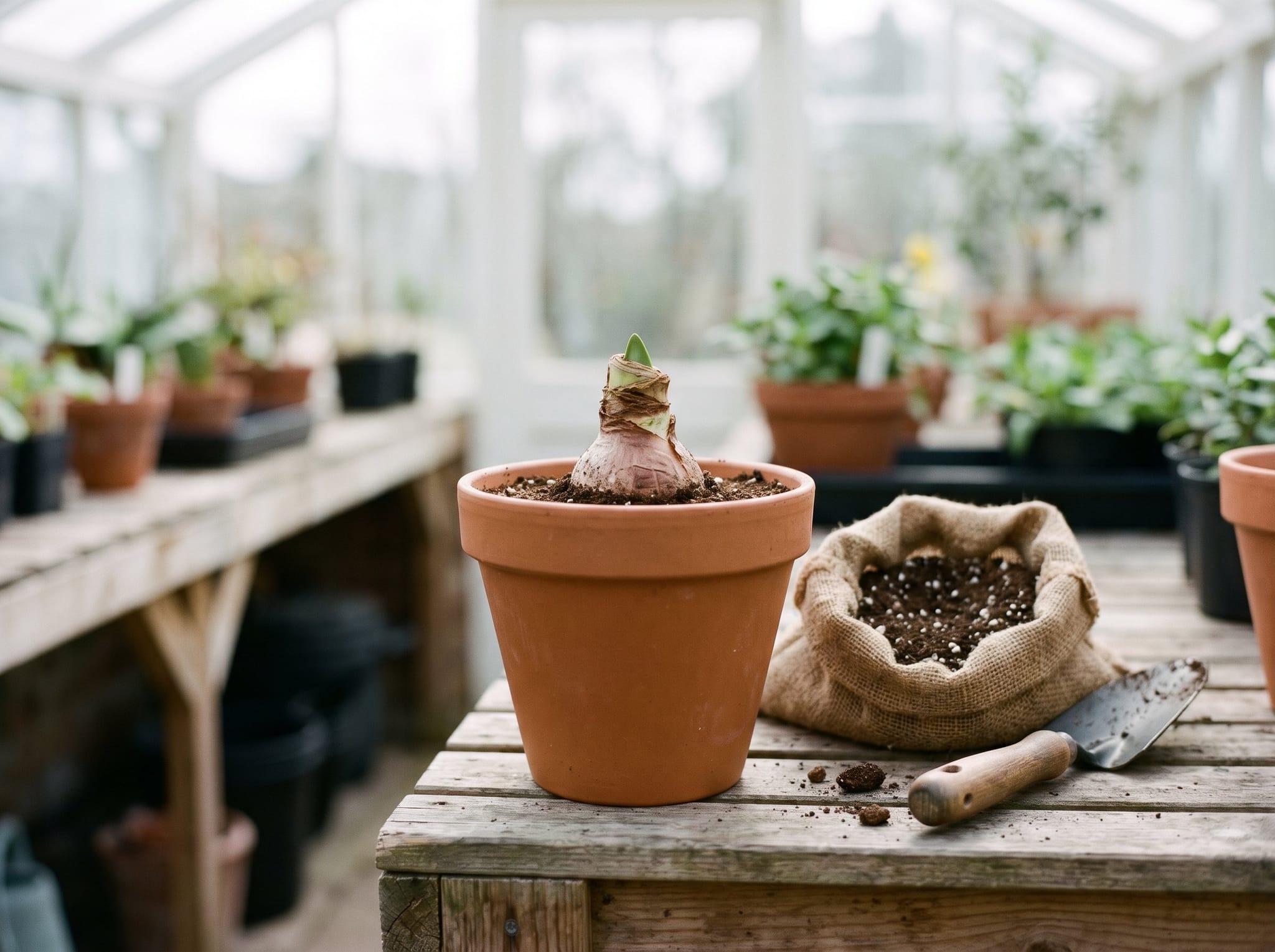
The watering is counterintuitive. Water thoroughly once at planting so the mix settles, then wait until the top 2 inches feel dry before watering again. A freshly potted bulb has almost no roots, so it cannot use much water, and keeping the mix wet while it has nothing to drink with is how a firm bulb turns soft. Once you see a stalk or leaves emerging, the plant starts drinking in earnest and you can water more regularly, feeding every 2 to 4 weeks with a dilute houseplant fertilizer.
One quirk worth expecting: an amaryllis often sends up its flower stalk before any leaves appear. That is normal and not a sign anything is wrong.
How to Force Paperwhites in Pebbles and Water
Set the bulbs on washed gravel in a bowl with no drainage holes, then add water until it just touches the bottom of the bulbs. Iowa State University Extension is specific that the water level should touch the bottom of the bulbs and be kept at that level throughout forcing. The bulbs themselves are never submerged.
That water line does all the work. Too low and the roots never find it. Cover the bulbs and they rot within a week or two. Check it every few days and top it up, because a bowl of rooting bulbs in a heated house drinks faster than you would think.
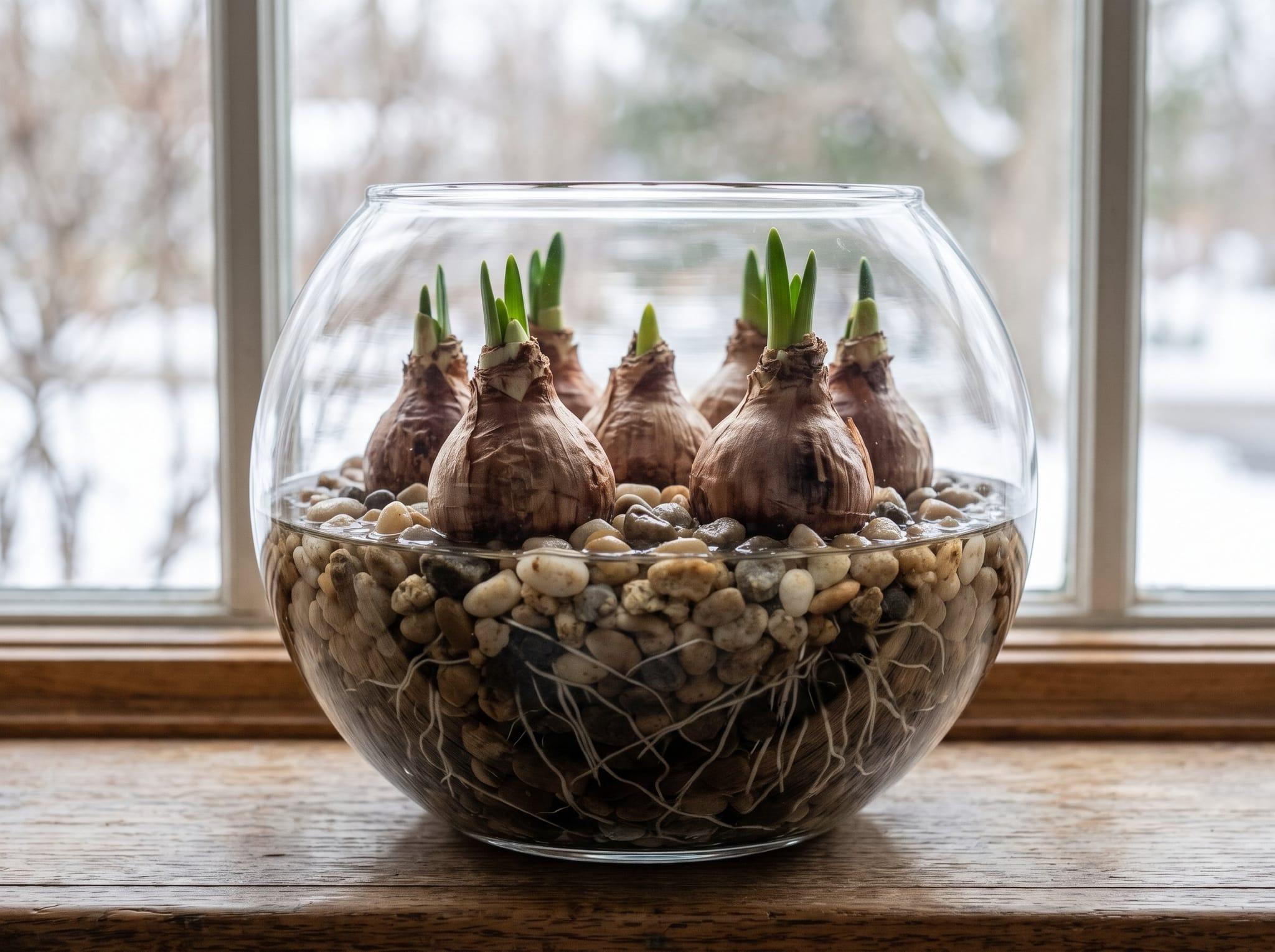
The sequence Iowa State recommends:
- Gravel first: Partly fill a shallow bowl with washed gravel or stones, set the bulbs on top, then add more gravel around them so only the tips stay exposed.
- Water to the base of the bulbs: Add water until it just touches the bottom of the bulbs, never higher.
- Cool and dark for 2 to 3 weeks: Hold them at 45 to 50 degrees in a dark spot to build roots. An unheated garage, a basement corner, or an uninsulated closet all work.
- Move them at about 3 inches: Once shoots reach roughly 3 inches, bring the bowl to a sunny window at 60 to 70 degrees.
- Shade them once they open: Moving the open flowers out of direct sun prolongs the bloom.
You can also plant paperwhites in potting mix with the tips above the soil, keeping the soil a half inch to an inch below the rim. Same timeline, less to look at, and harder to judge the water.
Paperwhites are strongly fragrant, and it is a scent people either love or genuinely cannot stand. Some find it cloying or faintly musty in a closed winter house. Start with one bowl before you commit your whole dining room, and keep them out of a small bedroom.
The Alcohol Trick That Stops Paperwhites Flopping
Water them with a dilute alcohol solution and the stems grow about a third shorter, with no change to the flowers. This is the single most useful thing we can tell you about paperwhites, and it comes out of real research rather than folklore.
Cornell University's Flower Bulb Research Program, where the work was done by Bill Miller and student Erin Finan, found that irrigating paperwhites with a 4 to 6 percent alcohol solution produces plants roughly one third shorter than normal, with flowers "just as large, fragrant, and long-lasting as usual." The leading theory is mild water stress: the alcohol makes water slightly harder to take up, which limits stem and leaf growth without affecting the flower itself.
The method matters as much as the ratio:
- Start in plain water. Grow the bulbs normally until roots have formed and the green shoot is 1 to 2 inches above the bulb, which takes about a week.
- Pour the plain water off. Cornell notes this step is optional, but skipping it dilutes the solution at the roots and you get less height reduction.
- Switch to the alcohol solution and stay on it. Use it for every watering from that point forward. Effects show within a few days.
The dilutions, which are worth getting right:
| What you have | Mix it | Resulting strength |
|---|---|---|
| 40 percent spirits (80 proof gin, vodka, whiskey, tequila) | 1 part spirit to 7 parts water | About 5 percent |
| 70 percent rubbing alcohol (isopropyl) | 1 part alcohol to 10 or 11 parts water | About 6 percent |
| Beer or wine | Do not use | Sugars cause major problems |
Stay well below 10 percent. Cornell reports growth problems becoming noticeable above that, and describes 25 percent as dramatically toxic. More is emphatically not better here, and the difference between a 5 percent solution and an undiluted splash of vodka is a dead bowl of bulbs.
Floppy paperwhites are a light-and-water problem you can solve before it starts. Root them cool and dark, give them a genuinely bright window afterward, and switch to a 4 to 6 percent alcohol solution once the shoots are an inch or two tall.
Light and Temperature for Both
Bright light and cool rooms. Those are the two levers, and most indoor bulb disappointment traces back to one of them.
| Amaryllis | Paperwhites | |
|---|---|---|
| Light while growing | Sunny window | Dark for rooting, then sunny window |
| Rooting temperature | Room temperature | 45 to 50 degrees, 2 to 3 weeks |
| Growing temperature | 65 to 70 degrees | 60 to 70 degrees |
| Once flowers open | Move somewhere cooler, out of direct sun | Move out of direct sun |
| Water | When the top 2 inches are dry | Keep level at the base of the bulbs |
| Fertilizer | Every 2 to 4 weeks, dilute | None needed |
The move-it-when-it-blooms advice is the step people skip, and it is free. University of Wisconsin Horticulture gives 65 to 70 degrees as room temperature for growing an amaryllis, then 60 to 65 degrees and out of direct sunlight once it flowers, specifically to prolong the bloom. Illinois Extension gives the same advice for the moment buds show color. A 72-degree living room will give you a shorter show than a 64-degree entryway, so the cool spot by the front door is doing you a favor.
Too little light produces a specific, recognizable failure in both plants: stems that stretch pale and tall, then bend under the weight of their own flowers. If your amaryllis is leaning hard toward the window, rotate the pot a quarter turn every couple of days.
Why Your Amaryllis Has Leaves and No Flower
Because it never got a real rest, or because someone cut its leaves off last year. An amaryllis flowers out of food it banked the previous season, and it banks that food through its leaves.
Iowa State Extension is direct about this: the bulb has to replenish depleted food reserves after flowering, the strap-like leaves are what manufacture that food, and reblooming requires a cool dormant period. Skip either half and you get foliage without a stalk.
Working through the likely causes in order:
- No cool rest period: Iowa State calls for a minimum of 8 to 10 weeks at 50 to 55 degrees. A bulb that sat on a warm windowsill all autumn usually pushes leaves only.
- The leaves were removed too early: Cutting foliage while it is still green takes away the bulb's only way to feed itself. Wait until leaves yellow on their own.
- The flower stalk was left to set seed: Illinois Extension notes that seed development drains the bulb's reserves. Cut spent flowers off, and remove the stalk once it yellows.
- Not enough light or food in the growing season: Iowa State suggests a sunny window and dilute fertilizer every 2 to 4 weeks indoors.
- Rushed back into growth: A bulb pulled out of dormancy after four weeks instead of ten has not finished the job.
- The bulb is simply too small or too old: A small or spent bulb may need a full growing season of good care before it has the reserves to flower again.
If you bought the bulb this season and it is pushing leaves first with a stalk behind them, nothing is wrong. That is just the order some bulbs do things in.
How to Get an Amaryllis to Bloom Again Next Year
Keep the leaves growing all summer, then give the bulb 8 to 12 weeks cool, dark, and dry in the fall. The whole year is really just those two phases.
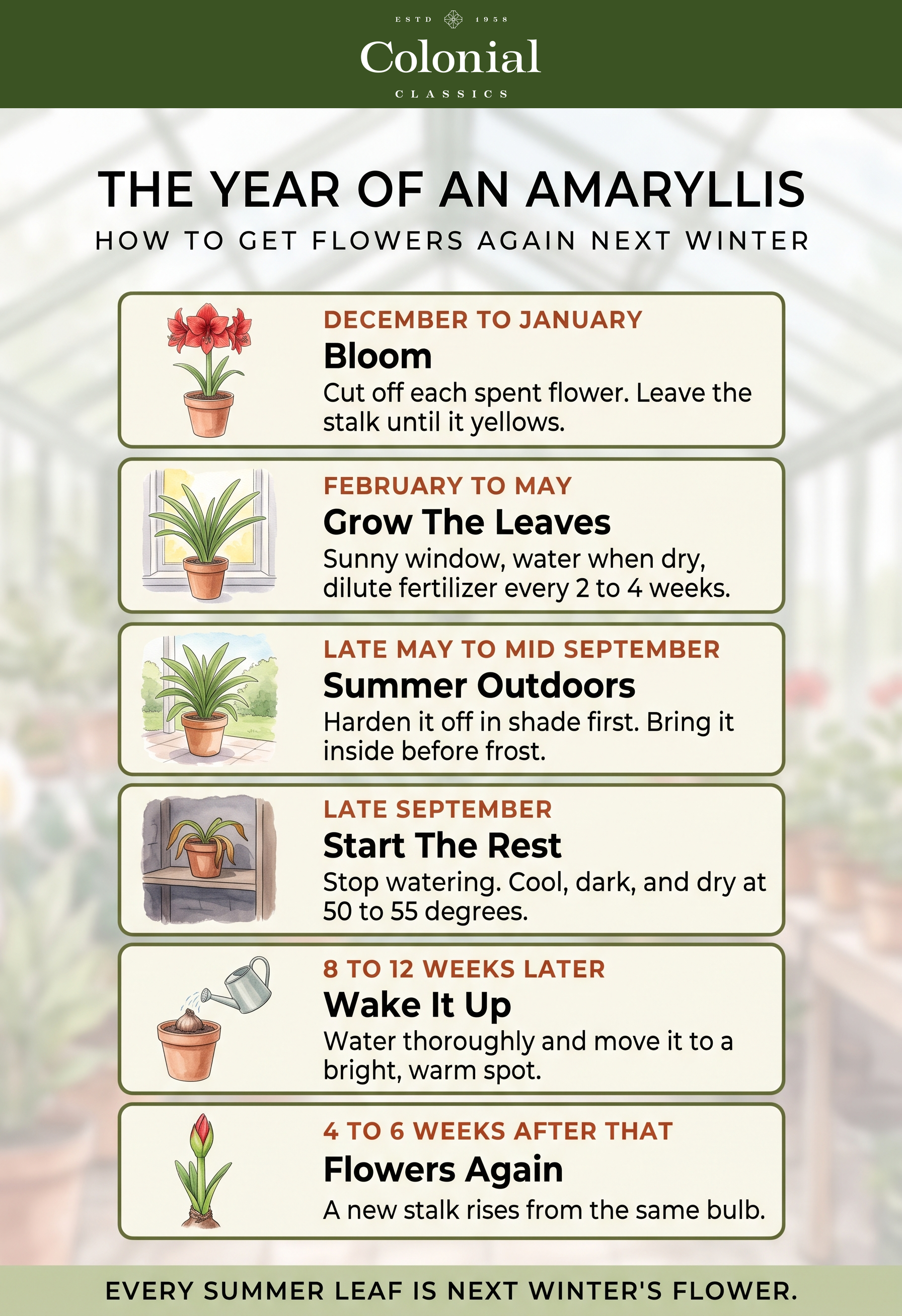
The sequence, drawing on both Iowa State Extension and Illinois Extension:
- After the flowers fade, cut each spent bloom off to stop seed forming. Leave the stalk until it yellows, then cut it 1 to 2 inches above the bulb.
- Through spring and summer, treat it as a foliage houseplant. Bright window, water when the surface is nearly dry, dilute fertilizer every 2 to 4 weeks. Every leaf is next winter's flower.
- Move it outside in late May, once nights are reliably warm. Harden it off over 7 to 10 days, starting in shade for 2 to 3 days before working up to direct sun, or the leaves will scorch.
- Bring it back indoors in mid-September, before frost.
- Start dormancy in late September. Move the pot somewhere cool, dark, and dry and stop watering entirely. Cut the foliage off once it browns. Hold it at 50 to 55 degrees for at least 8 to 10 weeks. Illinois Extension gives the range as 45 to 55 degrees for 8 to 12 weeks.
- Restart it when you want flowers. Water it thoroughly, move it to a bright spot at 70 to 75 degrees, and keep the mix moist but not wet until growth shows. Expect flowers 4 to 6 weeks after the rest period ends, which is faster than a newly purchased bulb because the roots are already there.
An unheated basement, a cool garage that stays above freezing, or a spare closet on an outside wall all work for step five. Here in the Evansville and Newburgh area, an attached garage usually holds in that 45 to 55 degree band through October and November without any help.
Throw the Paperwhites Away
Compost them after they finish. This is the one piece of advice that surprises people, and it is worth being plain about rather than leaving you to wonder.
Iowa State University Extension states that paperwhite narcissus bulbs should be discarded after flowering: they cannot be forced a second time, and they are not hardy outdoors. Clemson Cooperative Extension says the same thing just as bluntly, that paperwhites "cannot be forced again after blooming; discard them." Forcing takes essentially everything the bulb had stored, and unlike an amaryllis there is no practical way to rebuild it on a windowsill.
Planting them outside does not rescue them either. Paperwhites are Mediterranean and not winter hardy in USDA Zone 7a, which covers the whole Tri-State. They will not come back.
If you want narcissus that return every spring, that is a different bulb and a different season. Hardy daffodils go in the ground in the fall, and our fall bulb planting guide covers the timing and depth for Southern Indiana. Buy paperwhites as a six-week decoration, enjoy them, and let them go.
Both of These Are Toxic to Cats and Dogs
Yes, genuinely, and the bulbs are the dangerous part. This is worth a paragraph because both plants spend December at nose height on a coffee table.
The ASPCA lists Narcissus species, paperwhites included, as toxic to dogs, cats, and horses, with lycorine and other alkaloids as the toxic principles, and states plainly that bulbs are the most poisonous part. Signs are vomiting, drooling, and diarrhea, and a large amount can bring on convulsions, low blood pressure, tremors, or cardiac arrhythmias. The ASPCA's listing for holiday amaryllis (Hippeastrum, filed under its Danish name, Ridderstjerne) says the same: toxic to dogs, cats, and horses, the same toxic principles and signs, and the bulb as the most poisonous part.
Two practical consequences. A bowl of paperwhites in loose gravel is easy for a dog to dig a bulb out of, so a bowl on a high shelf is safer than one on an end table. And spare bulbs waiting to be planted should go in a closed cupboard, not a basket on the floor, because a loose amaryllis bulb looks a great deal like an onion to a curious dog. Call your veterinarian if your pet chews either one.
Come Pick Your Bulbs in the Greenhouse
The difference between a bulb bought locally and one shipped to your door is mostly about handling. You can pick up three amaryllis bulbs, feel which one is heaviest and firmest, and take that one home, which is the whole selection process and impossible to do through a website. A bulb that spent a week in a cold delivery truck arrives having already lost some of what it needs.
We carry amaryllis and paperwhites through the holiday season in the greenhouse, along with the gravel, bowls, and pottery to plant them in. If you want flowers on the table for Christmas, late October through mid-November is the window for amaryllis, and mid-to-late November for paperwhites. Come find us in the holiday and seasonal section, or browse the rest of the garden center while you are here. If you are after something that stays green all year instead, our guide to low light houseplants is a good place to start.
Not sure which bulb suits the spot you have in mind, or want a hand planting a bowl? Send us a message or stop in and ask. We would rather talk you into the right bulb than sell you the wrong one.