Nearly every houseplant sold in October is labeled easy, and a good share of them are labeled low light. One of those claims is usually true. The other is the reason a plant that looked perfect on the shelf is bare at the bottom and leaning toward the window by February. Genuine low light houseplants exist, but the label gets stuck on far more plants than have earned it.
Low light does not mean no light. It is a measurable range, roughly 25 to 100 foot candles, and it describes a real set of conditions that a surprisingly short list of plants can live in. This guide covers what that range actually looks like in a house, how to test the spot you have in mind before you spend money, which low light houseplants genuinely earn the label, and which popular ones do not. It also covers the winter care that matters here in USDA Zone 7a, where Southern Indiana and the wider Tri-State region, including Newburgh and Evansville, lose more than five hours of daylight between June and December.
What Low Light Actually Means
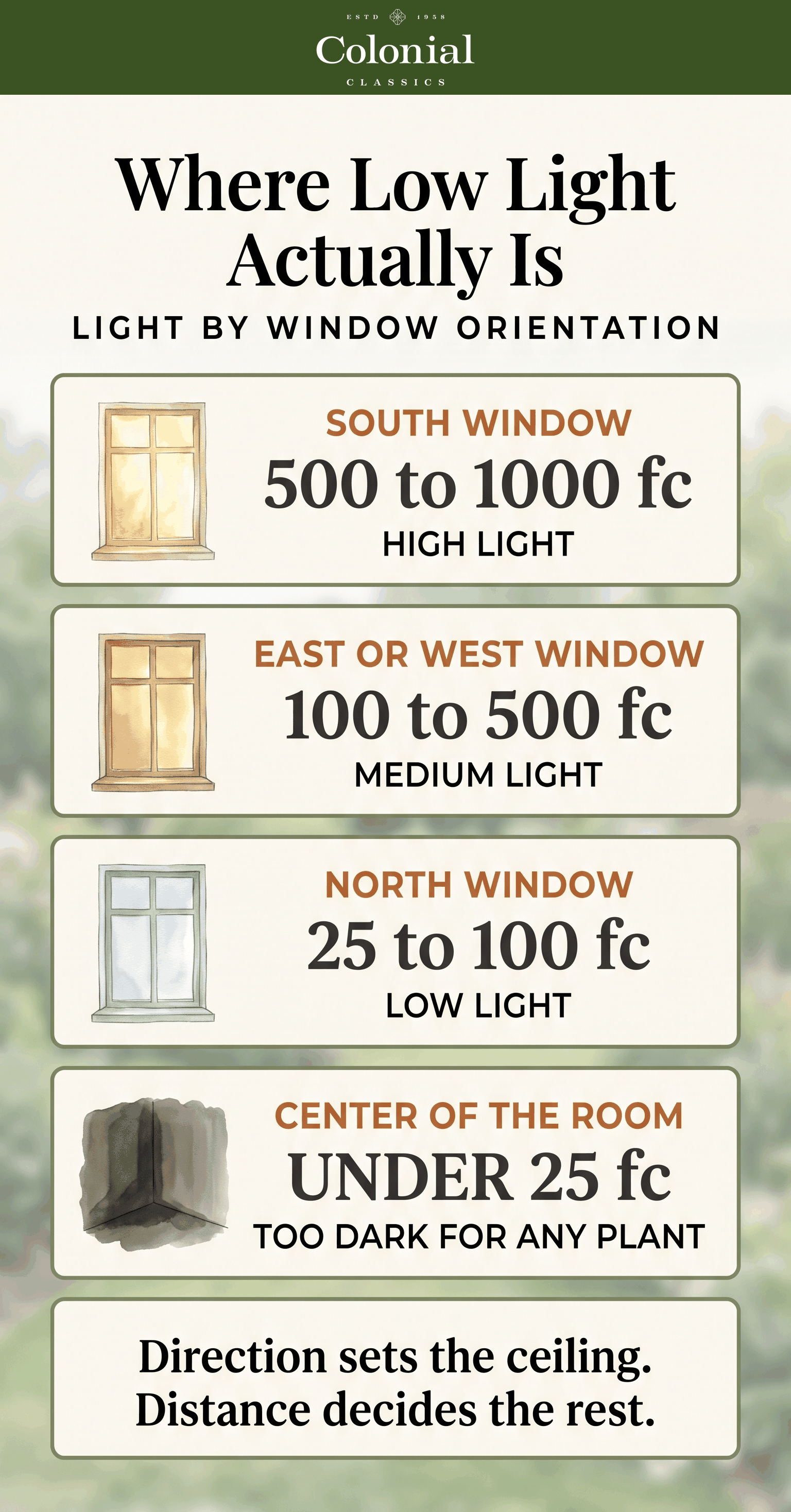
Low light is 25 to 100 foot candles. A foot candle is simply the amount of light falling on a surface, and it is the unit every published plant care range uses, which makes it the fastest way to stop guessing.
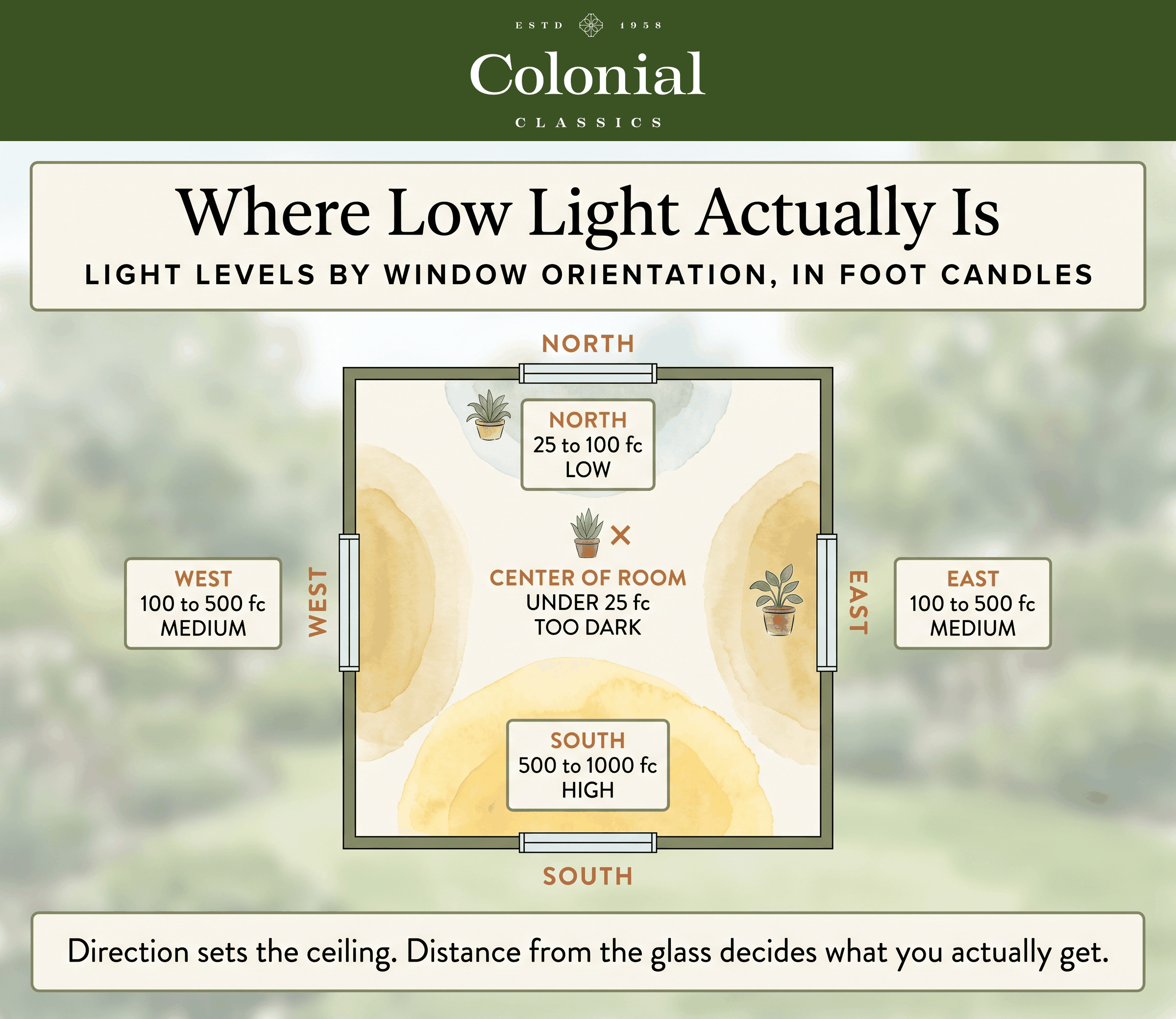
University of Maryland Extension breaks indoor light into four bands, and the useful part is that each one maps onto a window you already have. Low light is 25 to 100 foot candles, which is a north window or a spot well back from a brighter one. Medium-bright light is 100 to 500, roughly an east or west window. High light is 500 to 1000, an unobstructed south window. Anything over 1000 is direct sun, right up against south facing glass.
Two things in that range do most of the work. The first is that a north facing window is the only orientation that is low light by default, which means most people shopping for a low light plant are actually shopping for a dark corner of a room that has a perfectly good window somewhere else in it. The second is that distance matters as much as direction. Maryland Extension notes that light intensity "decreases rapidly with increasing distance" from its source, and the drop is steeper than it feels, because your eyes adjust and a light meter does not.
A plant three feet from an east window and the same plant ten feet back are living in two different light levels, even though the room looks equally bright to you. Direction sets the ceiling. Distance decides what you actually get.
How to Test the Light in Your Own Room
Stand where the plant will go, at noon on a clear day, and hold your hand about a foot above the surface. The shadow tells you most of what you need to know.
- A hard shadow with crisp edges: This is high light, 500 foot candles or better, which is south window territory.
- A soft shadow with blurry edges: This is medium light, the kind an east or west window gives, somewhere in the 100 to 500 range.
- Barely a shadow at all: This is low light, the 25 to 100 range where a cast iron plant is happy and a fiddle leaf fig is doomed.
For an actual number, use your phone. Iowa State Extension points out that "light meters, smartphone apps, and even SLR cameras can be used to measure light intensity" and that they typically report in lumens or foot candles. A free light meter app, held at plant height and pointed up toward the light rather than at the window, gets you close enough to compare your room against any published range.
Take the reading at plant height, not standing height, and point the phone up toward the light source rather than straight at the window. Aiming at the glass measures the window. Aiming up measures what the leaves actually receive.
Your Window in June Is Not Your Window in December
The single biggest thing national plant guides leave out is that your light changes with the calendar, and at our latitude it changes a lot.
Newburgh and Evansville sit near 38 degrees north. On the longest day in June, the area gets about 14 hours and 48 minutes of daylight, and the sun climbs to roughly 75 degrees above the horizon at noon, nearly overhead. On the shortest day in December, daylight falls to about 9 hours and 31 minutes, and the noon sun tops out around 29 degrees. That is a loss of more than five hours of daylight and a sun sitting less than half as high in the sky.
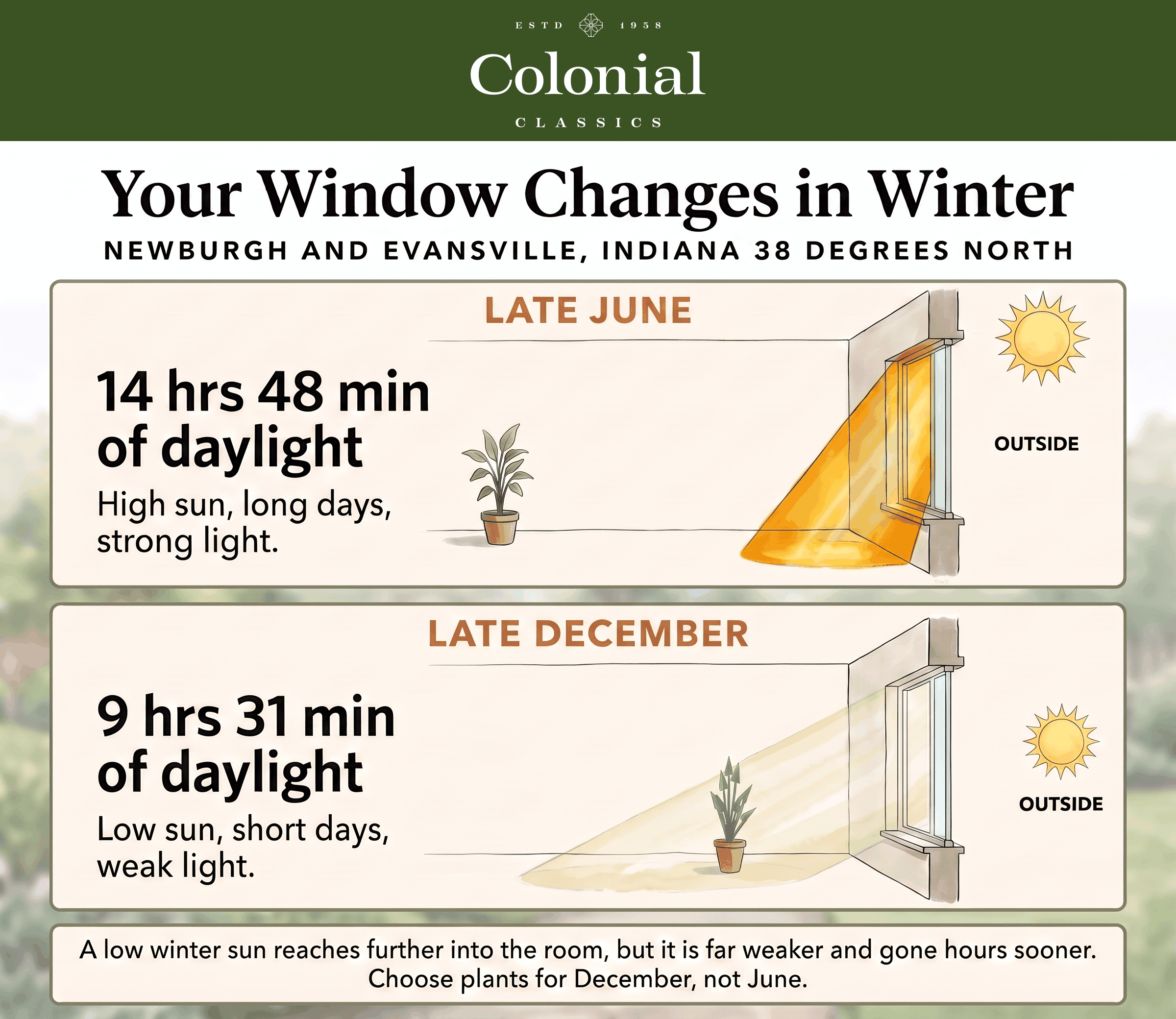
For a plant, that compounds in three ways at once. The days are shorter, so there are fewer hours of usable light. The sun is lower, so it travels through more atmosphere and arrives weaker. And our winters here are genuinely cloudy, which takes another cut off the top.
There is one genuine surprise in the geometry, and it is worth knowing because it cuts against the obvious. A low winter sun actually reaches further into a room than a high summer one. Light entering a vertical window at 29 degrees stretches several times deeper across the floor than light coming in at 75 degrees, which is the whole principle behind the overhangs that shade a south window in July and let the sun in come January. That deeper winter patch is still a downgrade for a plant, because it is far weaker, it sweeps past in a few hours rather than lingering, and on most days here it is behind cloud. More floor covered, much less light delivered.
The practical consequence is that a spot measuring 200 foot candles in July can sit below 100 in January. The plant did not change. The room did. This is also why so many houseplants look fine all summer and start dropping leaves in November, and why people blame the furnace or the watering can when the real culprit is the sun.
Buy for the darkest season, not the brightest. Take a light reading in December and choose plants that are comfortable at that number. A plant selected for a bright July reading spends four months of every year in a deficit, and that is the slow decline most people cannot explain.
The Low Light Houseplants That Actually Work
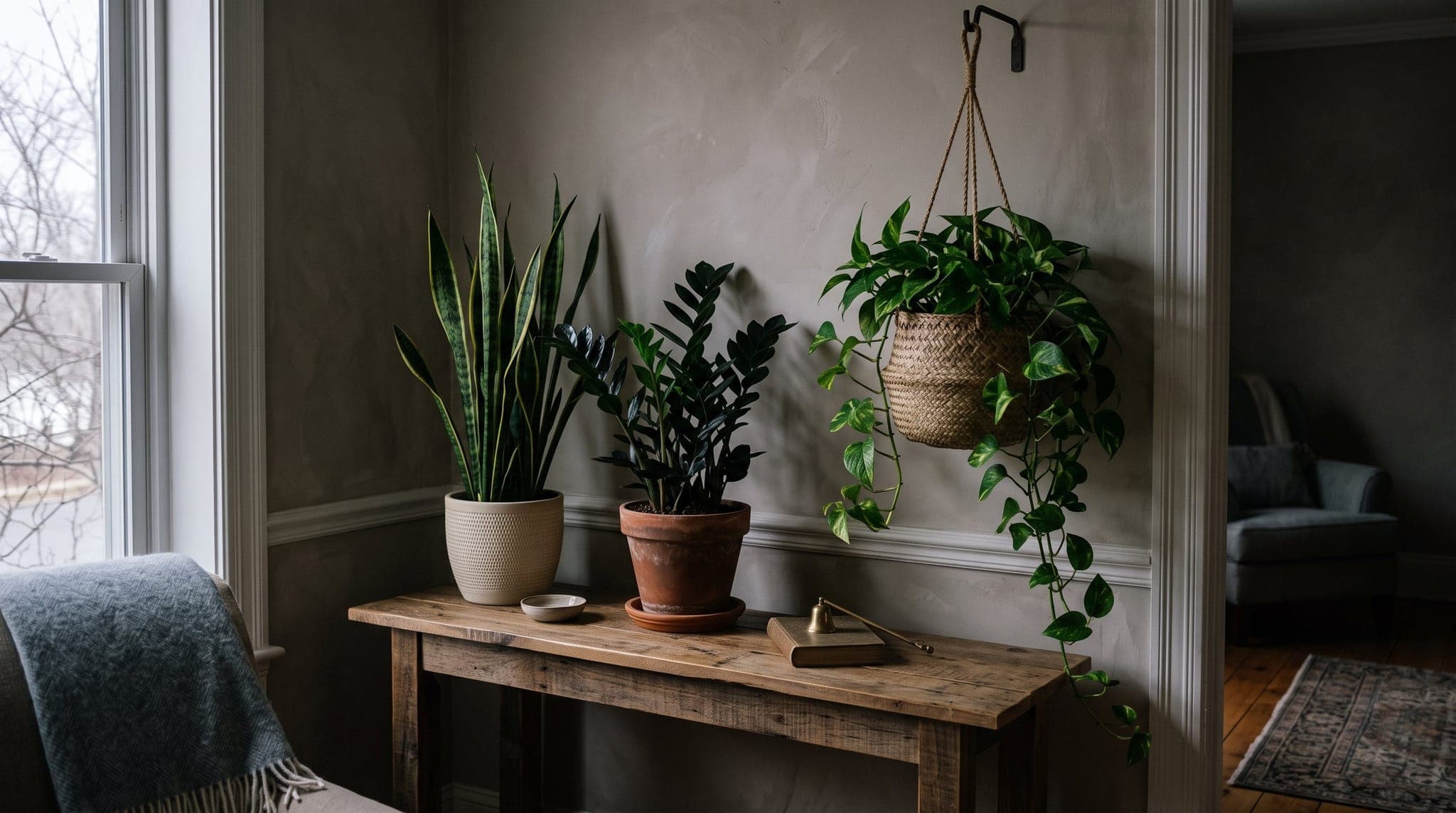
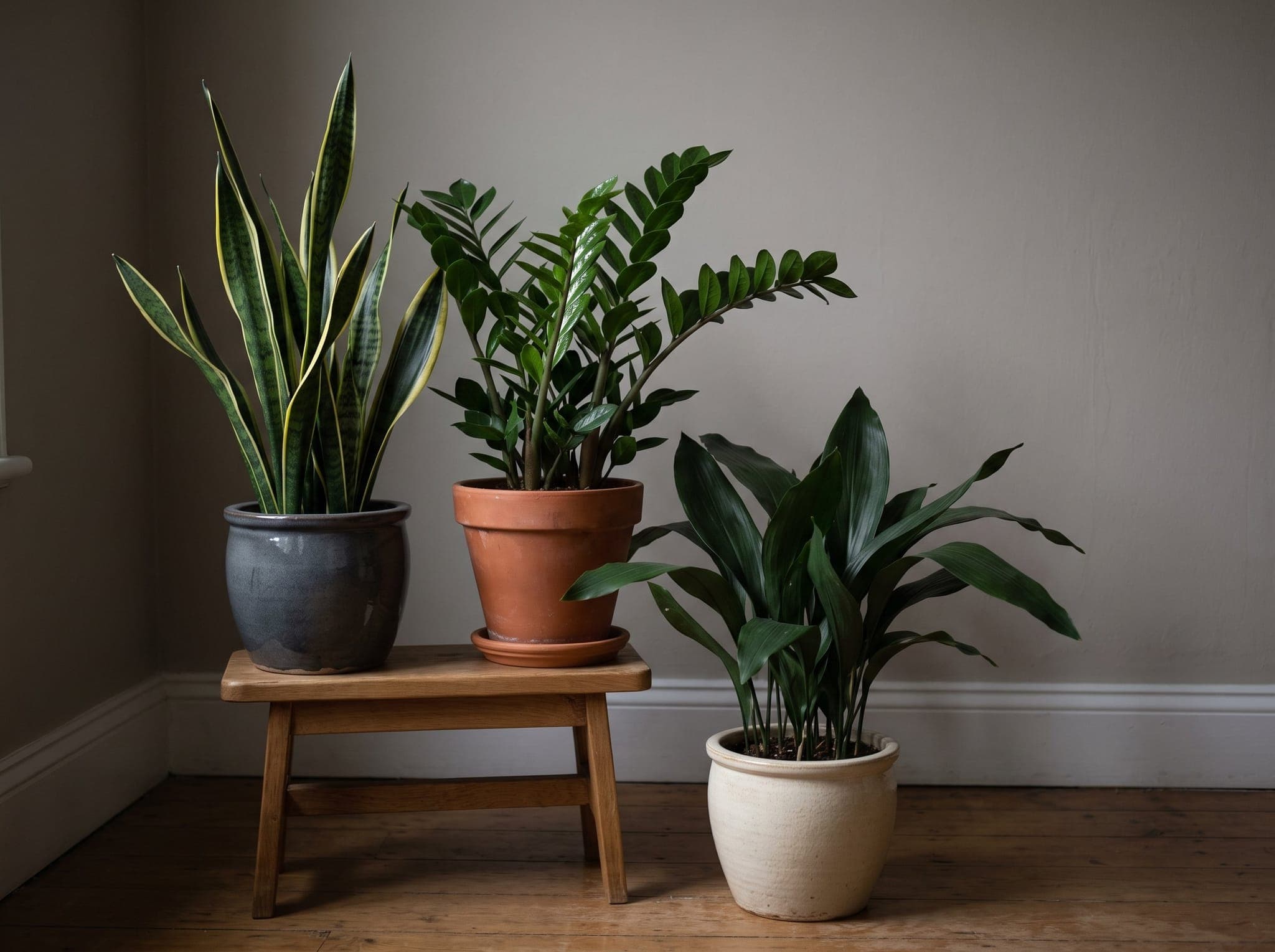
Eight plants genuinely hold up in 25 to 100 foot candles. Expect all of them to grow slowly there, which is the correct behavior rather than a problem to solve.
- Handles true low light
- Yes, the best of the group
- Pet safe
- Yes
- Water when
- Top inch dry
- Watch for
- Almost nothing. Very slow growth
- Handles true low light
- Yes
- Pet safe
- No
- Water when
- Soil dry 2 inches down
- Watch for
- Mushy base from overwatering
- Handles true low light
- Yes
- Pet safe
- No
- Water when
- Soil fully dry
- Watch for
- Yellowing from too much water
- Handles true low light
- Yes
- Pet safe
- Yes
- Water when
- Top inch dry
- Watch for
- Brown tips from dry air
- Handles true low light
- Yes, darker varieties
- Pet safe
- No
- Water when
- Top inch dry
- Watch for
- Pale patches if light is too strong
- Handles true low light
- Yes
- Pet safe
- No
- Water when
- Top inch dry
- Watch for
- Variegation fading to solid green
- Handles true low light
- Yes
- Pet safe
- No
- Water when
- Top inch dry
- Watch for
- Long bare stems if light is too low
- Handles true low light
- Yes, and still flowers
- Pet safe
- No
- Water when
- Leaves just begin to droop
- Watch for
- Brown tips from tap water salts
A few notes worth having before you buy:
- Cast iron plant is the honest champion. It earns its name, it is one of only two common low light plants the ASPCA lists as non-toxic to dogs and cats, and the only one cleared for horses as well, and it asks for almost nothing. The trade is patience, because it grows slowly enough that you will not see much change in a year.
- Variegation needs light. A marble queen pothos or a variegated snake plant will survive a dark corner, but the cream and white markings will fade toward solid green, because the pale parts of the leaf cannot photosynthesize and the plant gives them up. If you bought the plant for its pattern, give it medium light instead.
- Peace lily is the one that talks to you. It wilts visibly when thirsty and recovers within hours of watering, which makes it the easiest plant on the list to read. It is also the only one that reliably blooms in low light.
- Leggy growth is a light complaint. Long bare stems with leaves only at the tips mean the plant is reaching. Move it closer to the window rather than pruning it and hoping.
Plants Commonly Sold as Low Light That Are Not
Four popular plants get the low light label they do not deserve, and they account for a lot of disappointment.
- Fiddle leaf fig: It wants bright light and sheds leaves from the bottom up without it. Beautiful, widely sold as easy, and the fastest way to feel like you cannot keep plants alive.
- Succulents and cacti: These are the opposite of a low light plant. NC State Extension states plainly that "indoor plants that have the highest light requirements are cacti and succulents, citrus, and orchids." In a dark room they stretch, pale, and rot.
- Bird of paradise: It needs high light to stay dense and to have any chance of blooming. In low light it survives as a thin, floppy version of itself.
- Most flowering plants: Blooming is expensive, and a plant in low light does not have the budget. Peace lily is the genuine exception.
The hardest honest answer: a windowless room will not work. Low light is 25 foot candles at the bottom, and a bathroom or office with no window and the door usually shut does not reach that, even with the ceiling light on. The fix is a grow light or a different room, not a tougher plant.
Winter Care, Where Most Plants Are Actually Lost
More houseplants die between December and March than in the rest of the year combined, and the causes are predictable. Winter houseplant care comes down to four things, and one of them is the opposite of what you have probably been told.
Water on a Finger Check, Not a Schedule
Here is the counterintuitive part. Purdue Extension notes that although some plants grow more slowly through the short days of winter, "dry air can cause them to need to be watered even more frequently than when they were actively growing."
That runs against the usual advice to simply water less in winter, and both things are true at once. Lower light slows how fast a plant uses water. Furnace heat and dry air speed up how fast the soil loses it. Which force wins depends on your house, your plant, and how close it sits to a heat register, so a fixed schedule will be wrong in one direction or the other.
Push a finger an inch into the soil and water when that inch is dry. When you do water, water thoroughly until it drains from the bottom, then empty the saucer. A plant sitting in standing water in a cool, dim room is the classic winter root rot.
Treat Brown Tips as a Humidity Problem
Purdue reports that most houseplants do best at about 35 to 45 percent relative humidity, while indoor air during the heating season can drop to 15 percent. Iowa State puts some homes as low as 10 percent. Tropical foliage plants, which is nearly everything on the low light list, respond to that with brown tips and dry edges.
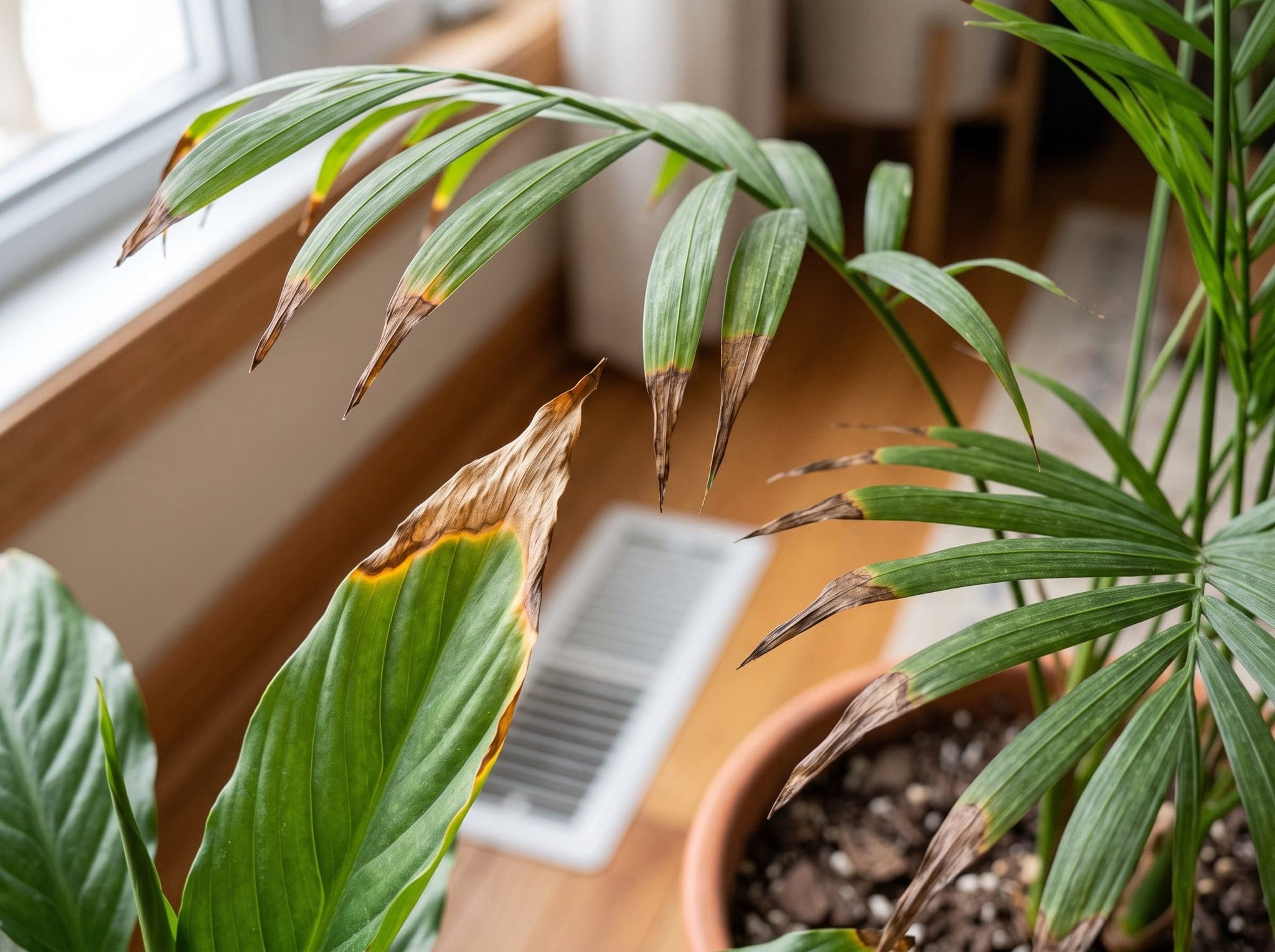
Purdue is also direct about what works and what does not. A running humidifier is the most effective option. "Grouping plants together on pebble trays filled with water can also help." Misting, though, "adds such temporary moisture that it does not effectively change the relative humidity." It feels productive and accomplishes very little.
Keep plants away from heat registers and away from the gap under an exterior door. A plant in the path of forced air dries out faster than anything else in the house.
Hold the Fertilizer Until Spring
Iowa State Extension advises that you "fertilize only when houseplants are actively growing," noting that many "have a period of rest, usually during the short days of winter, so reduced fertilization is needed during this time." Their feeding window runs from roughly March or April through November or December.
Feeding a plant that is not growing leaves unused fertilizer salts building up in the soil, and those salts burn roots and show up as the same brown leaf edges you were trying to fix.
Wait on Repotting Too
Repotting in January is a common winter project and a poor one. Iowa State notes that while it can be done any time, "most gardeners have the best success doing it in late winter or early spring, as houseplants start growing more vigorously with the warmer temperatures and longer days of spring." Disturbing roots works best right when the plant has the light and energy to rebuild them.
If a plant is genuinely root bound and struggling, go up one pot size and wait on the rest. If it is simply in a pot you do not love, our pottery and decor selection will still be there in March, and the team can repot anything you buy into a decorative container before you leave.
If You Have Pets, Build Around Two Plants
Cast iron plant and parlor palm are the two low light houseplants the ASPCA lists as non-toxic, and fortunately they cover different jobs. Cast iron plant is the low, broad leaved one for a shelf or a floor corner. Parlor palm gives you height, and it is a genuine low light palm rather than one that merely tolerates shade briefly.
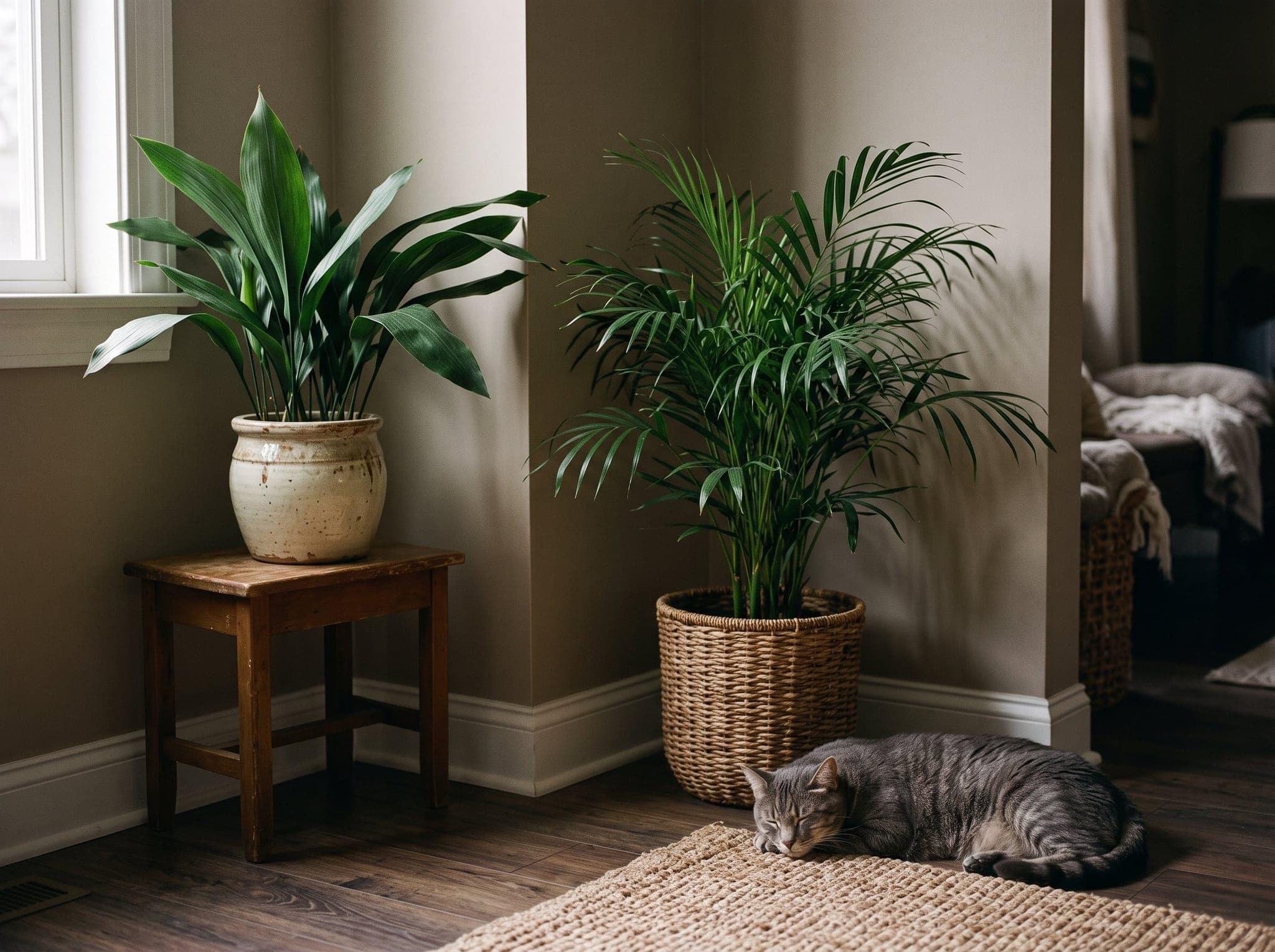
Almost everything else on the low light list is toxic to some degree. Pothos, philodendron, and peace lily all contain insoluble calcium oxalates, which cause mouth irritation, drooling, and vomiting when chewed. Snake plant is listed as toxic too, though its irritant is saponins rather than oxalates. ZZ plant does not have its own entry in the ASPCA plant database, but the ASPCA names it among the houseplants that cause the same reaction. None of these are generally life threatening, and plenty of households keep them on high shelves without incident. But if you have a cat that chews, the two safe plants are a better foundation than vigilance.
Getting a Plant Home in One Piece
One last thing that applies from November on, and that nobody mentions until it has already happened. Iowa State advises that you "always transport the houseplant in a plant sleeve or carefully wrap it," because "exposure to freezing temperatures, even briefly, may cause damage such as wilting, browning, or leaf drop."
Briefly means the walk across a parking lot. A tropical plant that spent its whole life in a greenhouse can take visible cold damage in the time it takes to load it into a cold car, and the damage often does not appear for several days, which is why it usually gets blamed on the new house instead of the trip. Ask for a sleeve, keep the plant in the passenger compartment rather than the trunk, and do not leave it in the car while you run another errand.
Start With the Light You Have
The whole thing comes down to one habit: measure the spot before you choose the plant, and measure it in the worst month rather than the best. A cast iron plant in a dim north corner will outlive a fiddle leaf fig in the same spot by years, and neither fact has anything to do with how good you are with plants.
Our houseplants and succulents collection runs from easy pothos and snake plants to statement fiddle leaf figs and rotating rare finds on the specialty shelf, and the staff can tell you what light, water, and soil each one needs before it leaves the building. Bring a photo of the corner you are trying to fill, or better, the foot candle reading off your phone. That one number turns the whole conversation from guesswork into a straightforward match.
Come late November the holiday and seasonal side of the garden center fills with poinsettias, fresh cut Fraser firs, and custom planters, and the same winter rules apply to all of it. Dry furnace air is the enemy, a spot away from the heat register is the fix, and our guide to keeping a fresh wreath and garland from drying out covers the outdoor half of the same problem.