A mum you buy in September should still be blooming when you set out the Thanksgiving decorations. Most do not make it that far, and almost none of them die of cold. They die of thirst, usually within two weeks of coming home, because a mum in a nursery pot is a dense root ball with almost no soil around it and it drinks like a plant twice its size.
That is good news, because thirst is a fixable problem. How to keep mums alive comes down to three things: picking a plant that still has its whole bloom ahead of it, watering it the way it actually needs, and building it into a porch pot that works with you instead of against you. This guide covers all three, plus what to plant alongside mums so the container holds its color long past the first frost. Everything here is tuned for USDA Zone 7a, which covers Newburgh, Evansville, and the wider Southern Indiana, Southern Illinois, and Western Kentucky region.
Why Most Fall Mums Die Before Halloween
Three things kill fall mums, and only one of them is weather. The plant runs out of water, it was bought in full bloom with most of its display already spent, or it was a florist mum sold for indoor use that was never going to hold up outdoors in the first place.
Water is the big one. Mums are shallow rooted, and by the time they reach a sales bench they have filled their pot with roots and very little soil. There is nowhere for water to be held in reserve. A mum sitting in full sun on a warm September porch can go from fine to fully wilted in a single afternoon, and every time it wilts hard, it drops a wave of buds it will not get back.
If your mums died fast last year, the fix is almost certainly the watering can, not the weather. Check the top inch of soil every single day and water the moment it feels dry.
Hardy Garden Mums vs Florist Mums
Garden mums are bred to root and survive outdoors, and florist mums are bred for one indoor display and then the compost pile. Both are Chrysanthemum x morifolium, and on a sales bench in September they look nearly identical, which is exactly why so many people end up disappointed in spring.
Purdue Extension puts it plainly, noting that many mums are bred as florist potted plants "meant to be enjoyed only once and then discarded." Those are the ones you tend to find in grocery store floral departments and gift shops. A real garden center sells hardy garden mums grown for landscape use.
| Feature | Hardy Garden Mum | Florist Mum |
|---|---|---|
| Bred for | Outdoor landscape use | A single indoor display |
| Root system | Vigorous, spreads to anchor the plant | Shallow, grown for the pot only |
| Winter survival in Zone 7a | Possible with spring planting and good drainage | Very unlikely |
| Bloom style | Many smaller flowers, dense mounded habit | Fewer, larger show flowers |
| Where you find it | Garden centers and nurseries | Grocery floral, gift shops, florists |
| Treat it as | A perennial worth trying to keep | A seasonal decoration |
Neither one is a mistake to buy. Just know which you have, so a florist mum on the porch is a decoration you enjoy and replace rather than a failure you blame yourself for.
How to Buy Mums That Bloom for Weeks Instead of Days
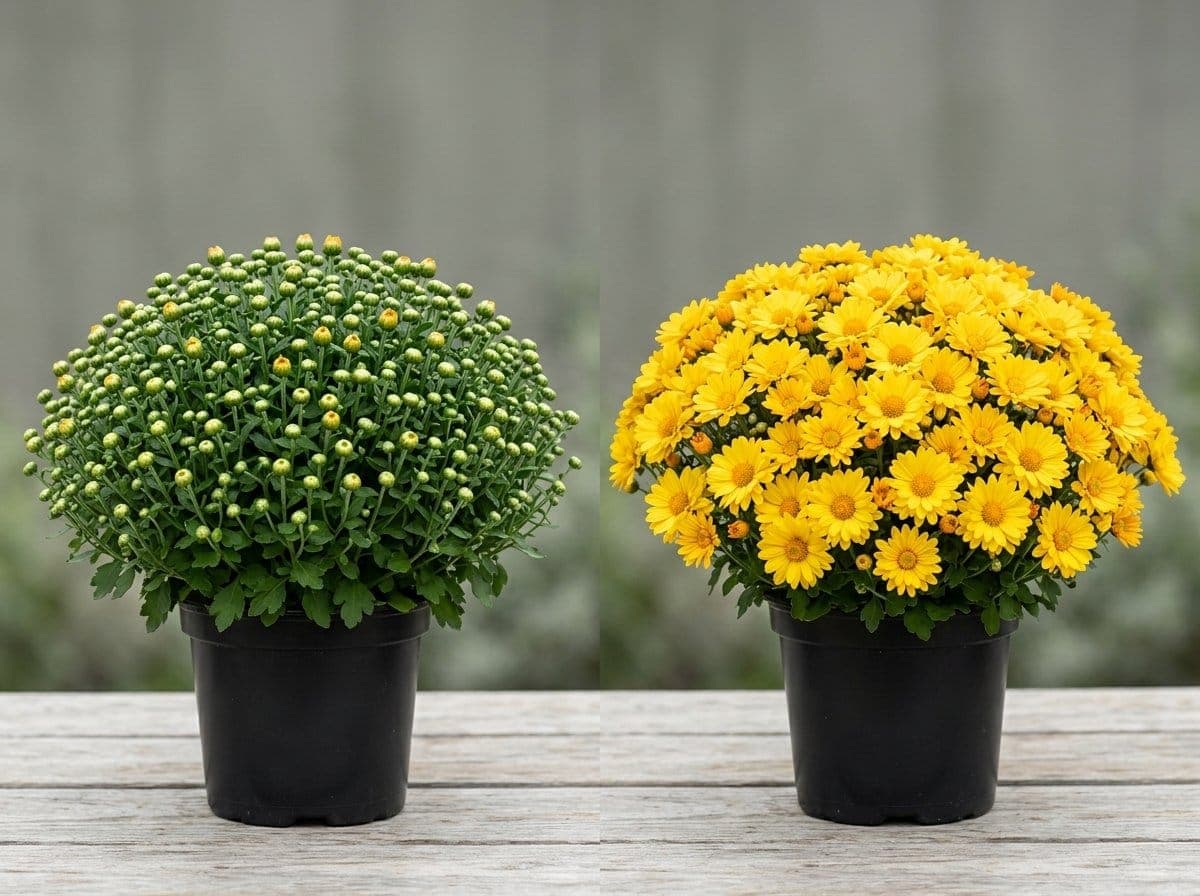
Buy mums in tight bud, with just enough color showing to tell you what shade you are getting. This is the highest leverage decision in the whole process and it costs nothing.
Purdue Extension notes that most cultivars set buds once days run shorter than 12 hours and then "generally continue to flower for a period of 6-8 weeks." That six to eight week clock starts when the flowers open, not when you get the plant home. Buy a mum already in full bloom and you have bought into the middle of that window. Buy one in tight bud and the whole run is still ahead of you.
A few other things worth checking on the bench:
- Weight: Lift the pot. A mum that feels light is already dry, and one that has been repeatedly dried out will bloom poorly no matter what you do next.
- Foliage color: Leaves should be deep green all the way to the base of the plant. Yellowing or crispy lower leaves means it has been stressed.
- Habit: Look for a tight, dome shaped mound. A mum that is loose and splayed open in the middle has usually been sitting too long.
- Bud coverage: Buds should cover the whole dome evenly, not just the top. Even coverage is what gives you that solid ball of color later.
How Often to Water Mums in a Pot
Check the top inch of soil daily and water whenever it feels dry. In warm September weather on a sunny porch, that will usually mean every day. Once nights cool into the 50s, it stretches to every two or three days.
Do not water on a schedule. Water on a finger check. The amount a mum drinks changes enormously with temperature, wind, and how much sun the porch gets, and a fixed Tuesday and Friday routine will either drown it in October or starve it in September.
When you do water, water thoroughly. Pour slowly until water runs out the drainage holes, which tells you the entire root ball got wet rather than just the top layer. A quick splash runs down the gap between the root ball and the pot wall and leaves the center bone dry, which is how a plant that "gets watered every day" still wilts.
If a mum dries out so completely that water runs straight through, set the whole pot in a bucket of water for 20 minutes and let it soak from the bottom. Dry peat based potting mix repels water when it shrinks away from the sides, and bottom watering is the only reliable way to rewet it.
Mums also want at least six hours of direct sun. Purdue recommends "a sunny, well-drained location with good air circulation" for the best growth and disease resistance, which applies to a pot just as much as a bed. A mum on a shaded north porch will stretch, flop, and bloom thinly.
Skip the fertilizer. A mum bought in bud in the fall was fed heavily at the greenhouse and has everything it needs for this bloom cycle. Feeding it now will not extend the flowers.
How to Build a Fall Porch Pot That Lasts
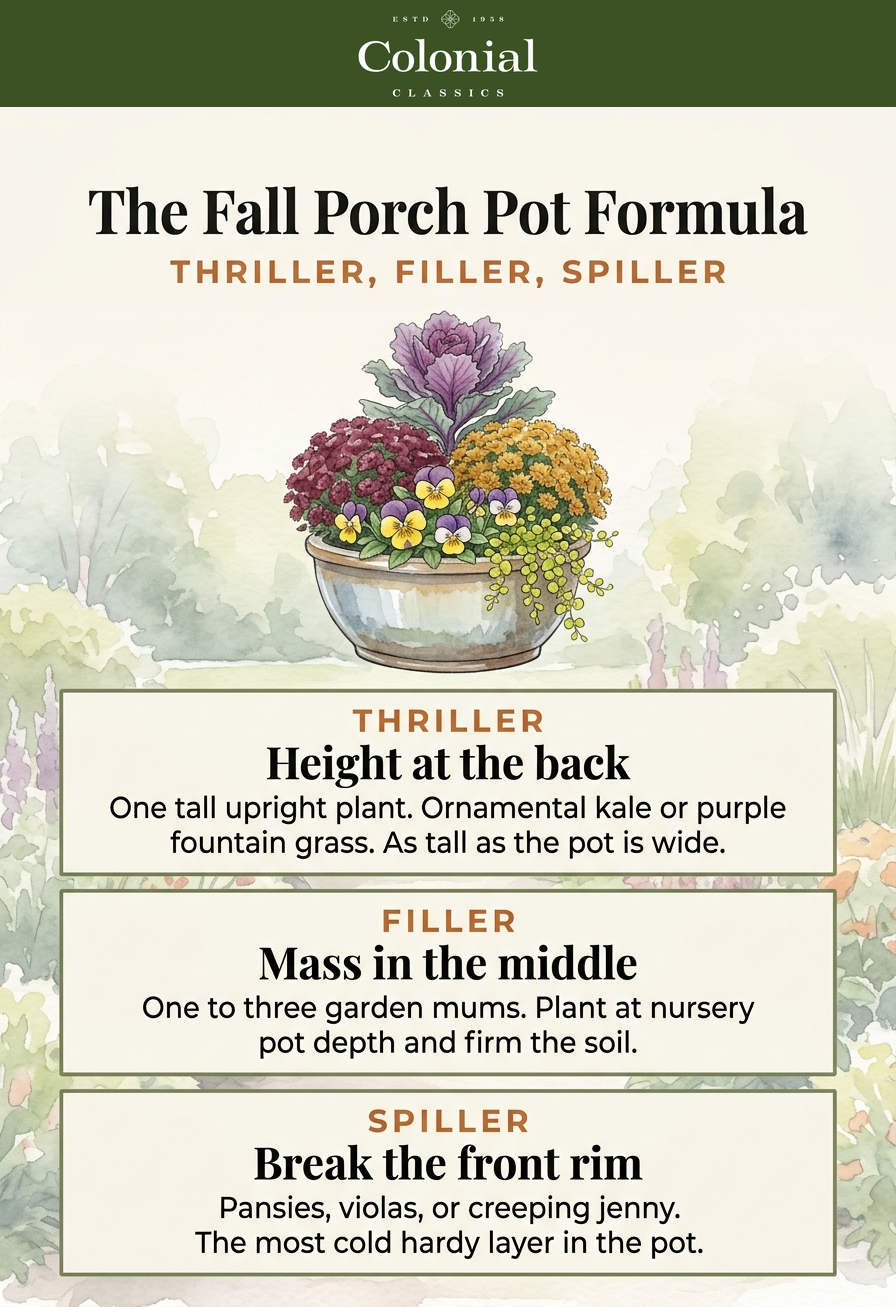
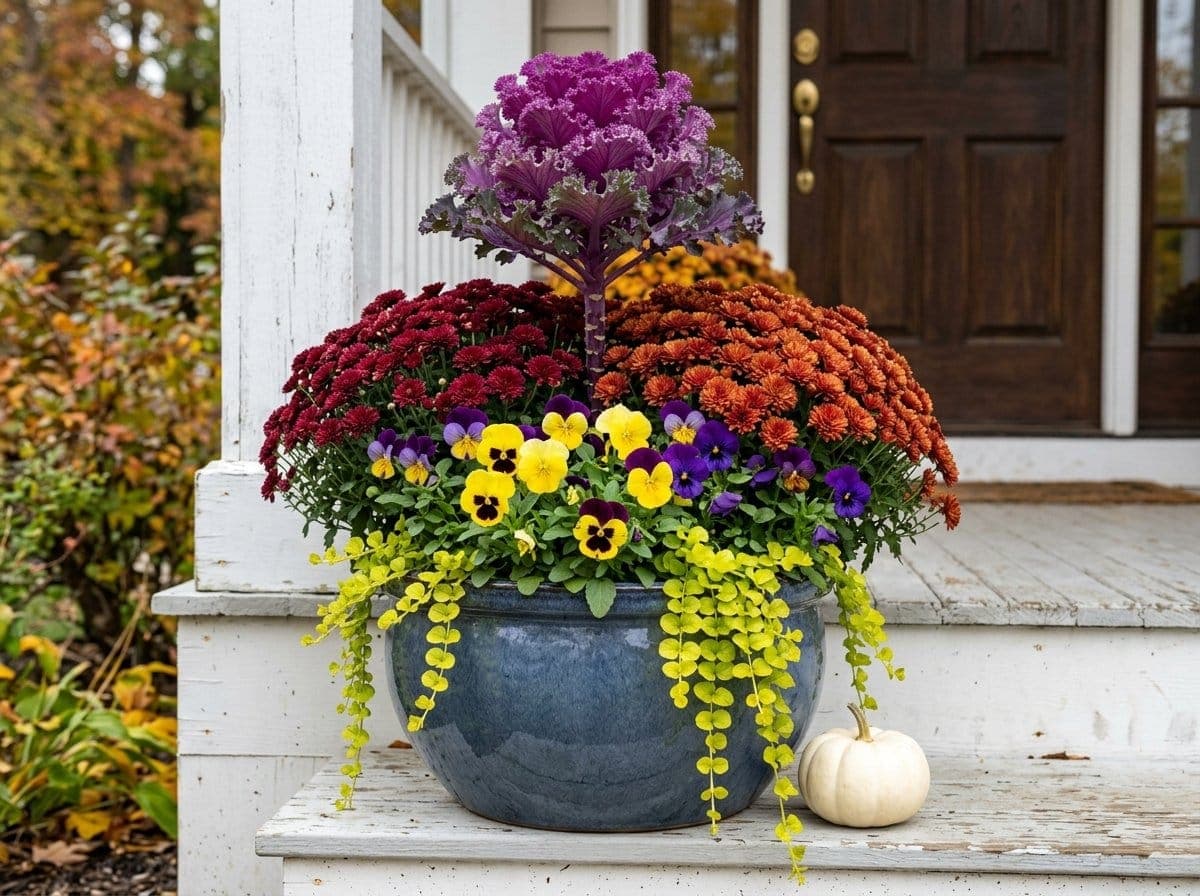
A porch pot beats a bare nursery pot for one practical reason beyond looks: more soil volume means more water held, which means the whole planting is far more forgiving. Use the standard thriller, filler, spiller formula and the arrangement builds itself.
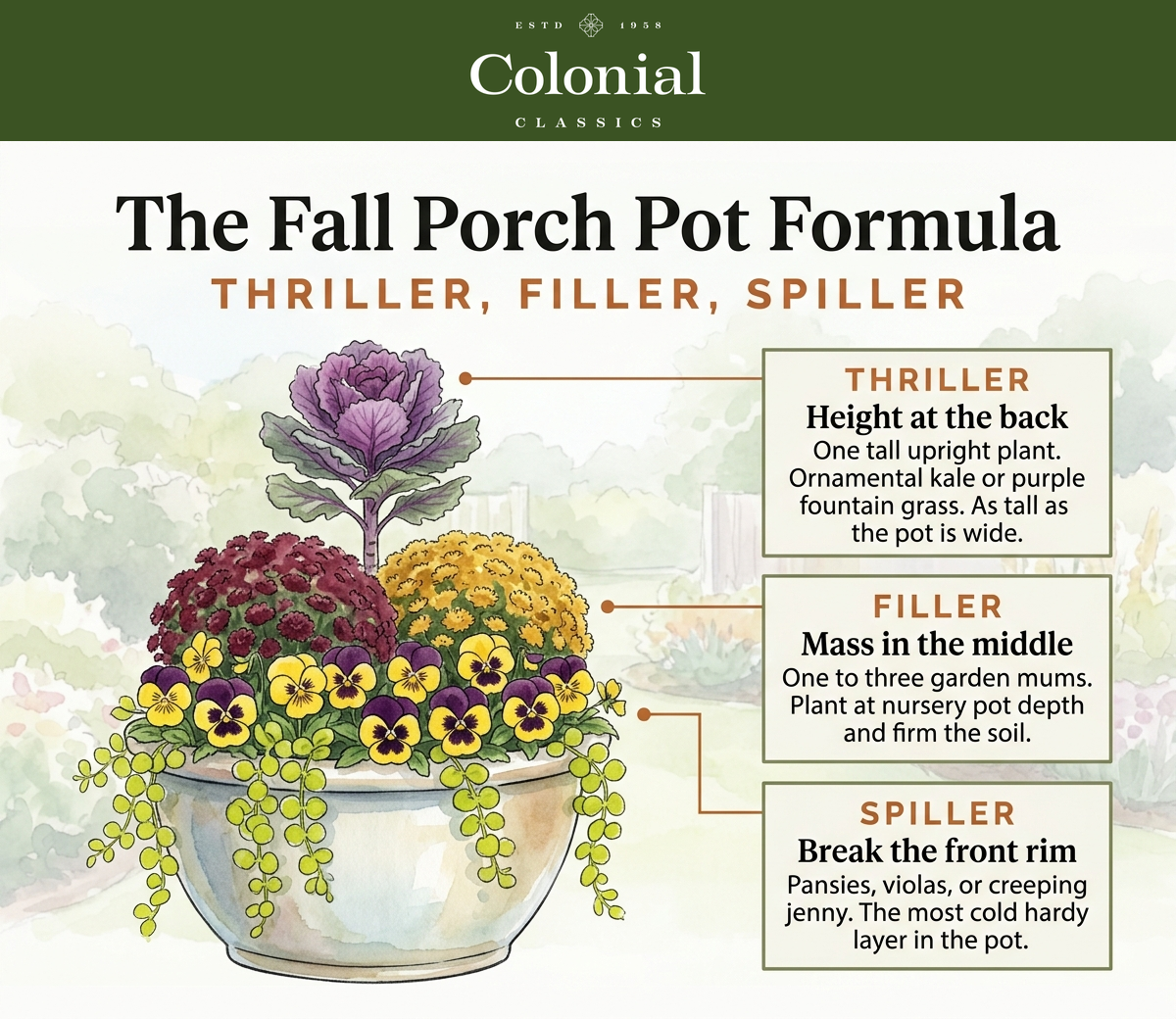
- Choose a frost-safe container. Go at least 14 inches across with open drainage holes. Glazed ceramic, fiberglass, resin, and metal all overwinter fine. Our pottery and decor selection is stocked with cold weather in mind.
- Set the thriller in the back. One tall upright plant sets the height, positioned off center or at the back. Ornamental kale on a tall stem or a purple fountain grass both work, and it should stand roughly as tall as the pot is wide.
- Add mums as the filler. One to three garden mums fill the middle with mass and color. Plant them at the depth they sat in their nursery pots and firm the soil around each root ball.
- Edge with a spiller. Pansies, violas, or creeping jenny along the rim break the edge and hide the pot line. Pansies and violas are the most cold hardy thing in the pot and will still be going when the mums finish.
- Water until it runs out the bottom. Soak the finished pot until water drains freely. This first deep watering settles every root ball and closes air pockets.
- Check the soil daily. Same finger test as before. A packed pot has less soil than it looks like, so it still dries fast.
Unglazed terracotta is the wrong pot for a fall arrangement you want to leave out. Clay is porous, it absorbs water, and that water expands when it freezes and splits the pot. Our first 28 degree night typically lands in early November, which is well within the life of a September planting.
Which Fall Container Plants Actually Survive Frost
Not everything sold on a fall display table is cold hardy. Several of the most popular fall container plants are tropicals that turn to mush the first night it freezes, which is a rough surprise in mid-October when you expected the pot to carry you to Thanksgiving.
| Plant | Handles frost? | Notes for Zone 7a |
|---|---|---|
| Pansy and viola | Yes, to single digits | Can freeze solid and recover. Violas edge out pansies for hardiness. |
| Ornamental kale and cabbage | Yes, to about 5 degrees | Color deepens as temperatures fall below 50. |
| Garden mum | Yes, light frost | Blooms are damaged by a hard freeze even when the plant survives. |
| Aster | Yes | A true perennial. Move it into a bed after the pot is done. |
| Heuchera | Yes | Foliage holds through winter. Transplants well into shade. |
| Sedum | Yes | Dried flower heads stay attractive into winter. |
| Creeping jenny | Yes | Hardy perennial spiller that returns in the ground. |
| Dusty miller | Light frost only | Marginal here. Expect it to look rough by December. |
| Purple fountain grass | No | Grown as an annual in Zone 7a. Collapses at a hard freeze. |
| Ornamental pepper | No | Very frost sensitive. |
| Coleus and croton | No | Tropicals. Gone the first freezing night. |
Clemson Extension calls pansies and violas "the best annual flowers for cool-season color" and puts ornamental cabbage and kale right alongside them for fall and winter containers, precisely because they hold up when everything else quits. If you want one pot that looks good from Labor Day through the holidays, build it around those three and treat the mums as the part you refresh.
Worth knowing before you plant: deer eat mums and pansies happily. If your property gets regular deer traffic, keep those pots close to an active door and lean on kale, heuchera, and grasses further out. Our guide to deer resistant plants covers which plants they reliably skip.
When Frost Actually Arrives in the Tri-State
Knowing the real dates takes the guesswork out of when to plant and when to protect. According to the National Weather Service office in Paducah, whose forecast area covers Evansville and Newburgh, the averages for Evansville look like this.
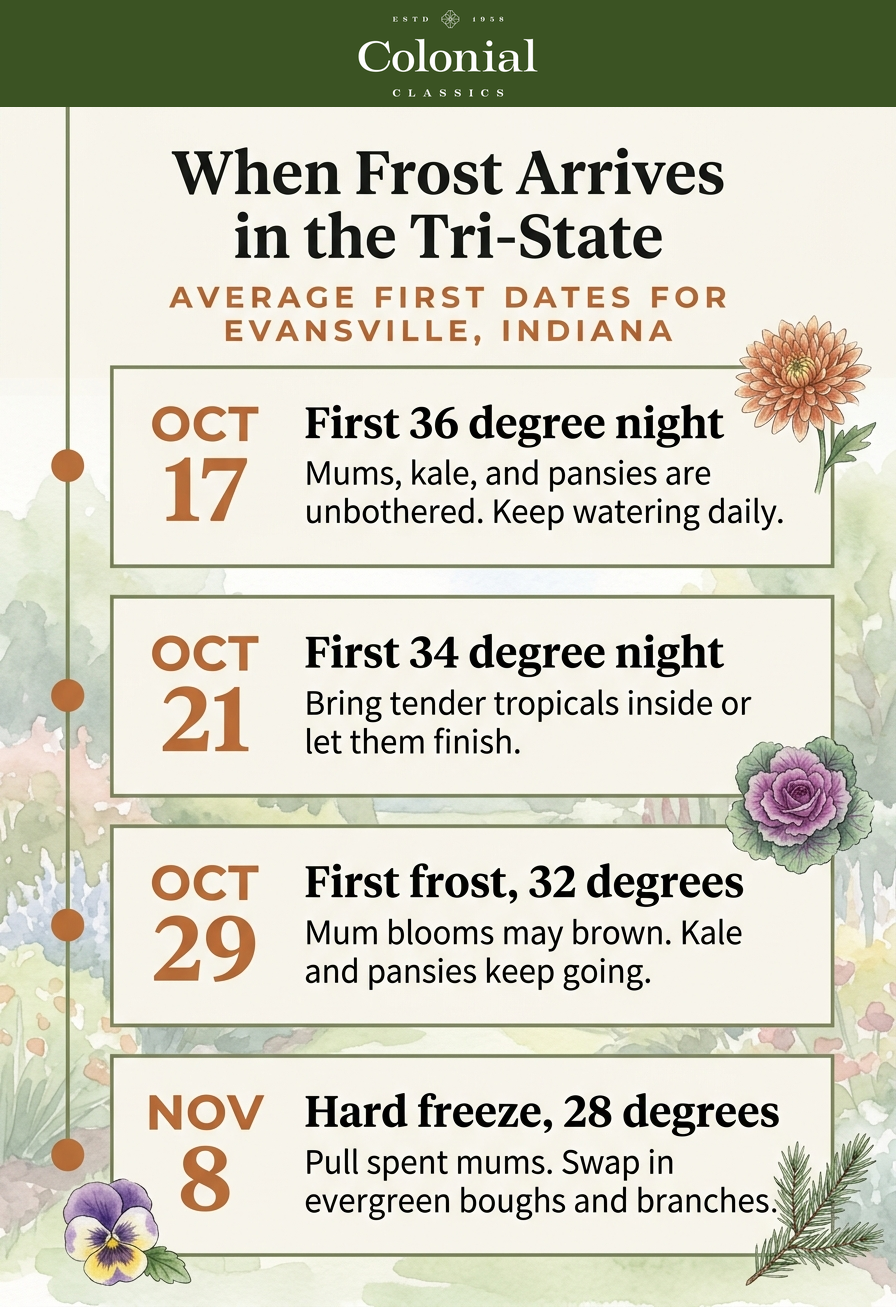
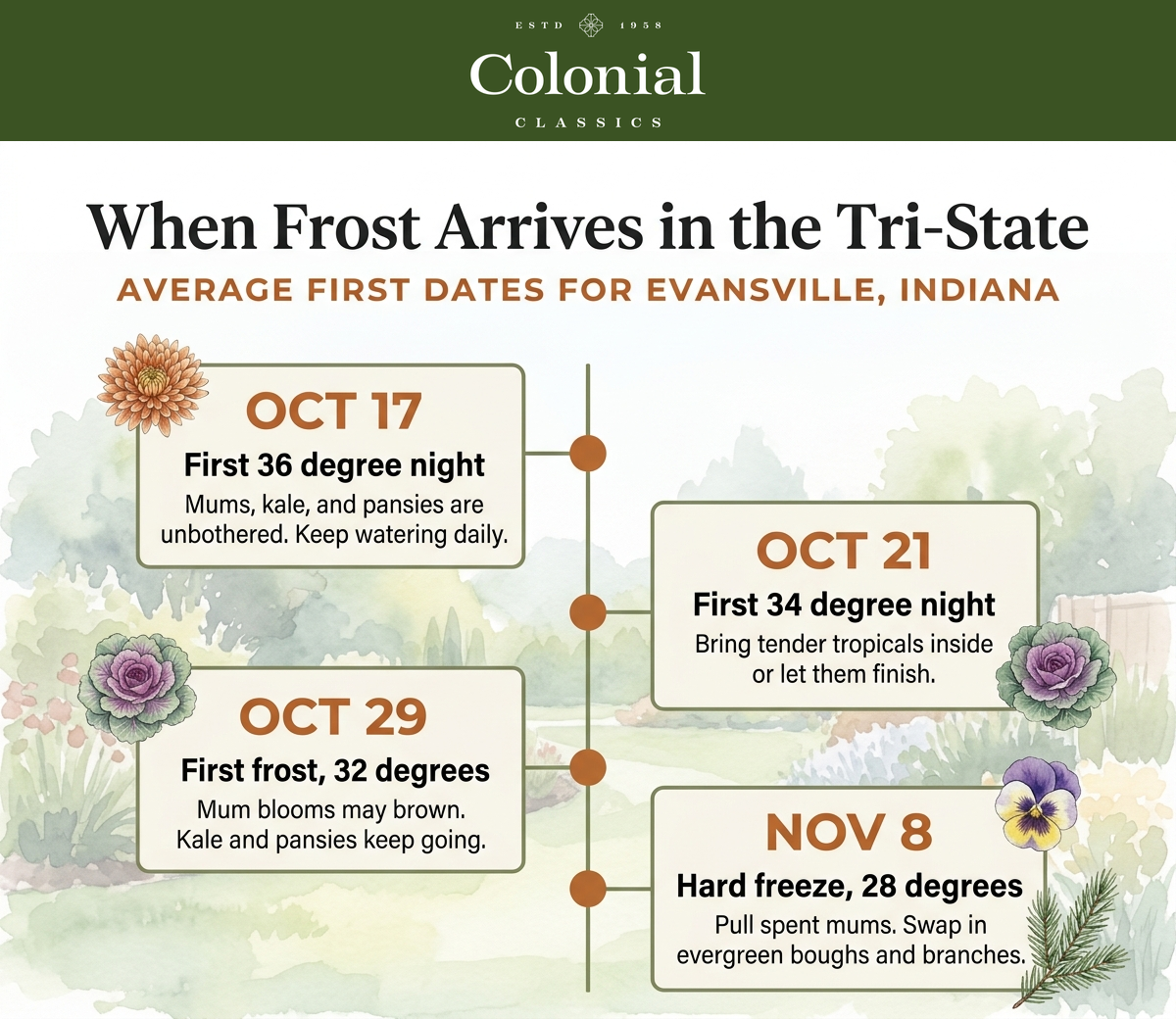
That spread is the useful part. You get roughly three weeks between the first chilly nights in mid-October and the first hard freeze in early November, and cold hardy plants sail straight through it. A pot planted in early September has a solid two months of good looks ahead of it before anything threatens it.
It also tells you when a September planting is worth the effort. Plant in the first half of September and the pot earns its keep. Wait until late October and you are buying three weeks of mums at full price.
These are long term averages, not forecasts. Evansville has recorded a 32 degree night as early as September 28 and as late as November 27. Watch the actual forecast in the last week of October, and if a hard freeze is coming, pull containers against the house or into the garage overnight.
Can You Plant Mums in the Ground and Get Them Back Next Year?
Sometimes, but plan on it being a bonus rather than the goal. Purdue Extension is direct about this: the best planting time for garden mums is late spring, and fall planting "can be successful with a little extra attention to watering and winter protection."
The problem is roots. A mum planted in October has a few weeks to establish before the ground cools, and a plant that goes into winter without an anchored root system gets heaved out of the soil by freeze and thaw cycles. If you want to try, stack the odds:
- Plant early: Get it in the ground in early September rather than late October so it has real rooting time.
- Drainage above all: Purdue notes that losses are most likely on poorly drained soils. A low spot that stays soggy will kill a mum faster than cold will.
- Keep watering: Newly planted mums need consistent water right up until the ground freezes, not just through the bloom.
- Mulch after the ground freezes, not before: Purdue recommends applying winter mulch in late November or early December after two or three nights below 20 degrees. The point is to keep soil uniformly cold and stop the freeze and thaw heaving, not to keep it warm. Our mulching and bed care crews handle this as part of fall bed work.
- Leave the stems standing: Do not cut it back in fall.
That last one surprises people. Purdue Extension is explicit that "for some marginally hardy perennials, like garden mums, waiting until early spring to cut back the dead tops can actually improve a plant's chances of survival," because the standing stems collect leaves and snow that insulate the crown.
What to Do After the First Hard Freeze
Once a hard freeze takes the mums, you do not have to throw out the whole pot. The cold hardy pieces are still very much alive, and the container is already sitting where you want it.
Pull the spent mums and the tropicals, leave the kale, pansies, violas, and heuchera in place, and fill the gaps with cut evergreen boughs, red twig dogwood stems, winterberry, or birch poles. The pansies will keep blooming on mild days and often push a fresh flush in early spring. It is the same pot, one swap, carrying you from Labor Day into January. Our holiday and seasonal selection is built for exactly that handoff.
Perennials worth rescuing, like asters, heuchera, and sedum, can come out of the pot and go straight into a bed. They will be better plants next year for it, and you can browse the rest of our perennials and grasses to see what else pairs well.
While you are thinking about fall, it is also the right window for two other jobs that pay off in spring. October and November are prime time for planting spring bulbs, and fall is genuinely the best season to plant trees and shrubs in our clay.
Stop By and Build Yours
Colonial Classics Landscape & Nursery has been growing and selling plants in Newburgh for over 65 years, and our greenhouse fills with garden mums, pansies, violas, and ornamental kale every fall. You can walk the annuals and tropicals tables, pick your colors in person, and see the actual plants rather than guessing from a website.
If you would rather not build the pot yourself, bring your container in or pick one out and our team can plant it for you. Our planting services cover everything from a single porch pot to a full seasonal display. Send us a message and we will let you know what is looking best on the benches this week.