Most poinsettia care advice starts at the watering can. It should start in the parking lot. The plant that drops half its leaves on your dining room table three days after you bought it was almost certainly damaged on the ride home, and nothing you do afterward will put those leaves back.
So this guide starts there, then covers how to pick a plant that was healthy to begin with, how to water it without rotting the roots, and how to read the specific way it is failing so you can fix the right problem instead of the first one that comes to mind.
How Long Should a Poinsettia Last?
A healthy poinsettia should hold full color for several weeks and still look good well after New Year's Day, according to Iowa State University Extension. If yours is bare by the second week of December, something specific went wrong. It was not just "their time."
This is worth knowing because it sets your expectations correctly. Purdue Extension notes that older poinsettia varieties dropped their bracts, the colored parts most people take for petals, soon after the true flowers finished shedding pollen, which is where the plant's disposable reputation comes from. Modern cultivars were bred specifically to hold those bracts for a long display. The plant you buy today is a far better product than the one that frustrated your grandparents.
The Ride Home Is Where Most Poinsettias Are Lost
Poinsettias are damaged below 50 degrees, and the damage compounds the longer the exposure lasts. University of Minnesota Extension puts the damage threshold at 50 degrees and notes that freezing temperatures kill the plant outright.
That number should change how you shop. A December afternoon in Southern Indiana sits below 50 degrees more often than not, and the same holds across the rest of the Tri-State area into Illinois and Kentucky. The walk across the parking lot and the wait in a cold car are both doing real harm.
Buy the poinsettia last. Not first, and not in the middle of a round of errands. Twenty minutes in a cold car while you finish shopping is enough to cause damage that will not show up until the leaves start dropping at home two days later.
Four habits protect the plant on the way home:
- Ask for a sleeve: Many grocery and big-box stores do not wrap plants at all. Ask, or bring a paper bag. Cover the plant before you walk outside, not after.
- Put it in the heated cabin, not the trunk: A trunk is roughly outdoor temperature, and cargo areas run colder than the seats.
- Do not leave it in the car: Buy it on the last stop of the trip and drive home.
- Cut the sleeve off at home: Sliding a sleeve down over the plant snaps stems and strips lower leaves. Cut it away instead.
Cold damage is sneaky because it shows up late. The chilling injury happens in the parking lot, but the leaf drop arrives a day or two later, by which point the cold car no longer looks like the culprit. On red varieties the other tell is the bracts themselves, which can take on a blued or bruised cast along the edges.
The Red Parts Are Not Flowers
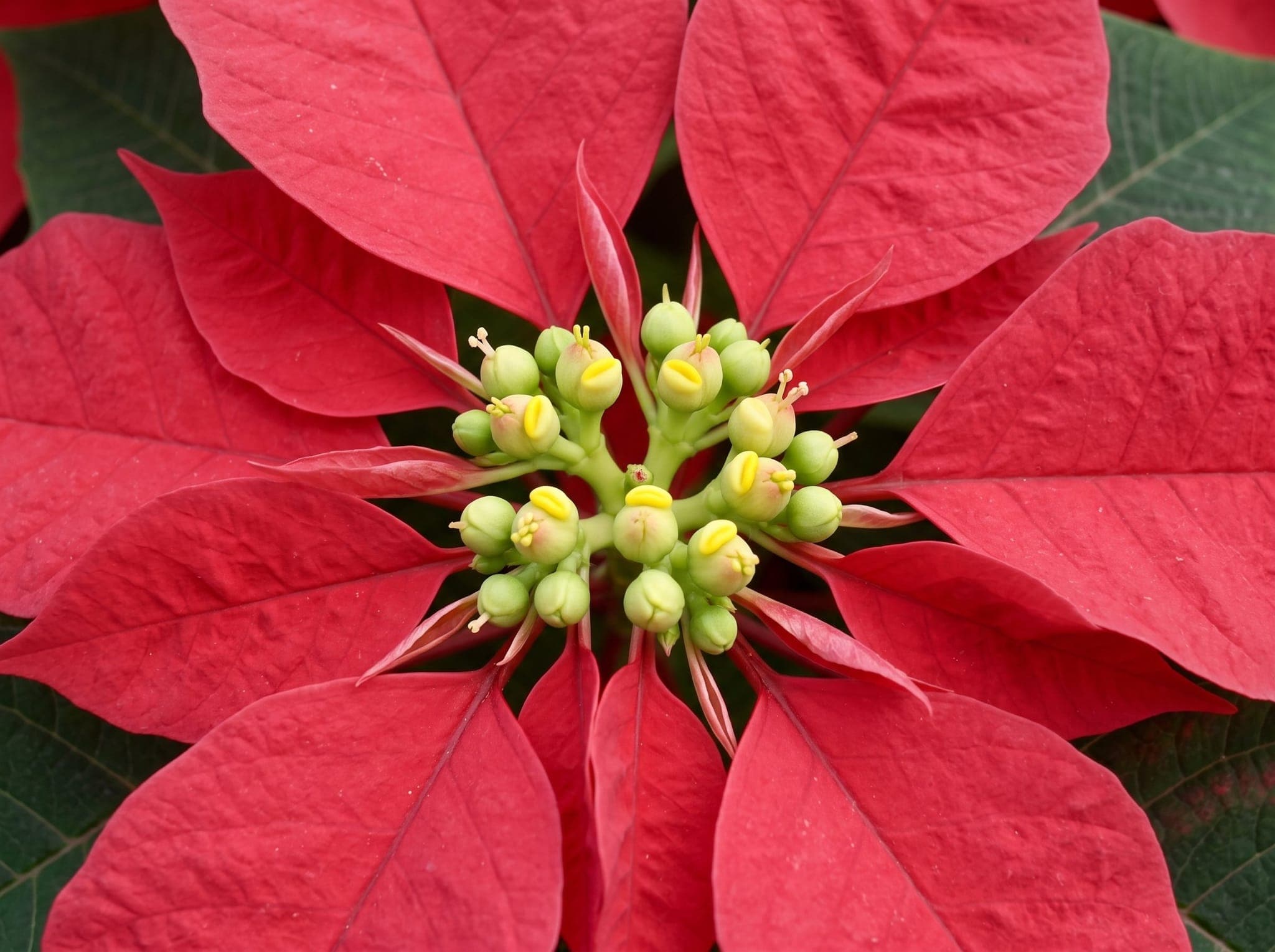
The colored parts are bracts, which are modified leaves, and the true flowers are the small yellow-green cluster at the center. Purdue Extension calls these cyathia, and they contain both male and female flower parts but no petals at all.
This is not trivia. It is the mechanism behind the buying test in the next section. Because the bracts are leaves rather than petals, they are not on a flower's clock, which is exactly why breeders have been able to stretch the display out for weeks. But the plant still begins winding down once the true flowers have matured and released their pollen. Checking those centers at the store is checking where the plant sits in that cycle.
How to Pick One That Will Actually Last
Check the centers first. The small structures in the middle of the colored bracts tell you the plant's true age better than anything else on the bench.
University of Illinois Extension advises choosing plants whose centers are either green or red-tipped, with little or no visible pollen. Once those centers have opened and gone yellow with pollen, the bracts will begin dropping soon after, and you are buying the tail end of someone else's display.
The rest of the checklist goes quickly:
- Dark green leaves down to the soil line: Bare lower stems mean the plant has already been stressed somewhere along the way.
- Fully colored bracts: no green streaking or pale patches.
- A full, balanced shape: Illinois Extension suggests a plant roughly two and a half times as tall as its container is wide, and one that looks good from every side rather than having a single good face.
- Soil that is moist but not wet: A wilted plant sitting in soggy soil is showing root rot, not thirst. Walk away from that one.
- No whiteflies or aphids: Check the undersides of a few leaves.
- Not sleeved and not crowded: Plants packed tightly together on a sales floor are already shedding.
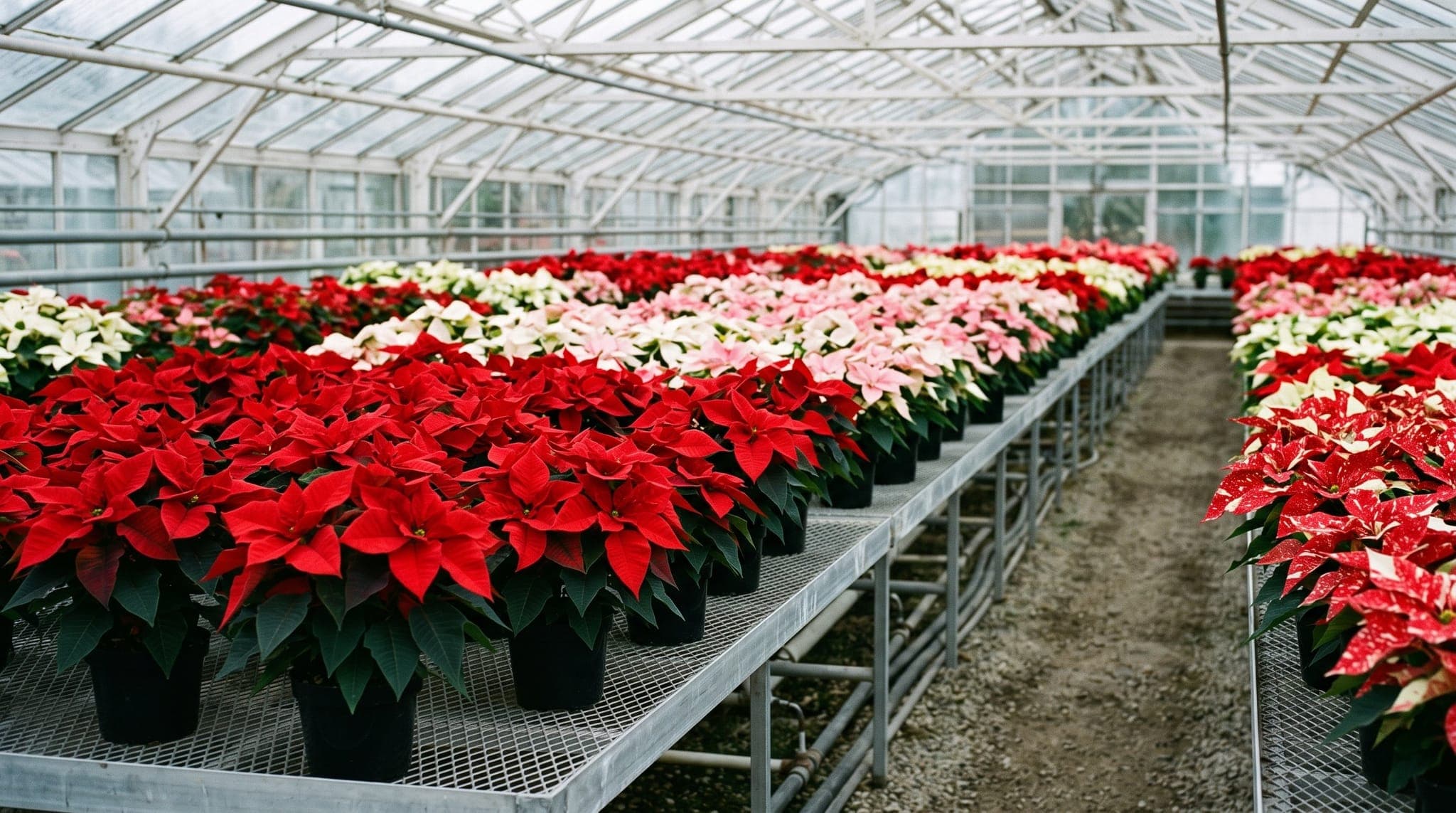
That last point is the quiet argument for buying from a greenhouse rather than off a pallet at the front of a big-box store. Our holiday and seasonal greenhouse gets poinsettias in from late November in red, white, pink, and speckled varieties, and they sit with room around them in greenhouse conditions rather than stacked in a cold entryway.
How to Water a Poinsettia
Water when the soil surface feels dry to a light touch, take the foil off first, and let the pot drain completely in the sink. Indoors that usually works out to every three to five days, but check by touch rather than by calendar.
The foil is the real hazard. It is a decorative wrapper with no drainage, so water that runs through the soil collects in the bottom and sits against the roots. Iowa State and University of Minnesota Extension both give the same instruction: remove the cover, water in the sink until liquid runs out the bottom, let it drain, then return the pot to its cover. Never let water stand in the foil or the saucer.
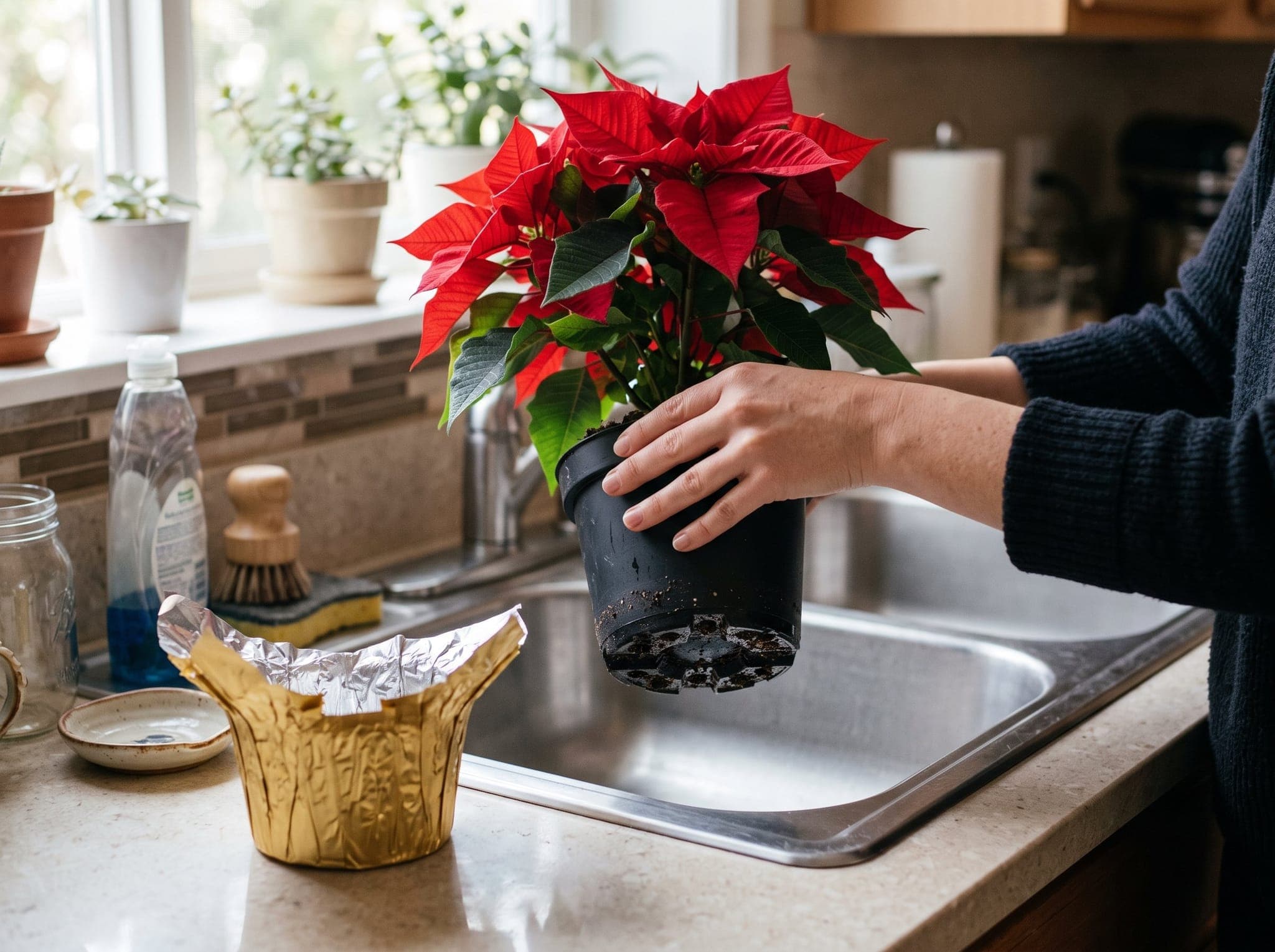
Two failure modes to avoid in either direction. Constantly saturated soil causes root rot, which shows up as sudden wilting that watering makes worse. Letting the plant wilt from dryness also costs you leaves, and the lower ones usually do not come back.
Light and Temperature
Put it in a south, east, or west window where it gets bright daylight, and keep it between 65 and 70 degrees, away from both heat vents and cold drafts. Those are University of Minnesota Extension numbers, and Iowa State gives a slightly wider acceptable band of 60 to 70.
| What it needs | The number |
|---|---|
| Light | Bright daylight at a south, east, or west window |
| Ideal temperature | 65 to 70 degrees |
| Acceptable range | 60 to 70 degrees |
| Damage threshold | Below 50 degrees |
| Watering | When the soil surface feels dry, usually every 3 to 5 days |
Placement matters more than people expect, and the two worst spots in most homes look like the two best. A sunny windowsill is ideal until the leaves touch the cold glass, which does the same thing to them that a draft does. A mantel over a working fireplace, or a shelf above a heat register, dries the plant out and swings its temperature repeatedly through the day. Entryways get a blast of outdoor air every time the door opens, which in December is a blast of air well under 50 degrees.
Pick a bright spot a few inches off the glass, away from vents, doors, and the fireplace, and then leave it there. Poinsettias do not appreciate being moved around the house.
Why Your Poinsettia Is Dropping Leaves
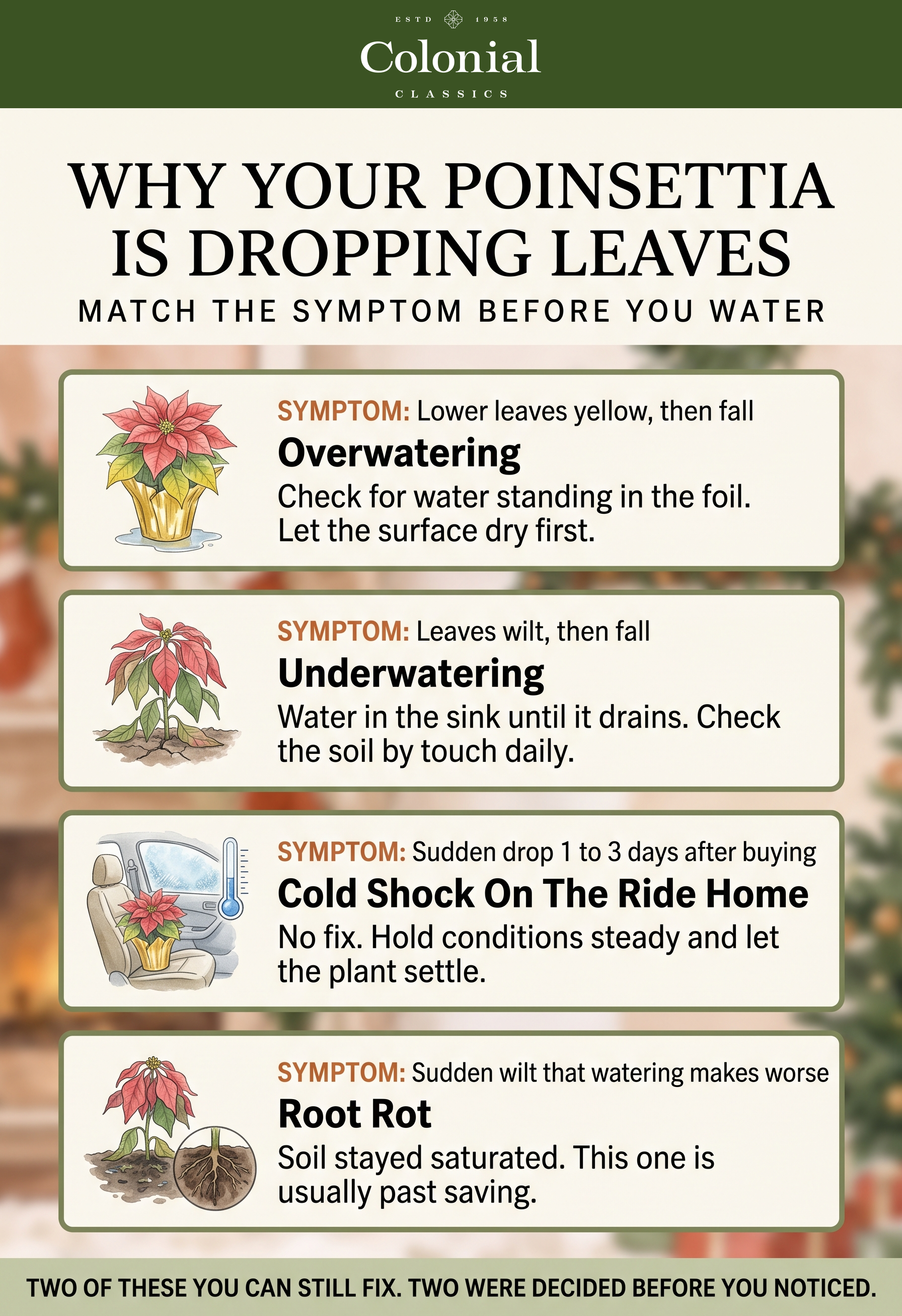
Improper watering is the most common cause of leaf drop, according to Iowa State Extension. Cold damage, drafts, and rapid temperature swings are the other usual culprits. The useful part is that each cause drops leaves in a recognizably different way, so the plant tells you which mistake you are making.
Read the pattern before you act:
- Lower leaves yellow, then drop: overwatering. Check whether water is standing in the foil, and let the soil surface dry before the next watering.
- Leaves wilt, then drop: underwatering. Water thoroughly in the sink and keep checking the surface daily.
- Sudden drop one to three days after you brought it home: cold shock from the trip. There is no fix, so keep conditions steady and let the plant stabilize with what it has left.
- Sudden wilting that watering makes worse: root rot from saturated soil. This one is usually fatal.
- Steady drop from a plant near a vent, door, or fireplace: temperature swings and dry air. Move it to a stable bright spot.
- Leaves blacken, then fall: freezing exposure. The blackening is the tell that separates a freeze from ordinary cold stress.
Note that adjusting how you water fixes exactly two of those six. For the other four it does nothing at all, which is why the diagnosis comes first. The instinct to reach for the watering can whenever a plant looks unhappy is how a cold-shocked poinsettia ends up with root rot on top of the cold.
Are Poinsettias Poisonous to Cats, Dogs, and Kids?
Not dangerously, and the reputation is wildly out of proportion to the evidence. Iowa State Extension reports that out of 22,793 recorded poinsettia exposures there were no fatalities, fewer than five percent required any medical treatment, and under eight percent produced stomach upset, vomiting, or diarrhea.
The ASPCA does list poinsettias as toxic to dogs, cats, and horses, with irritant sap as the toxic principle. Its own description is the clearest summary available: "irritating to the mouth and stomach, sometimes causing vomiting, but generally over-rated in toxicity."
So both things are true at once. It is not a harmless plant and it is not a dangerous one. A dog or cat that chews a leaf may drool or vomit from the irritation, which is unpleasant and worth a call to your veterinarian, but it is not the emergency the folklore suggests. Keep the plant out of reach of pets and small children the same way you would any houseplant, and wear gloves if you are cutting stems, because the milky sap can irritate skin on contact.
Poinsettias are not the deadly plant the myth claims, but they are not a snack either. Expect mouth and stomach irritation from a chewed leaf, keep the plant out of reach, and call your veterinarian if a pet eats a significant amount.
Can You Get It to Turn Red Again Next Year?
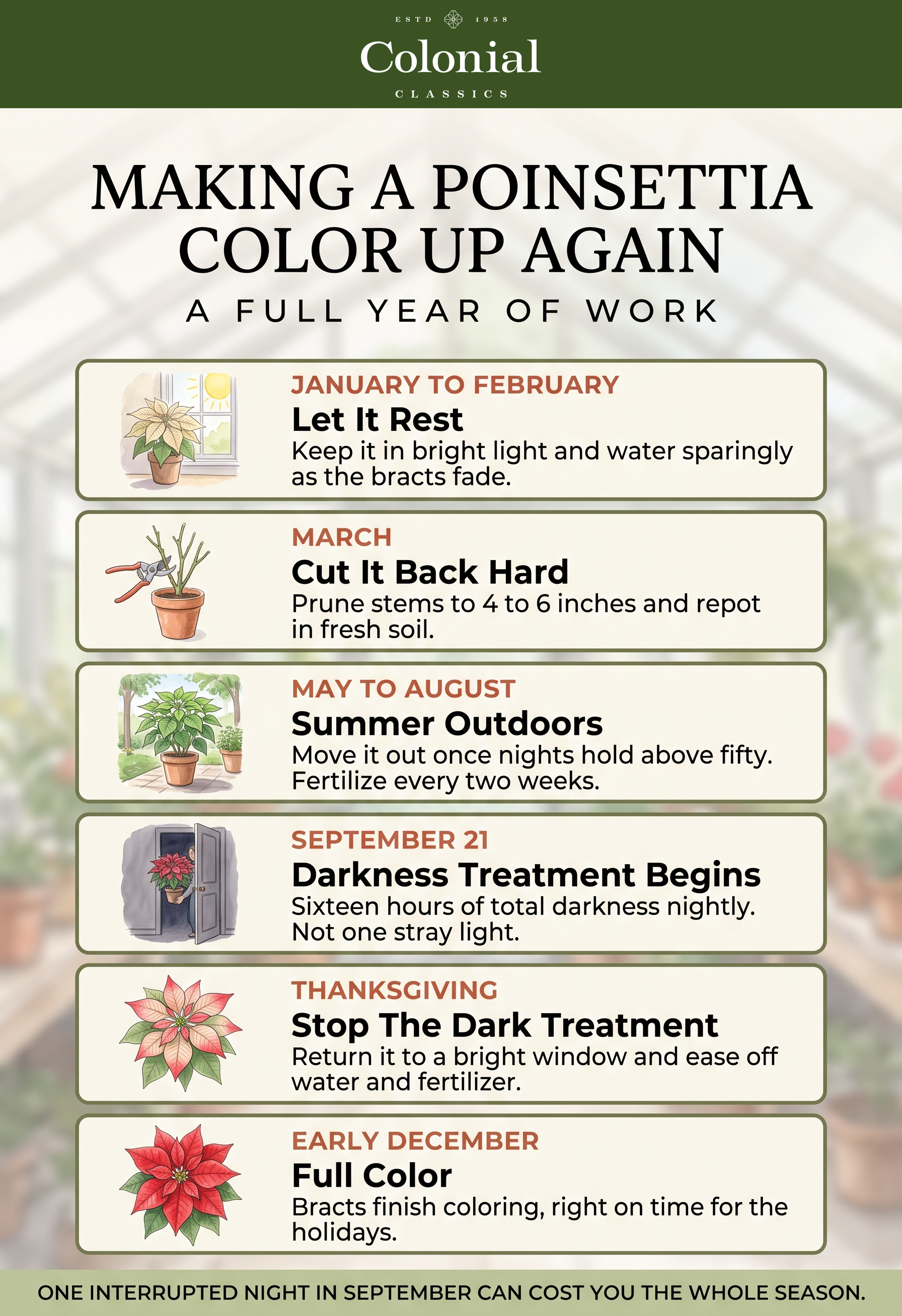
Yes, and it is genuinely difficult. Poinsettias are short-day plants, meaning they set color in response to night length rather than anything you feed them.
University of Minnesota Extension lays out the requirement: beginning on or near September 21, the plant needs around 16 hours of completely uninterrupted darkness every night, plus eight hours of bright light during the day, kept in the low 60s, until the bracts color up. Iowa State frames the same thing as a clock, complete darkness from 5:00 PM to 8:00 AM daily from early October until color appears, usually by early December.
"Uninterrupted" is the word that breaks most attempts. A hall light flipped on at 9:00 PM, a streetlight through a gap in a closet door, or the glow of a television is enough to disrupt the cycle. Doing this properly means moving the plant into a closet every evening and out every morning for roughly two months without missing a night, plus a spring cutback, summer fertilizing, and a stretch outdoors once nights hold above 50 degrees.
When to Stop Trying
Give yourself permission to throw it out. If the plant is bare-stemmed by mid-December, or it wilted in wet soil and root rot has set in, there is no technique that brings it back, and a struggling poinsettia does not improve with attention.
That is worth saying plainly, because a lot of care advice treats every holiday plant as a multi-year project and leaves people feeling they failed at something. A greenhouse-grown poinsettia represents months of controlled light, temperature, and humidity that a living room cannot reproduce. Buying a fresh one next December is a completely reasonable choice, and it is what nearly everyone does, including people who grow plants for a living.
If you do want a holiday plant that keeps going, the better candidates are the ones that are not photoperiodic to begin with. Several of the houseplants that handle low light will outlive a decade of poinsettias, and the same logic applies to the potted plants worth overwintering rather than replacing.
Come See Them in the Greenhouse
Poinsettias arrive here in late November, in classic red along with white, pink, and speckled varieties, and they stay in greenhouse conditions with room around them until they leave with someone. We also build custom holiday planters, and the same crew puts together the fresh wreaths and garland that need a similar kind of care once they are hanging on your door.
If you want help choosing a plant, or you have one that is dropping leaves and you cannot tell which of the causes above is the real one, stop by the greenhouse or send us a message and describe what you are seeing. The pattern usually gives it away.