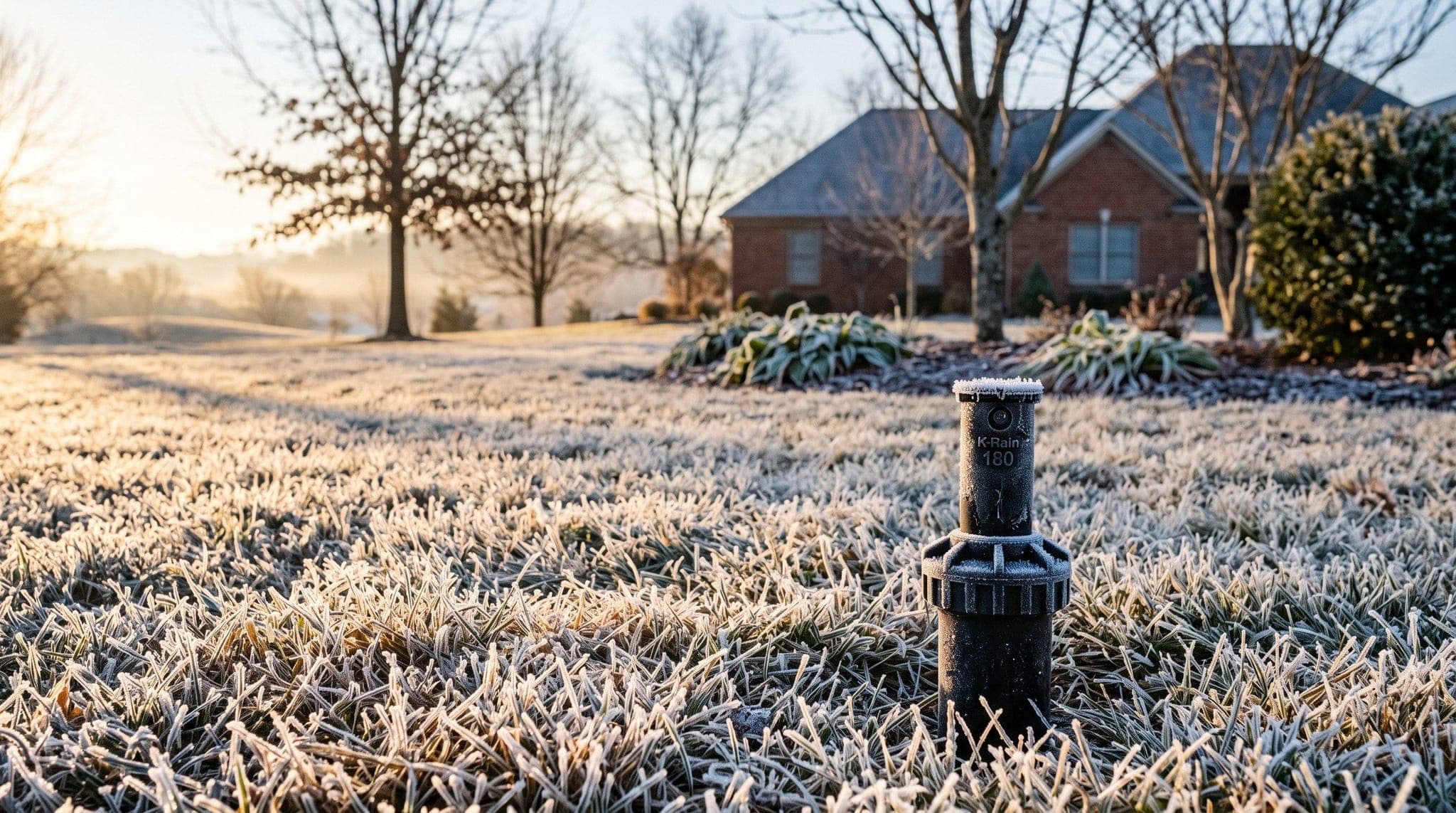
Your irrigation system spends all summer keeping the lawn alive. Sprinkler winterization is what keeps the system itself alive through the cold, and skipping it is the most expensive mistake a homeowner in Indiana, Illinois, or Kentucky can make. The damage lands on one cold night in late fall, when the first hard freeze turns whatever water is still sitting in those lines into ice.
Water expands roughly nine percent when it freezes, and it does not care what is in the way. It splits PVC laterals lengthwise, cracks valve manifolds at the fittings, and ruptures the backflow preventer sitting above ground where the cold hits first. The cruel part is that none of it shows up in November. You find out in April, when you turn the system on and water comes up through the lawn instead of out of the heads.
This guide covers when to schedule the job in the Tri-State area and how a compressed air blowout actually works. It also covers the pressure limits that keep your pipes intact, and an honest look at whether this is a job worth doing yourself.
Every project is different. The pricing and timelines discussed here are general estimates based on typical projects in our area. Your actual costs and schedule will depend on your property, materials, scope of work, and other factors. Contact us for a personalized estimate.
When Should You Winterize a Sprinkler System?
Winterize before the first hard freeze, which means scheduling for mid to late October in Southern Indiana and the surrounding Tri-State area. That timing gives you a comfortable cushion without shutting the system down while the lawn still needs water.
Here is what the calendar looks like across Indiana, Illinois, and Kentucky. All three states share USDA Zone 7a, so the freeze pattern is similar throughout the region:
- First 32 degree frost: Typically late October to early November. A light frost will not damage buried pipe, but it will reach an above ground backflow assembly.
- First 28 degree hard freeze: Typically the first half of November. This is the one that does real damage, and it is the deadline you are working against.
- The safe window: Early to mid October. The lawn is going dormant and no longer needs supplemental water, and you are still weeks ahead of the freeze.
The mistake most homeowners make is waiting for cold weather to remind them. By the time the forecast shows a hard freeze, every irrigation company in the region is booked solid, and a surprise early freeze does not wait for your appointment. Southern Indiana has seen hard freezes arrive in late October more than once.
What Actually Breaks If You Skip It
Freeze damage concentrates in the parts of your system that hold standing water, and the repairs are expensive because most of them are buried or require a certified technician.
- What Freeze Does to It
- Cracked or split housing, usually a full replacement
- Typical Repair Cost
- $350 to $1,780
- What Freeze Does to It
- Cracks at glued joints and threaded fittings
- Typical Repair Cost
- $150 to $300+
- What Freeze Does to It
- Splits lengthwise from expansion stress
- Typical Repair Cost
- $100 to $490+
- What Freeze Does to It
- Cracked cases, damaged seals and nozzles
- Typical Repair Cost
- $80 to $320 per service call
The backflow preventer is the most common and most expensive casualty. It sits above ground by code, which means it has no soil insulating it, and it holds water in its chamber by design. It is the first thing to freeze and the priciest thing to replace.
Professional winterization costs about $105. A single cracked backflow preventer starts around $350 and can run past $1,700. Winterization is the cheapest insurance policy on your property.
The Three Ways to Winterize a Sprinkler System
There are three methods, and only one of them works reliably in a climate that freezes as hard as ours.
- Manual drain: Some systems are built with manual drain valves at the low points of each zone. You shut off the water, open the valves, and let gravity pull the water out. This works only if the system was designed with proper slope and drain placement. It does nothing for water trapped in valve bodies or in any line that runs uphill.
- Automatic drain valves: These open on their own once system pressure drops below roughly 10 to 15 PSI. In theory they are hands off. In practice they clog with grit and mineral deposits, they fail without any visible sign, and they leave water sitting in every component that is not directly above a drain. Treat them as a backup, never as your winterization plan.
- Compressed air blowout: Air is forced through the mainline and out through each zone, physically pushing the water out of every pipe, valve, and head. This is the method recommended by irrigation manufacturers and by Colorado State University Extension, whose winterization guidance is the reference most of the industry works from. It is the only approach that clears a system completely, and it is what any reputable contractor in the region will do.
How a Compressed Air Blowout Works
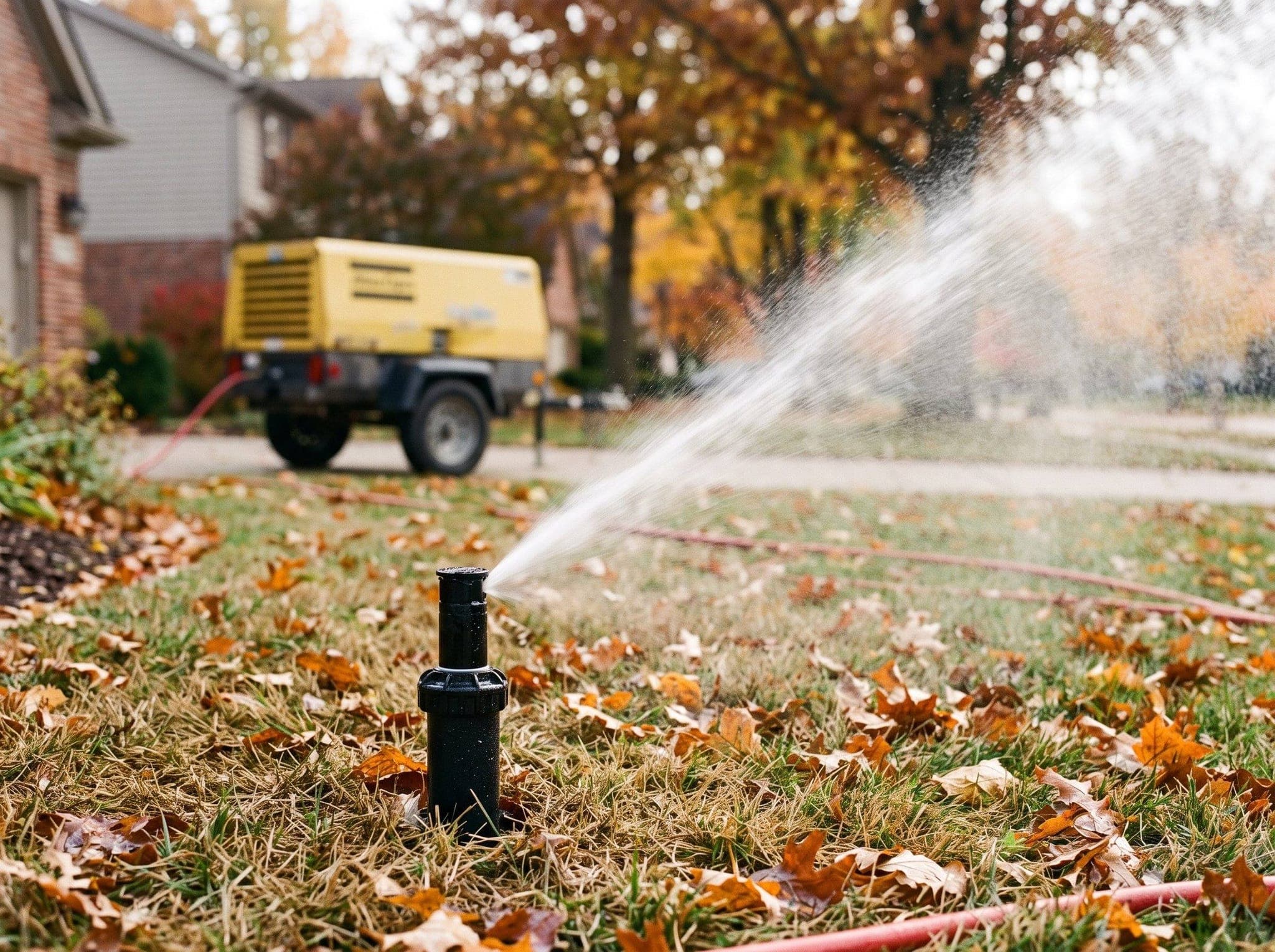
A blowout runs zone by zone, from the farthest zone back toward the compressor, with the water shut off and the backflow preventer isolated. The whole job on a typical residential system takes 30 to 45 minutes.
- Shut off the water and stop the controller. Close the irrigation shutoff valve, then set the controller to off or rain so no zone opens on its own once the system is dry.
- Drain and isolate the backflow preventer. Close both isolation valves and open the test cocks about halfway so trapped water drains out.
- Connect the compressor downstream of the backflow. The blowout port sits on the mainline past the backflow device, and the regulator stays closed until a zone is open.
- Open a zone before adding air. Start with the zone farthest from the compressor. Pressurizing a closed system is what blows fittings apart.
- Blow out one zone at a time. Bring pressure up slowly and stop as soon as the heads are spraying mist instead of water, usually one to two minutes per zone.
- Work through every zone, then release pressure. Cycle the shortest zones a second time, disconnect the compressor, and leave the test cocks open for the winter.
The Pressure Limits That Protect Your Pipes
Two numbers matter more than anything else in this job, and they are set by your pipe material:
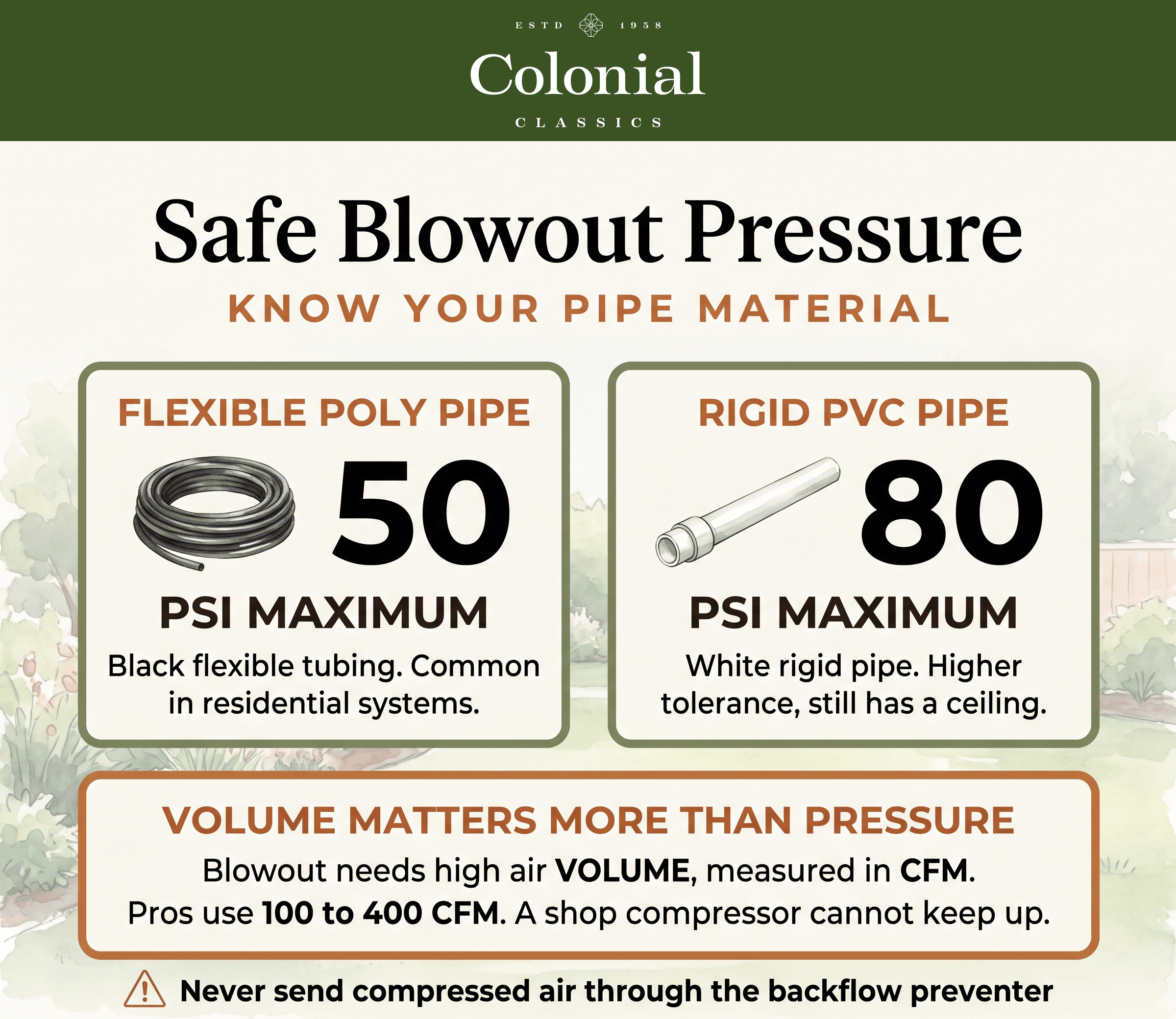
- 50 PSI maximum on flexible black polyethylene pipe: This is the standard published by Rain Bird, Hunter, Toro, and K-Rain. Poly pipe is common in residential systems throughout our area.
- 80 PSI maximum on rigid PVC pipe: This is the ceiling confirmed by both manufacturers and university extension guidance.
Push past these and the failure modes are ugly. Overpressurized pipe ruptures, fittings blow apart underground, and heads can launch out of the ground. There is a subtler danger too: forcing air through too fast generates friction heat, and that heat melts the internal wiper seals in gear driven rotor heads. A melted seal seizes the rotor permanently.
Never blow air through the backflow preventer. High velocity air destroys the internal check valves and seats. The compressor connects downstream of the device, and the backflow assembly gets drained separately through its test cocks.
Why a Shop Compressor Is the Wrong Tool
This is the part that surprises people. Blowing out a sprinkler system is a volume job, not a pressure job, and volume is measured in CFM, or cubic feet per minute.
A pancake compressor from the garage can hit 120 PSI all day long, which sounds like plenty. What it cannot do is sustain airflow. Professional blowout compressors deliver 100 to 400 CFM, and the practical minimum for a residential system is around 50 CFM. A small tank compressor produces a tiny fraction of that.
Without enough volume, the air takes the path of least resistance and channels straight over the top of the standing water instead of pushing it out. The heads mist, the system looks clear, and there is still enough water sitting in the low spots to split a pipe in January. Meanwhile the compressor runs continuously trying to keep up, which is exactly the condition that overheats rotor seals.
If you own or can rent a compressor in the 50 CFM range and you are comfortable working around the backflow assembly, a DIY blowout is achievable. If your plan involves the compressor already in your garage, it will not work.
Do Not Forget the Backflow Preventer
Your backflow preventer is the device that keeps irrigation water, along with any fertilizer or herbicide that got drawn back into the line, out of your home's drinking water. It matters year round, and it has its own winter requirements.
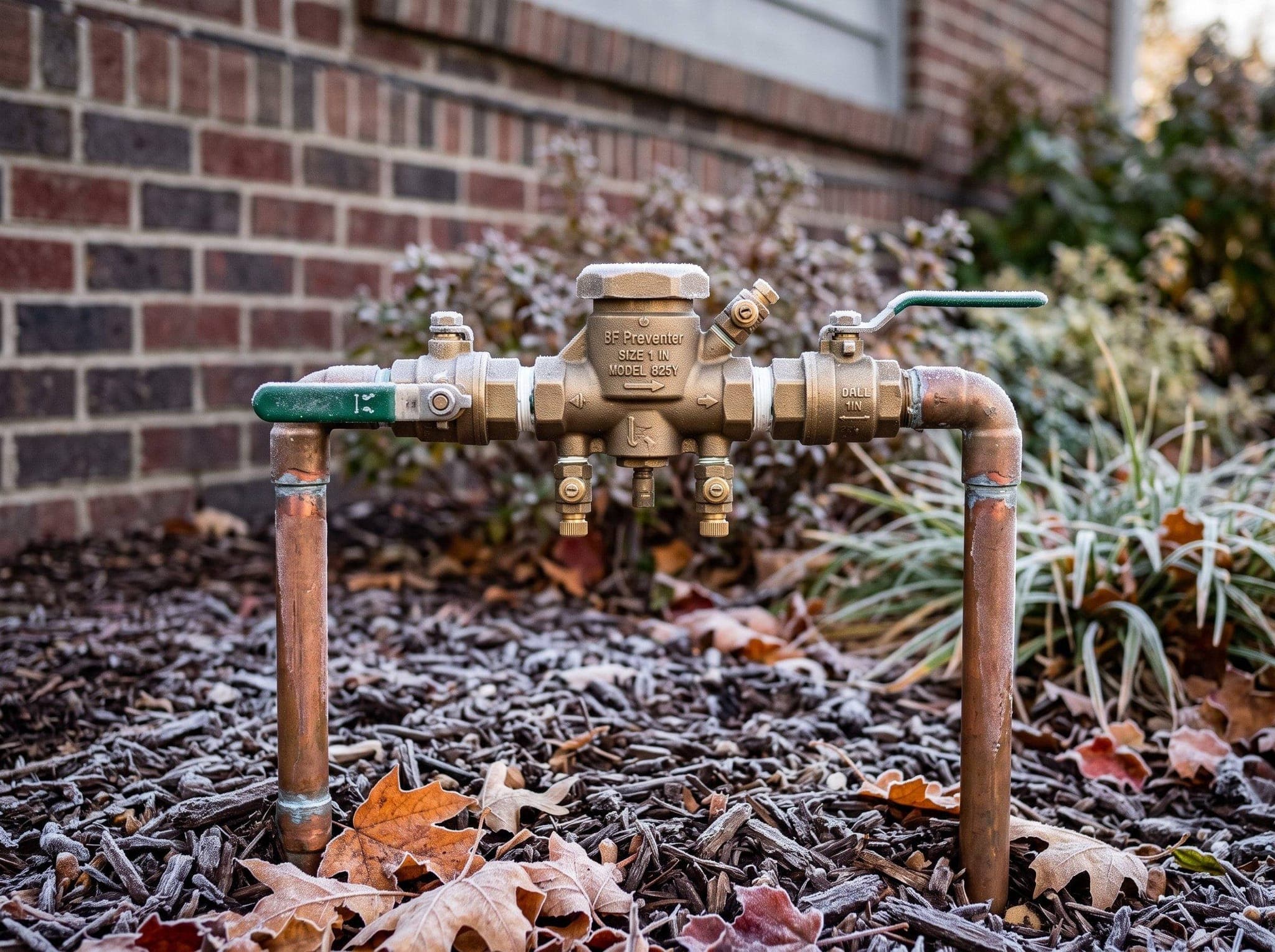
After the blowout, close both isolation valves and leave the test cocks open about halfway through the winter so no water can collect and freeze inside the body. Some homeowners add an insulated cover, which helps but does not replace draining the device.
There is also a legal requirement worth knowing. Indiana Administrative Code 327 IAC 8-10-9 mandates annual testing of backflow prevention devices, performed at the owner's expense by an IDEM certified tester. Most water districts across Indiana, Illinois, and Kentucky enforce this, and the results have to be filed with your water department. Our irrigation service includes certified backflow testing with the paperwork filed on your behalf, so it is worth pairing with winterization rather than treating as a separate errand.
Should You DIY or Hire a Pro?
Here is the honest math. Professional sprinkler winterization runs $85 to $150 for most homeowners nationally, and Colonial Classics charges a flat $105 for standard residential systems in the Tri-State area. Compressor rental alone for a machine large enough to do the job properly often lands in the same range, before you have spent a Saturday on it.
DIY makes sense if you have a genuine high volume compressor and know where every valve and drain sits. You also need to be confident isolating the backflow assembly. Hire it out if you are unsure where your blowout port is, if your system has more than six or seven zones, or if you have never done it before. The downside risk is not a wasted afternoon, it is a $1,700 backflow replacement discovered in April.
One more argument for booking it: a contractor doing the blowout is walking your system anyway, and that is when problems get spotted. A head that has drifted out of coverage is much cheaper to fix in October. Finding it during next summer's first heat wave costs you a lot more.
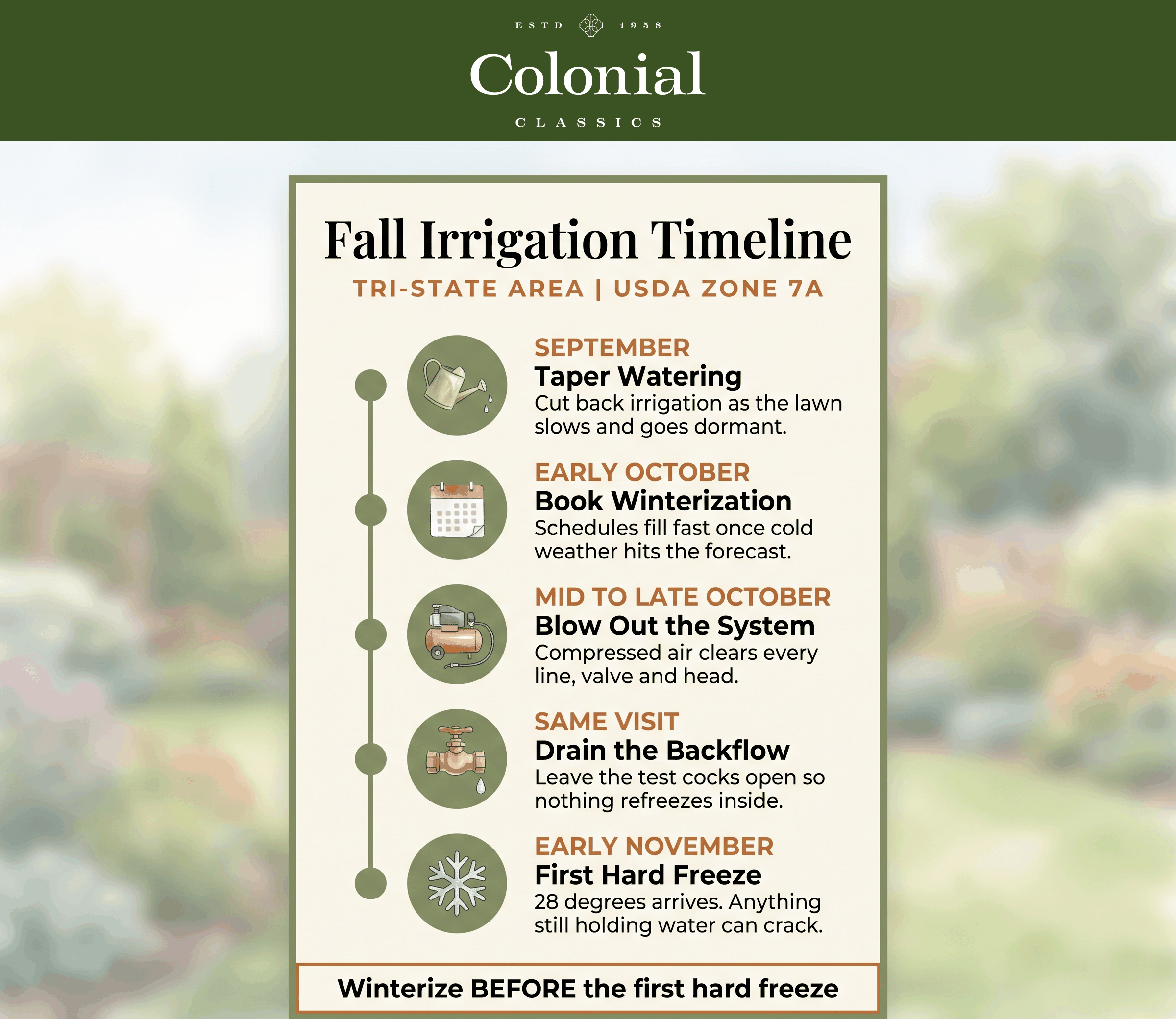
Your Fall Irrigation Timeline
Winterization is one item on a short list of fall tasks that protect the investment you have in your landscape:
- September: Cut back watering as temperatures drop and the lawn slows down. Our guide to summer lawn watering covers how to taper off correctly.
- Late August through early October: Aerate and overseed while the soil is still warm. See the fall lawn aeration and overseeding guide for timing and seed selection.
- Early October: Book winterization. Schedules fill fast once the first cold snap hits the forecast.
- October: Plant spring bulbs. The fall bulb planting guide walks through tulips, daffodils, and alliums.
- Mid to late October: Blow out the irrigation system, drain the backflow, shut down the controller.
- November: Final seasonal cleanup with leaves cleared and beds cut back before winter.
For more on irrigation management through the growing season, Purdue Extension's Irrigation Practices for Homelawns is a solid Indiana specific reference.
The Bottom Line
Winterize your sprinkler system in mid to late October, before the first hard freeze arrives in early November. Use a compressed air blowout rather than relying on drain valves. Keep pressure at or below 50 PSI on poly pipe and 80 PSI on rigid PVC. Never send air through the backflow preventer, and leave the test cocks open through the winter.
A blowout is a small, predictable expense on a fall to do list. Skipping it turns into an unpredictable one, and it always arrives in spring when you least expect it.
Ready to get on the schedule? Our irrigation service covers spring start up, certified backflow testing, a mid season check, and winterization, billed as each service is completed. Send us a message and we will get your system on the fall calendar.