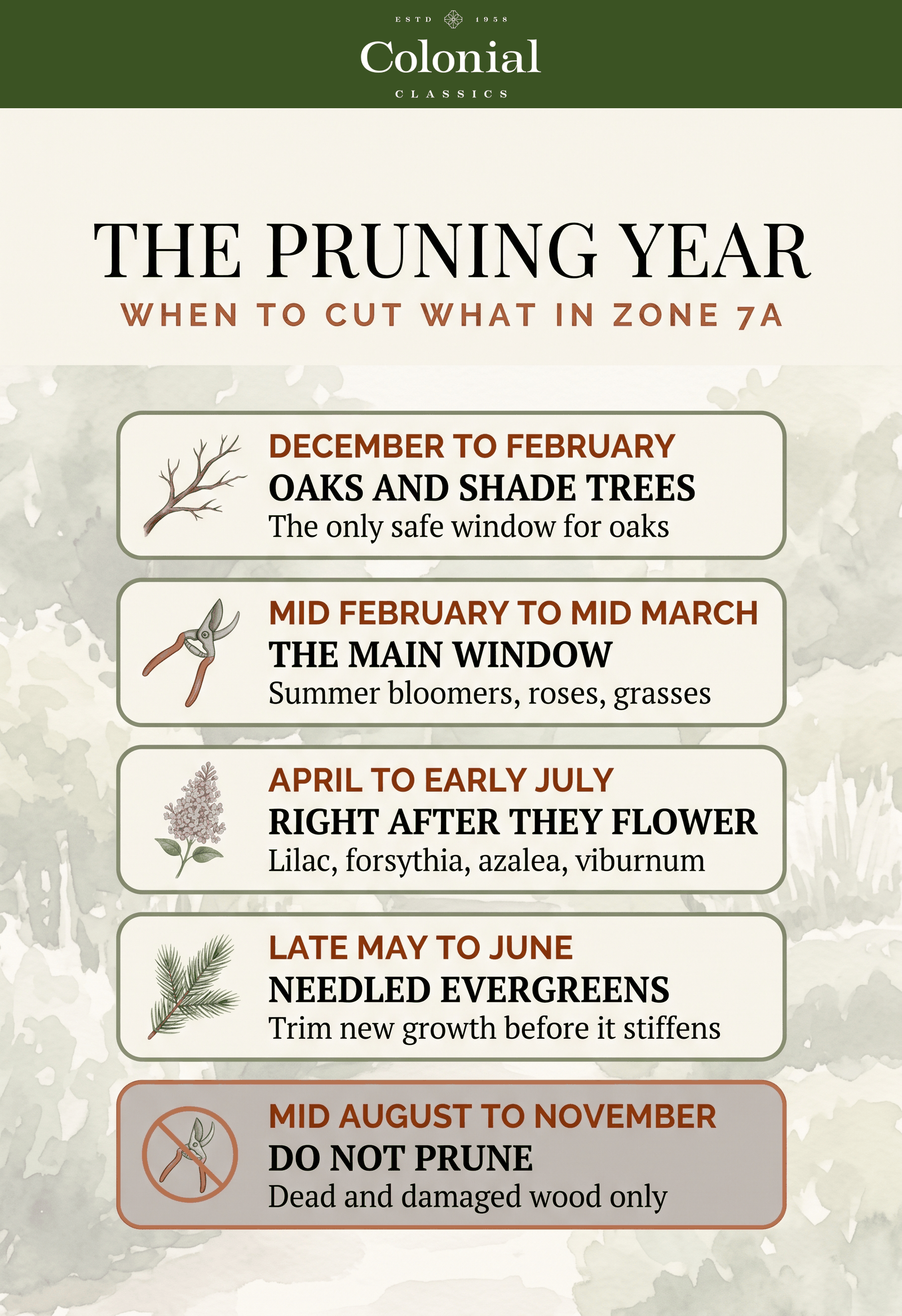
When to prune shrubs comes down to a single rule: if a shrub flowers before the end of June, prune it right after the blooms fade. If it flowers after the end of June, prune it in late winter before new growth starts. That one distinction, drawn from Purdue Extension's pruning guide, settles the timing for the overwhelming majority of shrubs growing in Southern Indiana and across the wider Tri-State area.
The reason it works is that flower buds form on two different schedules. A lilac sets next spring's buds during the summer before, so those buds are riding on the stems all winter. Cut the plant back in October and you have thrown the flowers away without knowing it. A panicle hydrangea, by contrast, forms its buds on growth it has not made yet, so a hard late-winter cutback gives you stronger stems and bigger blooms.
Everything else in this guide is either an application of that rule or one of the handful of genuine exceptions to it.
Blooms before the end of June? Prune right after flowering. Blooms after the end of June? Prune in late winter. Dead, diseased, and broken wood comes out in any month.
When Is the Best Time to Prune Shrubs?
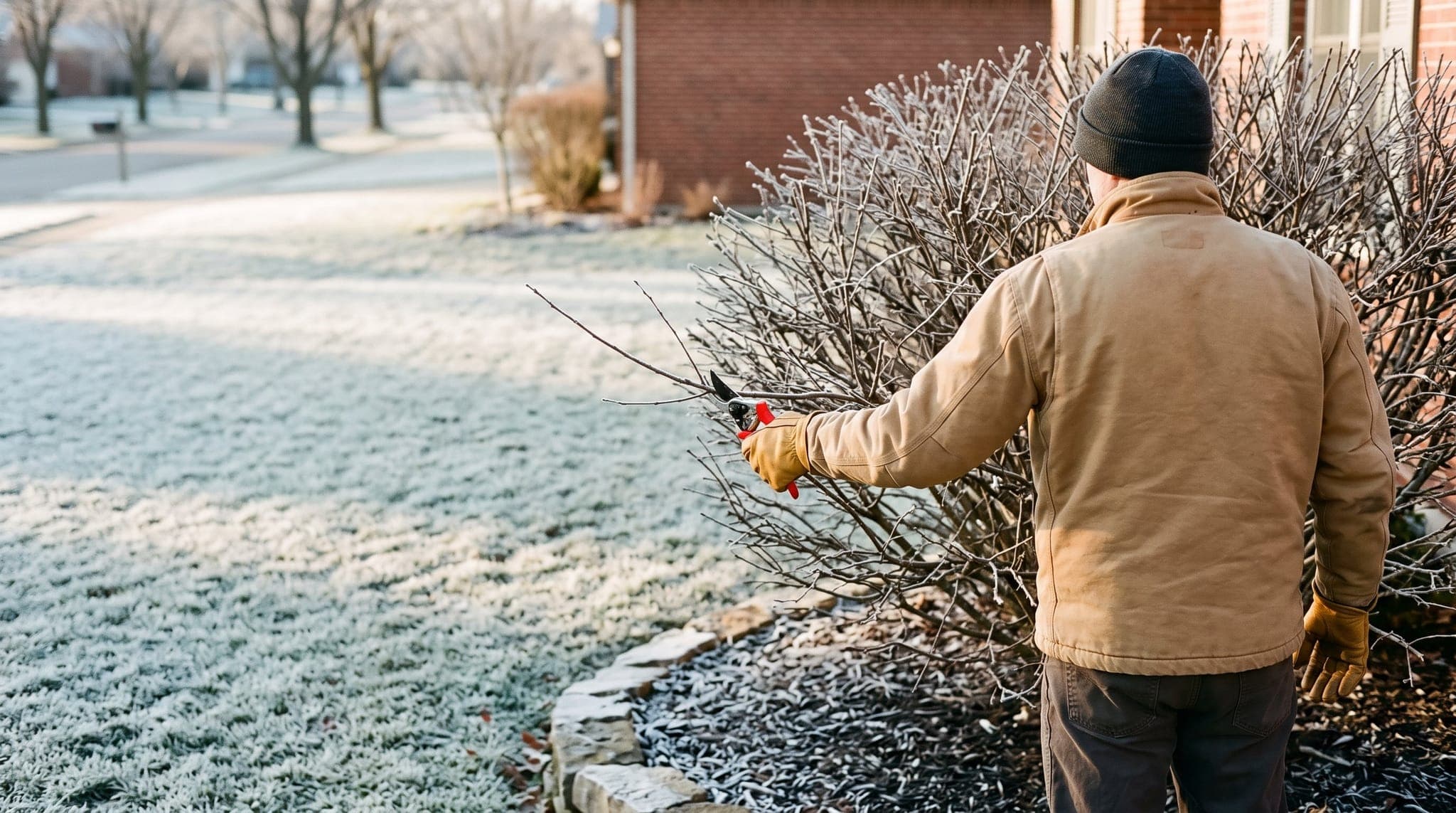
Late winter to early spring, roughly mid February through mid March here in USDA Zone 7a, is the best all-purpose pruning window. Four things line up at once during that stretch. The plant is dormant, so it is not spending stored energy on growth you are about to remove. The leaves are gone, so you can actually see the branch structure you are shaping. Insects and fungal pathogens are inactive, so fresh cuts are far less likely to get infected. And growth resumes within weeks, so wounds close quickly instead of sitting open.
That window is also the most forgiving one. Purdue notes that severe pruning is best done just before spring regrowth, because the bare stubs you leave get hidden fast. Prune the same plant the same way in July and you look at those cuts for months.
Why Fall Is the Worst Time to Prune Most Shrubs
If you only remember one thing about what not to prune in fall, make it this: anything that flowers before the end of June. Fall pruning mistakes fall into two separate categories, and a lot of yards get hit by both at once.
The first is the flower buds. Every spring-flowering shrub in your landscape formed next year's buds back in summer. When you tidy the yard in October and shear everything into neat shapes, you are cutting off the display you were waiting for. The plant looks perfectly healthy the following May because leaves grow from different buds than flowers do, which is exactly what makes this mistake so hard to diagnose. This is far and away the most common reason a hydrangea refuses to bloom, and the same thing happens to lilacs, azaleas, forsythia, and viburnum.
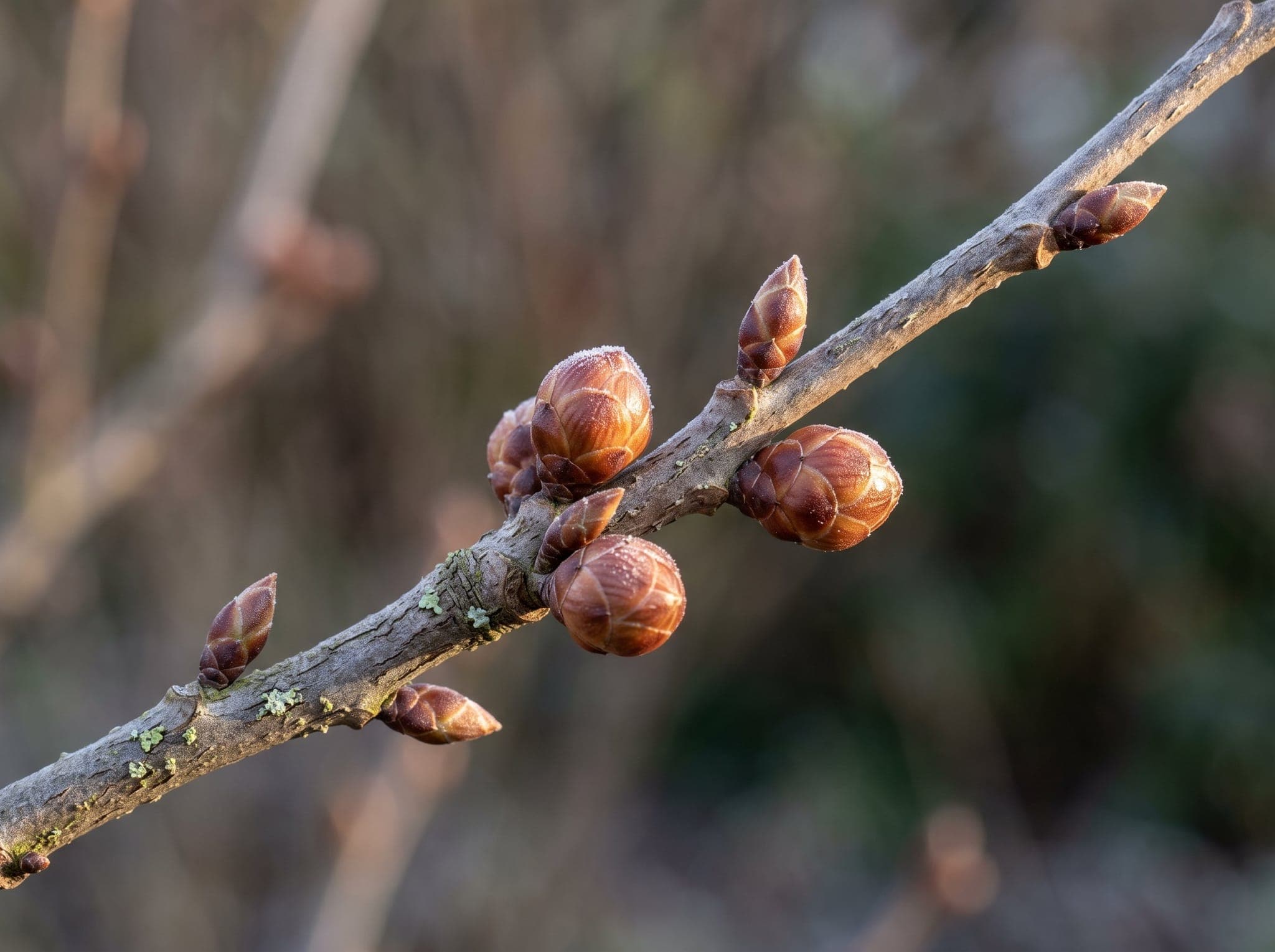
The second reason is winter injury. Pruning is a growth signal. Cut a shrub in late summer or early fall and it responds by pushing out soft new shoots at precisely the moment it should be shutting down for the year. That tissue never hardens off, and the first hard freeze kills it. Purdue's guidance is direct on this point: late summer pruning should be avoided because it stimulates succulent growth that may not harden sufficiently to avoid winter dieback.
The October cleanup trap. A full-property shear in fall feels productive and looks tidy for about six weeks. It costs you next spring's flowers on every old-wood shrub and leaves tender growth exposed to the first freeze. If you want a clean look heading into winter, remove dead wood and spent flower heads and leave the living stems standing.
What You Can Safely Prune in Fall and Winter
Plenty of work is still fair game once the weather turns. Dead, diseased, broken, and crossing branches should come out whenever you find them, in any month, on any plant. Storm damage should be cleaned up as soon as it happens rather than left to tear further. Oaks actually prefer this time of year, for reasons covered further down. And any shrub that blooms after the end of June can be cut back once it is fully dormant.
What you are avoiding in fall is the discretionary work: shaping, size reduction, shearing, and anything that touches a plant which has already set its buds.
Prune These After They Flower
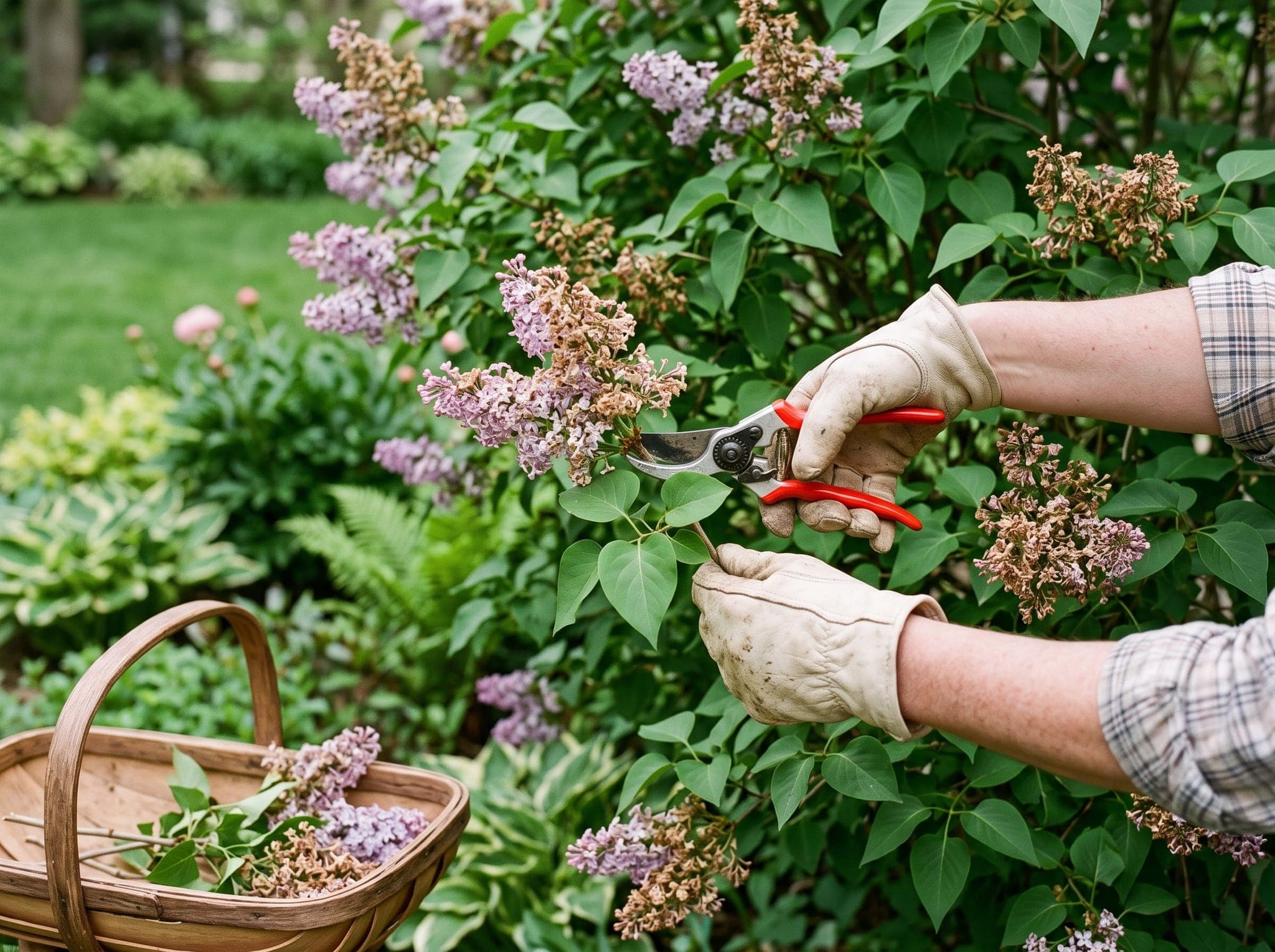
These shrubs and small trees bloom on old wood, meaning the buds formed during the previous summer. Prune them within roughly six weeks of the flowers fading, which in the Evansville and Newburgh area usually means somewhere between late April and early July depending on the plant.
- Lilac: Prune right after bloom. Lilac wood is often more than three years old before it flowers, so bring an overgrown plant down gradually across several seasons rather than all at once.
- Forsythia: Prune after bloom. It also tolerates a complete cut to the ground when it has gotten away from you.
- Azalea and rhododendron: Prune after bloom, and keep it light. These need very little cutting in a normal year.
- Viburnum: Prune after bloom, unless you are growing it for the berries, in which case wait until the fruit has dropped or been eaten.
- Flowering dogwood, redbud, crabapple, and magnolia: Prune after bloom. All four set buds the previous season.
- Weigela, deutzia, mock orange, and beautybush: Prune after bloom.
- Flowering quince, spirea (the early white types), and cotoneaster: Prune after bloom.
- Climbing and shrub roses: Prune after the main flush. Hybrid teas are the exception and belong in the late-winter group.
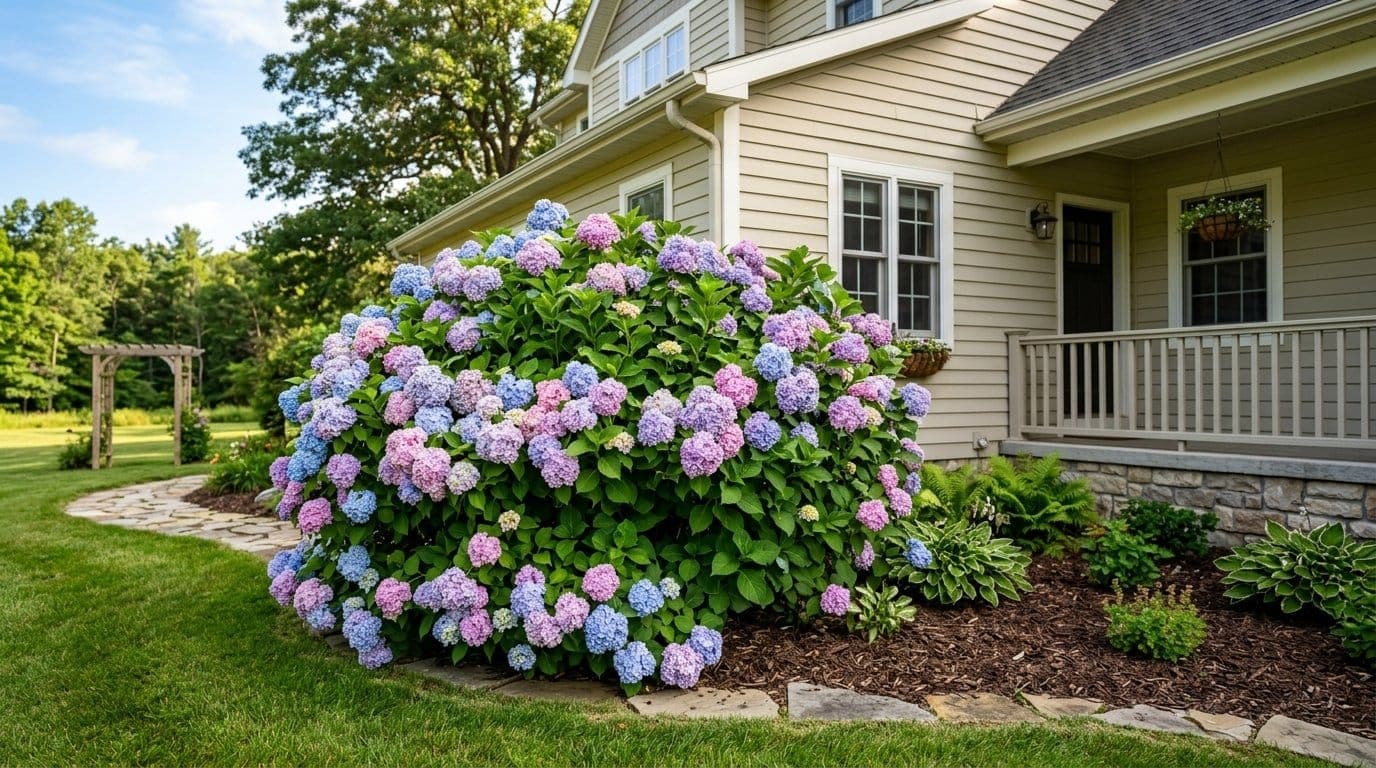
- Bigleaf, mountain, and oakleaf hydrangea: Prune after bloom, and lightly. Our full hydrangea troubleshooting guide breaks the types down in detail.
Prune These in Late Winter
These bloom on the current season's growth, so cutting them while dormant costs you nothing and usually improves the show. Mid February through mid March is the target.
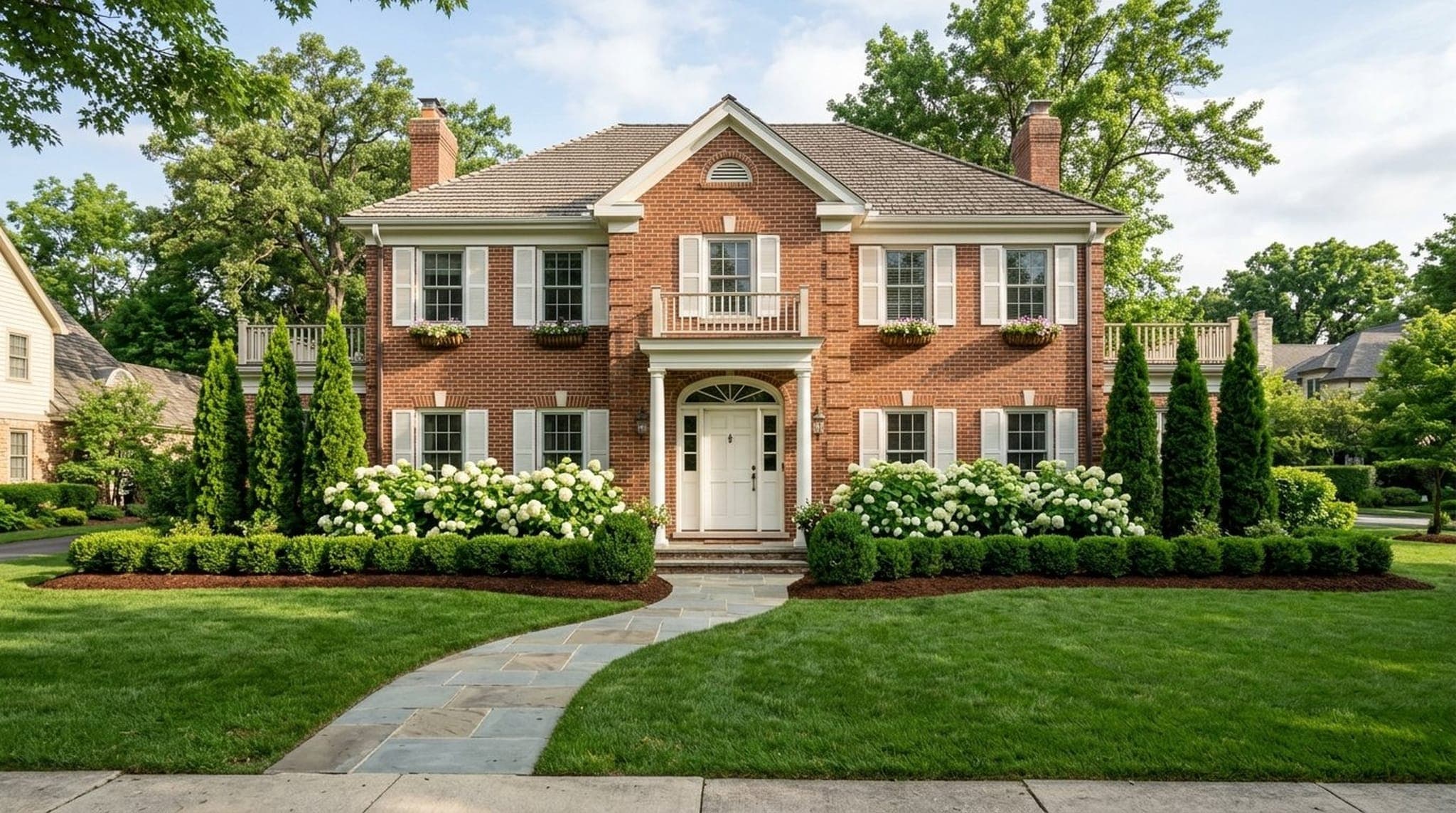
- Panicle and smooth hydrangea: Cut back hard. Limelight, Little Lime, and Annabelle all flower better for it.
- Butterfly bush: Cut back hard, nearly to the ground.
- Rose of Sharon: Prune for shape and size before buds break.
- Glossy abelia, St. Johnswort, and beautyberry: Prune before growth starts.
- Sumac, false spirea, and snowberry: Prune before growth starts.
- Hybrid tea roses: Prune as the buds begin to swell, which locally lands in March.
- Ornamental grasses: Cut to a few inches above the crown. Leave them standing through winter for the structure, then cut just before new green appears at the base.
- Most shade and ornamental trees: Prune while dormant for structure, clearance, and deadwood.
Evergreens Follow Their Own Rules
When to prune evergreens depends on which of two groups yours falls into, and confusing them is how people end up with permanent bare patches.
Needled evergreens (pine, spruce, fir, juniper, arborvitae) are pruned in late spring as the new growth elongates but before it stiffens. The rule that matters most here is that these plants generally will not push new shoots from older wood. Cut back past the living foliage into the bare interior and that section stays bare permanently. Pines in particular are shaped by pinching the soft new candles in spring, not by shearing.
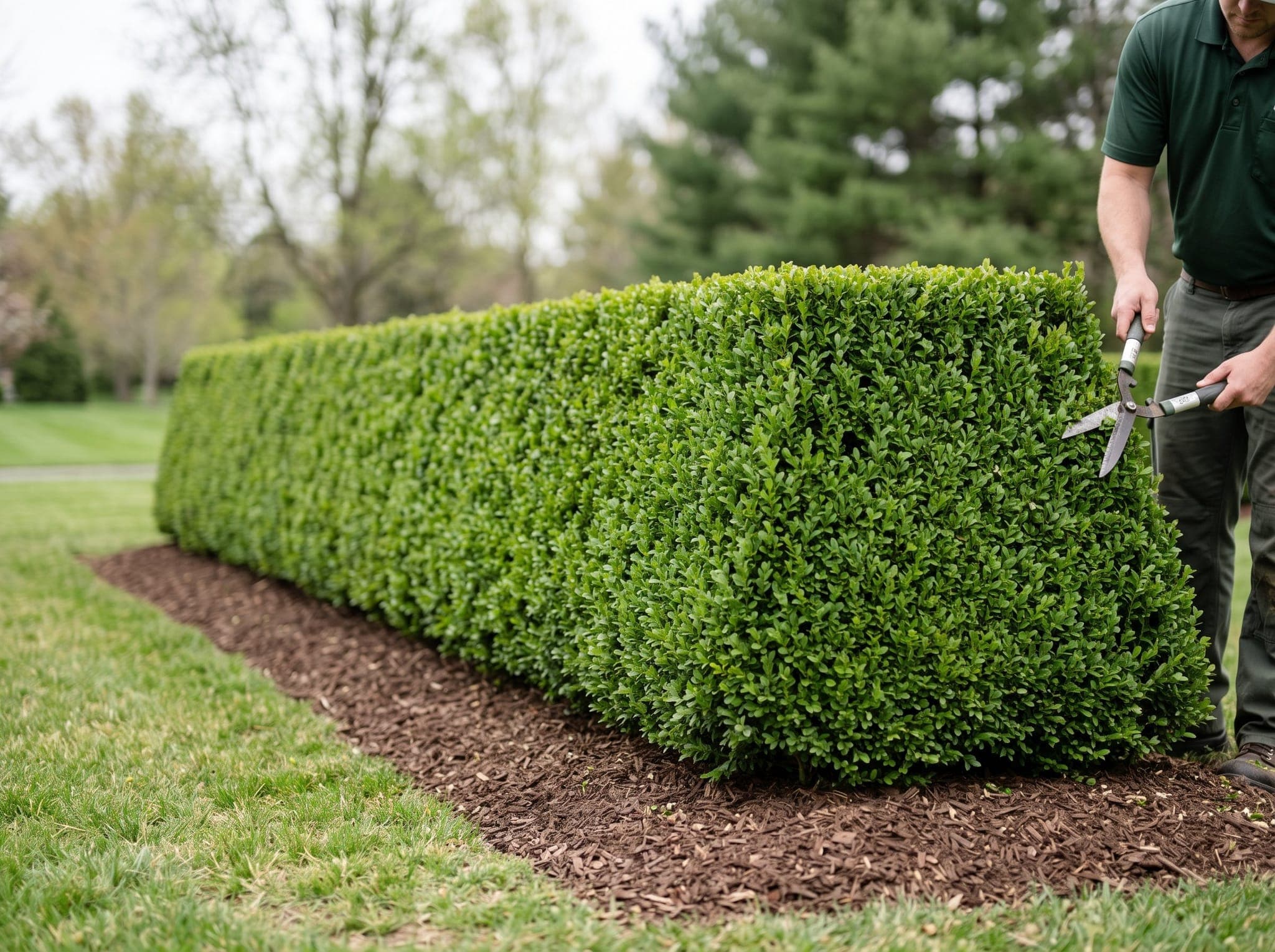
Broadleaf evergreens (boxwood, holly, cherry laurel, Japanese holly) are more forgiving and can be pruned any time the wood is not frozen. Late winter through early summer is ideal. Skip the late-summer shearing, since the flush of soft growth it triggers is the same tissue that browns out in a February cold snap. If you are still choosing plants for a bed, our guide to the best shrubs for landscaping covers which of these hold their shape with the least work.
Oaks and Sap Bleeders Need Specific Timing
When to prune trees is mostly the late-winter rule above, but two groups are timed around tree health rather than flowering.
Oaks should be pruned between December 1 and the end of February. Oak wilt is a fatal fungal disease of red and black oaks, spread in part by sap-feeding beetles that are attracted to fresh wounds. According to Purdue Extension's oak wilt publication, the high-risk period for beetle transmission runs from March 1 through the end of November, with little risk from December 1 through the end of February. That narrow winter window is when oak pruning belongs. If a storm wounds an oak during the risk period, treating the cut promptly is one of the few situations where a wound dressing is genuinely recommended.
Heavy sap bleeders include maple, birch, dogwood, elm, walnut, and yellowwood. Pruned in early spring, these run sap heavily from the cuts. It does not hurt the tree, but it is messy over a driveway or walkway. Prune them in midsummer or late fall instead if the dripping bothers you.
Not sure what you have? Bring a stem with leaves attached to the garden center and our staff can identify it and tell you the right window. It is a two-minute conversation that can save an entire season of flowers.
How Much to Cut and Where
Timing decides whether you get flowers. Technique decides whether the plant stays healthy.
How much to remove
Stay under one third. Removing more than about a third of a plant in one season stresses it and often triggers a wave of weak, whippy regrowth.
Renewal pruning rebuilds an overgrown shrub over three years. Each late winter, cut one third of the oldest, thickest stems all the way to the ground and leave the young vigorous ones. By the third year the plant has been completely replaced without ever looking like it was under construction. This is the right approach for lilac, viburnum, privet, and most multi-stemmed shrubs.
Rejuvenation pruning cuts the whole plant to the ground at once. It only works on species that resprout readily from the base. Purdue lists butterfly bush, forsythia, rose of Sharon, smooth hydrangea, oakleaf hydrangea, privet, honeysuckle, spirea, and lilac as candidates. Do it in late winter and expect to thin the crowd of new shoots that follows. On the old-wood bloomers in that list, lilac and oakleaf hydrangea especially, it costs you a season of flowers, so save it for a shrub too far gone to fix any other way. Try it on a boxwood or a spruce and you will simply have killed it.
Where to make the cut
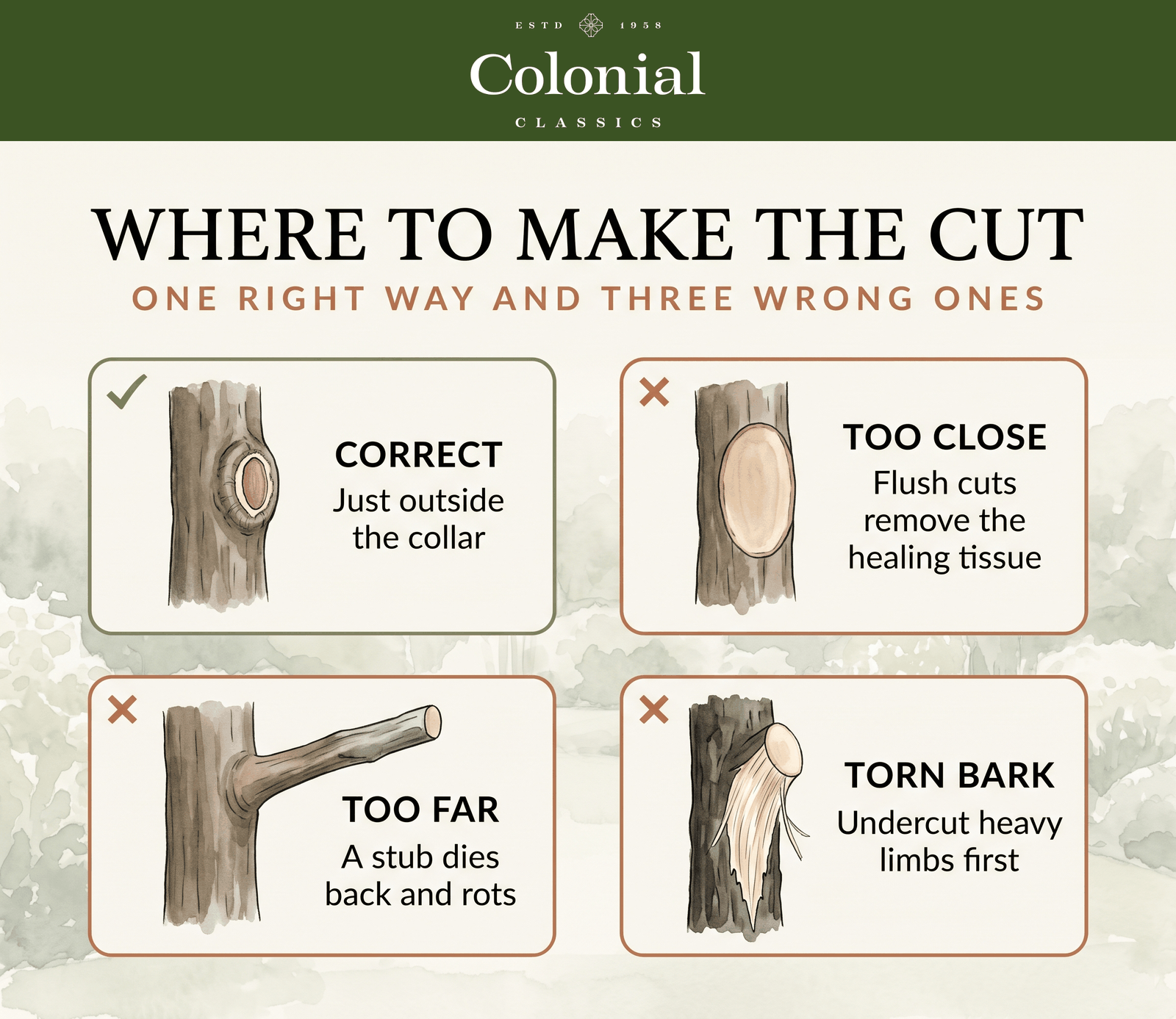
Cut just outside the branch collar. The collar is the slightly swollen ring where a branch meets the trunk, and it contains the tissue that seals the wound. Cut flush to the trunk and you remove it, which opens a path for decay into the part of the tree you wanted to keep.
Never leave a stub. When shortening a branch, cut about a quarter inch above a healthy bud or a lateral branch. A stub left out in the open dies back and rots.
Skip the wound paint. Purdue's research summary is clear that dressings slow wound closure rather than speed it, and can harbor disease organisms. A clean cut heals itself. The oak wilt situation above is the exception that proves the rule.
Four Mistakes That Show Up Every Spring
- Shearing everything into balls and boxes. Hedge shears cut without regard to where the buds are, which builds a dense outer shell that shades out the interior. The plant ends up hollow, with green only on the surface. Hand pruning to a bud or lateral keeps the natural form and lets light reach the middle.
- Topping trees. Cutting a mature tree back to stubs is not a size reduction, it is an injury. The stubs decay, the tree responds with weakly attached water sprouts, and you have created a hazard where you had a shade tree. Proper reduction removes specific limbs back to laterals and keeps the tree's shape.
- Crape murder. Crape myrtles get whacked to knuckled stumps every March out of habit. They survive it, but you trade an elegant multi-stemmed form and attractive bark for a cluster of floppy shoots that flop over in summer rain. Thin out crossing branches and suckers instead.
- Pruning on a schedule instead of on a plant. The single most useful habit is walking the property once a year and asking what each plant actually needs. Purdue makes the point that most shrubs are ignored for years and then need drastic work to be salvaged, which is a harder job than annual maintenance ever is.
When It Makes Sense to Call Someone
Handle the small stuff yourself. Hand pruners cover branches up to about a quarter inch, loppers get you to an inch and a half, and a pruning saw handles most of the rest at ground level.
Bring in help when the work involves any of these:
- Anything requiring a ladder or a chainsaw, which is where the serious injuries happen.
- Large limbs over a roof, a driveway, a fence, or a power line.
- Mature trees that need structural work. We handle shrubs and small trees reachable from the ground or a standard ladder, and coordinate with a certified arborist for anything larger.
- An overgrown landscape where you are not sure what half the plants are or how far back they can go.
- A property you want on a consistent annual cycle rather than a rescue mission every few years.
Our pruning service works on species-specific schedules for exactly this reason, hitting spring bloomers after they flower and summer bloomers in late winter rather than doing the whole yard in one convenient pass. It also pairs naturally with seasonal cleanup, since the two jobs overlap in the same windows.
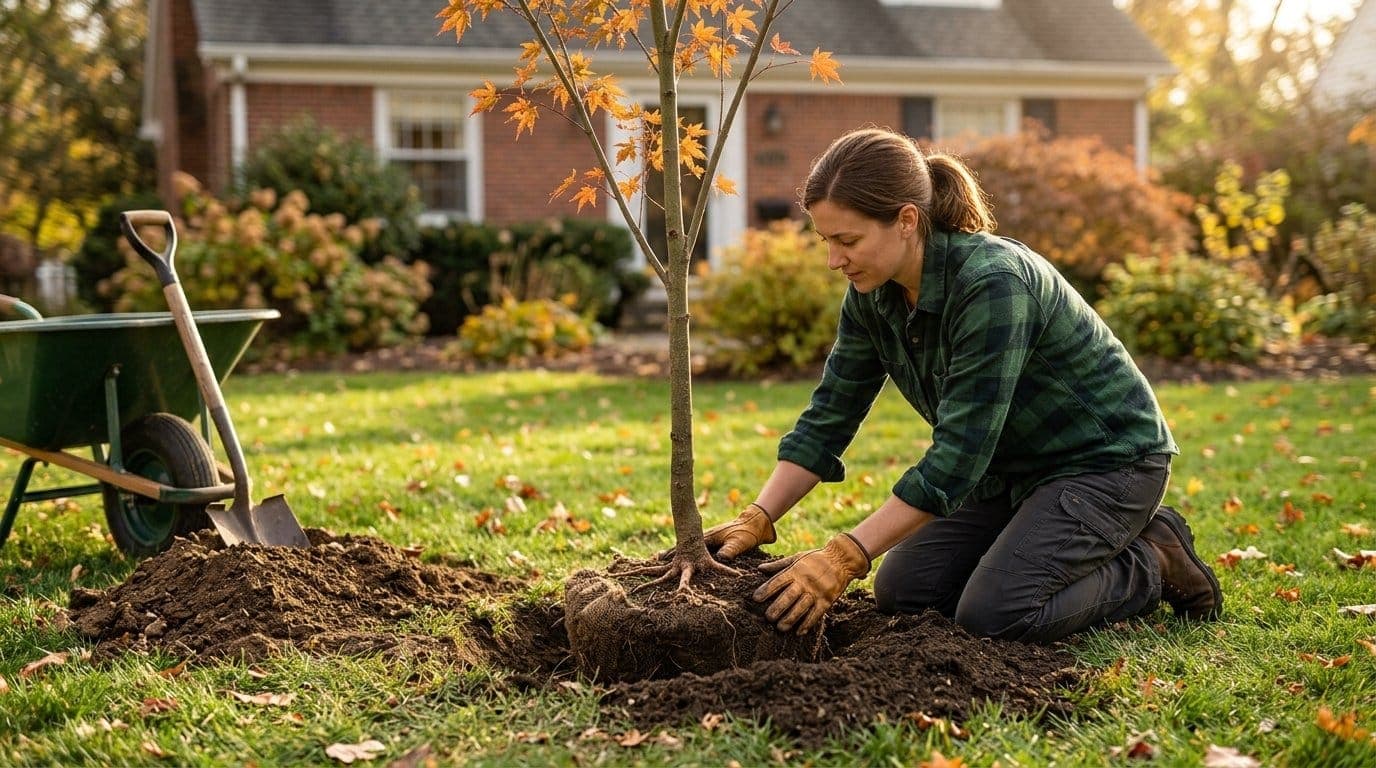
If you are adding plants this year rather than maintaining what is there, timing matters just as much on the front end. Our guide to the best time to plant trees covers why fall beats spring for most woody plants in this region.
The Short Version
Watch when a plant flowers and let that decide when you prune it. Before the end of June means prune after bloom. After the end of June means prune in late winter. Leave the oaks for December through February, handle needled evergreens in late spring, and take out dead and damaged wood whenever you see it. Keep each season's cutting under a third of the plant, cut to a bud or the collar, and put the wound paint back on the shelf.
Do that much and the plants take care of the rest. Questions about a specific shrub in your yard? Get in touch and we will tell you when to cut it.