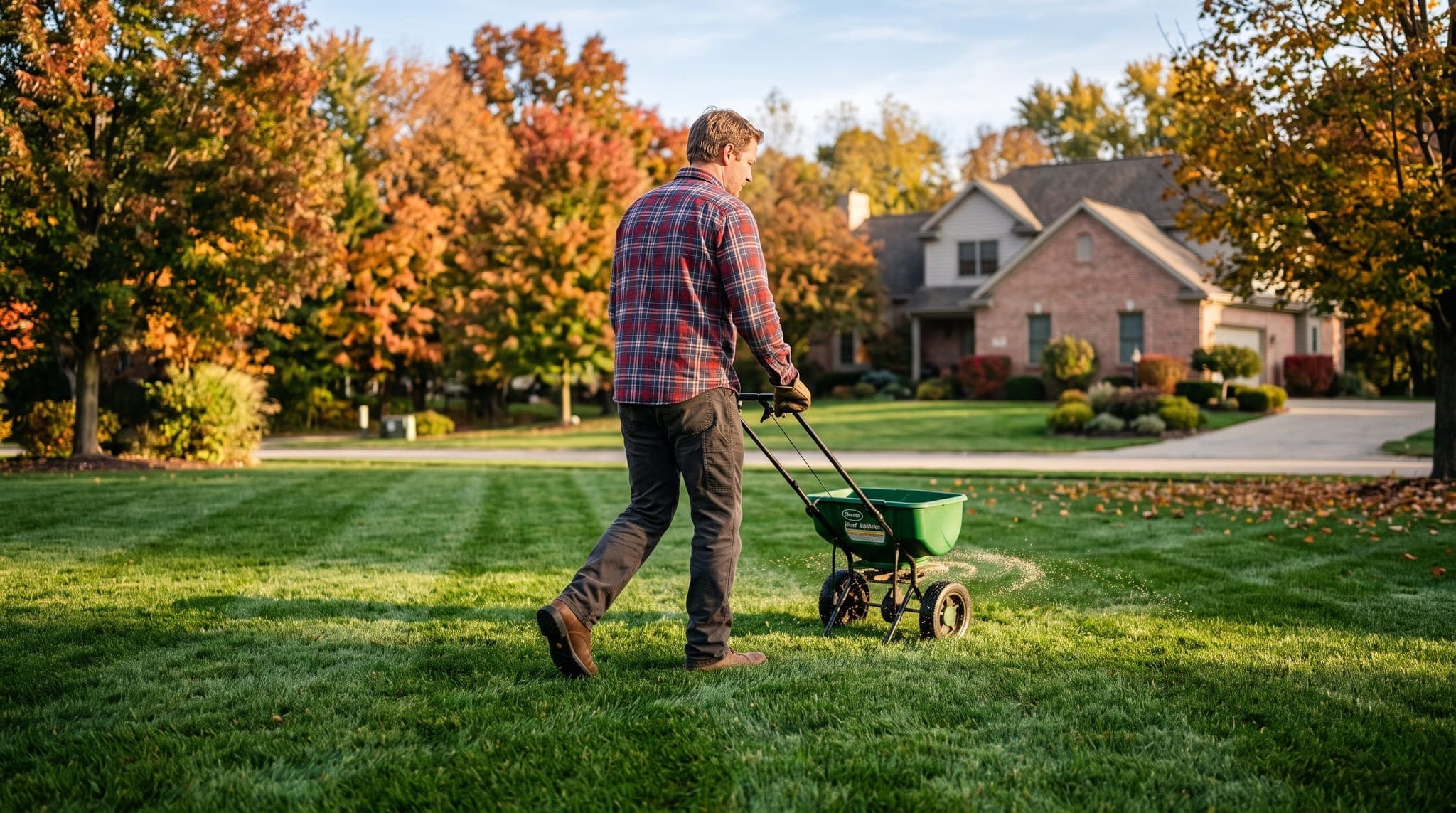
Fall is the most important feeding window of the year for a cool-season lawn, and most yards in the Tri-State area only need two feedings to take full advantage of it. Feed once between late August and the end of September to help the lawn recover from summer, then feed again from mid October into early December to build the root reserves that decide how your lawn looks next April. That second feeding is the one most homeowners skip, and it is the one that does the most good.
The reason has to do with what the grass is doing underground. Once night temperatures drop, Kentucky bluegrass, ryegrass, and tall fescue stop putting energy into top growth and start storing carbohydrates in their roots and crowns. Nitrogen applied during that stretch does not produce a flush of growth you have to mow. It goes into storage. A lawn that goes into winter with full reserves greens up earlier, fills in thinner spots on its own, and shrugs off the heat that arrives the following summer.
When Should You Fertilize Your Lawn in Fall?
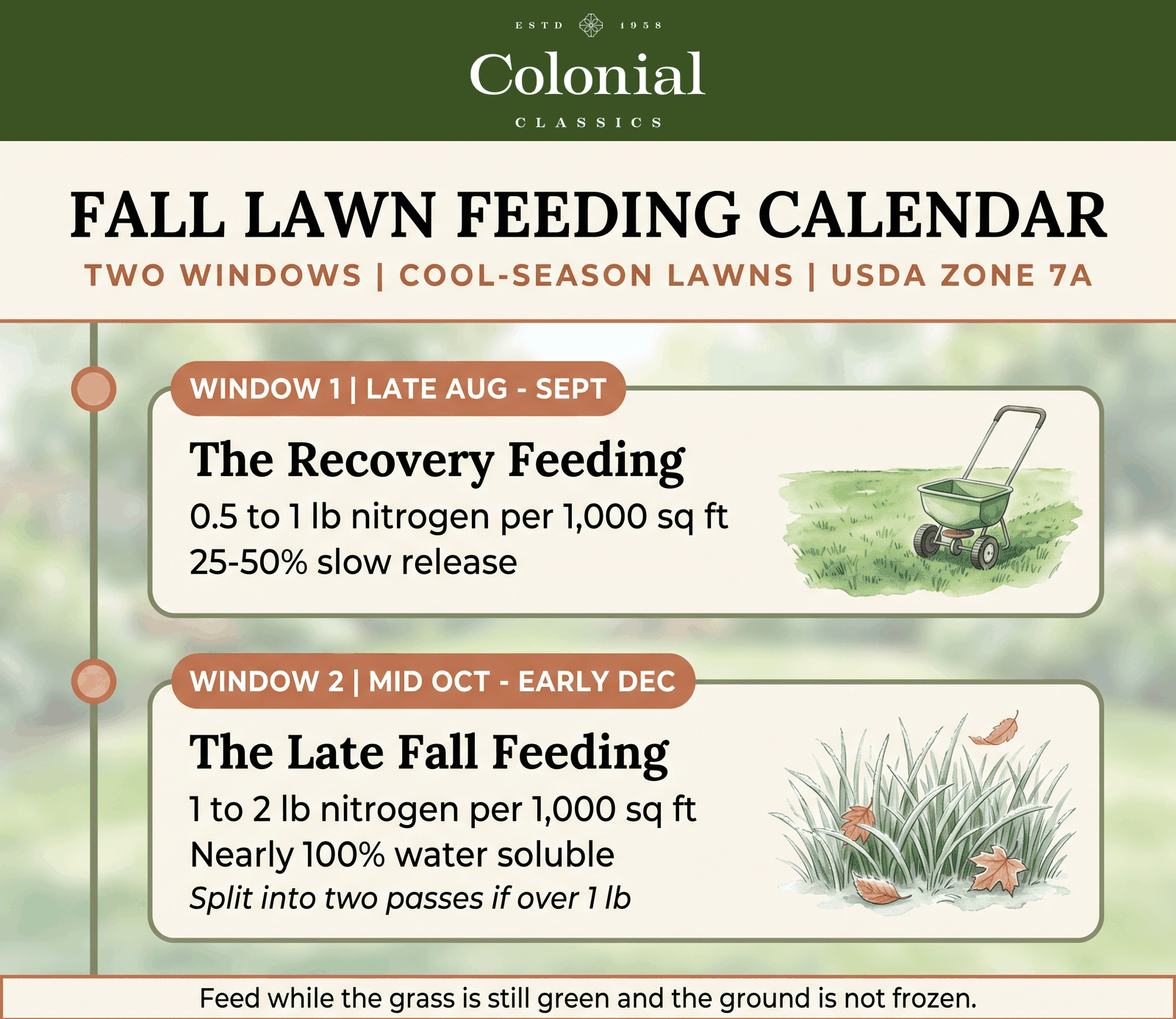
Feed in two windows: late August through September, and October through early December. Purdue's turfgrass program splits the fall into exactly these two periods and treats both as core parts of an annual program for cool-season lawns.
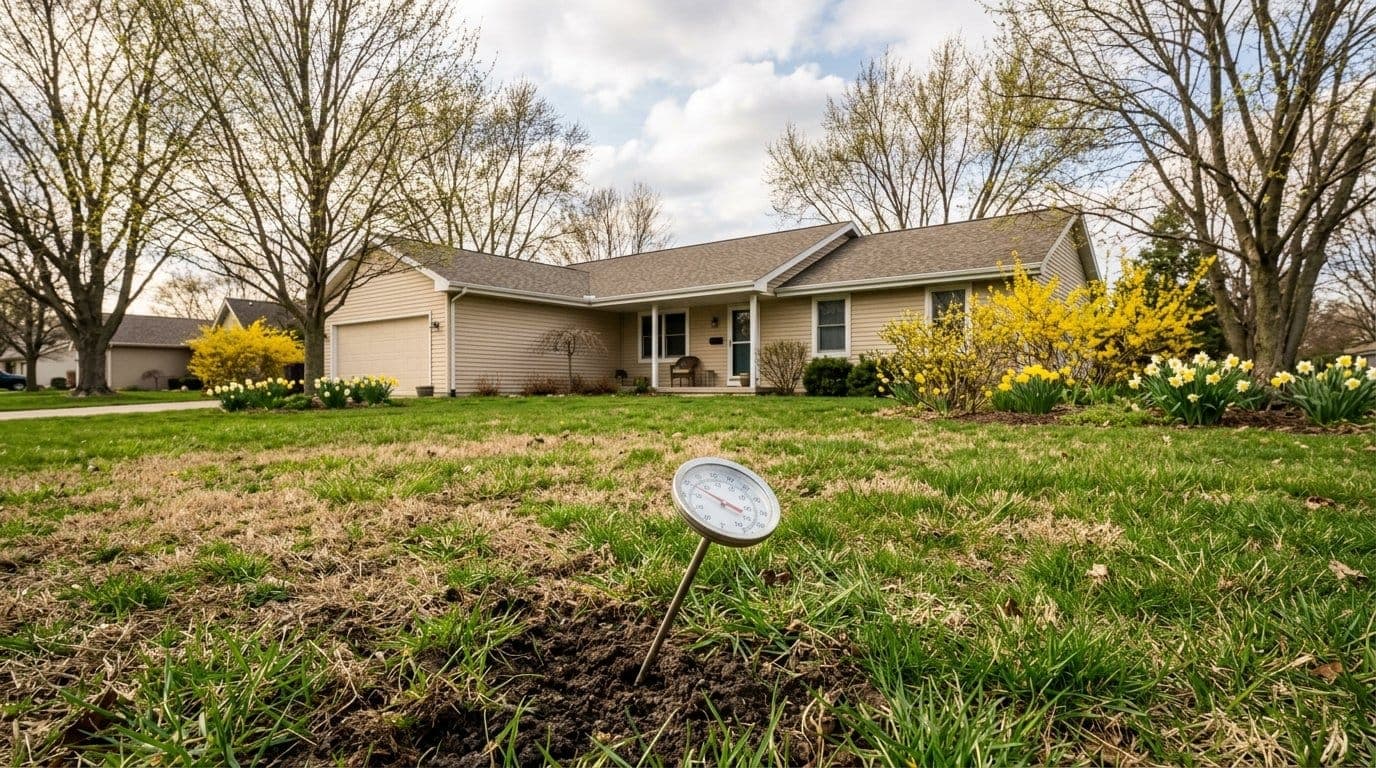
Southern Indiana sits in USDA Zone 7a, and so do the parts of Illinois and Kentucky we serve, so the same schedule works across all three states. What it does not match is the central and northern Indiana conditions most statewide lawn advice is written for. Our grass keeps actively growing a bit later into the season, so you can comfortably run each window about a week later than statewide guidance suggests. The practical test is not the calendar anyway. As long as the lawn is still green and growing and the ground is not frozen, it can still use what you put down.
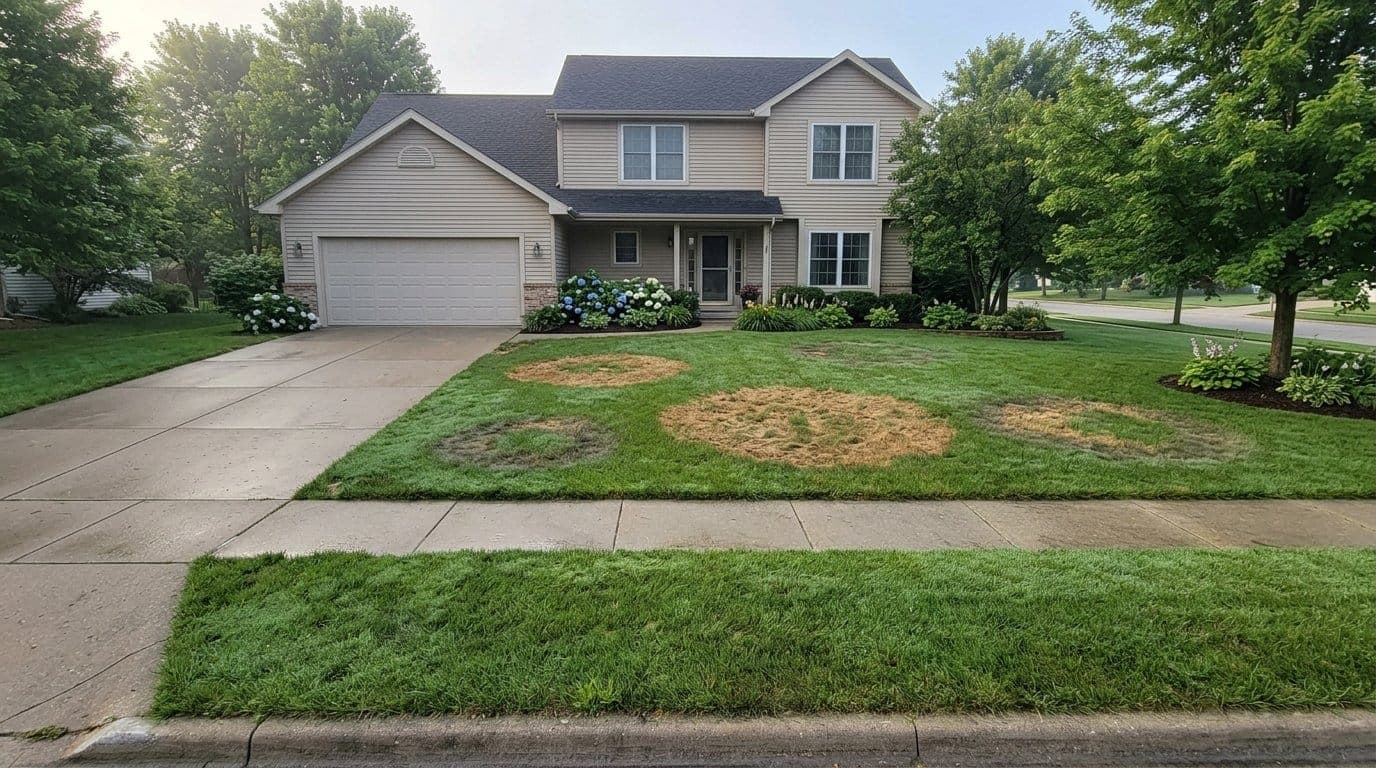
Watch the grass, not the date. If your lawn is dormant, browned out, or badly drought stressed, wait for rain and green-up before you feed. Fertilizer applied to dormant turf does not get used, and it is far more likely to run off.
The Fall Lawn Fertilizer Schedule, Month by Month
Here is how the two windows break down into a schedule you can actually put on a calendar. The rates below are given in pounds of actual nitrogen per 1,000 square feet, which is how every university recommendation is written.
Late August to Mid September: The Recovery Feeding
Apply 0.5 to 1 pound of nitrogen per 1,000 square feet using a product with 25 to 50 percent slow-release nitrogen. This is the feeding that pulls the lawn out of summer. After weeks of heat, humidity, and whatever drought stress the season handed you, the turf is thin and the roots are short. A steady, moderate feeding now rebuilds density before weeds have a chance to move into the gaps.
Slow-release nitrogen matters here because soil temperatures are still warm. A product that dumps all its nitrogen at once in early September gives you a growth surge, more mowing, and a greater chance of leaf burn. A blend that releases over several weeks gives you color and density without the spike.
Mid October to Early December: The Late Fall Feeding
Apply 1 to 2 pounds of nitrogen per 1,000 square feet in a nearly all water-soluble form, any time from mid October until the grass stops growing. This is the window that pays the biggest dividend and the one almost nobody uses. By mid October the air has cooled, top growth has slowed, and the plant is moving into storage mode. Soil temperatures are dropping too, which means slow-release products that depend on soil microbes start working more slowly and less predictably.
Split this window into two passes if you are applying more than 1 pound. Purdue caps any single water-soluble application at 1 pound per 1,000 square feet, so a 2 pound program becomes one pass in mid October and a second in November after your final mowing, while the grass is still green. If you are only applying 1 pound total, make it the November pass. That is the higher-value half of the window.
Mid October is also the point in the season where fall broadleaf weed control is most effective, since dandelions and clover are actively moving nutrients down into their roots and carry herbicide along with them.
Purdue is direct about the product choice here. Their guidance for established cool-season lawns states that "from early October through early December (or when the ground freezes) a product that contains nearly 100 percent water-soluble N is preferred." Urea is the common example. The grass takes it up within days rather than waiting on soil biology that has largely shut down for the year.
Stop when the ground freezes. Fertilizer applied to frozen or snow-covered ground cannot be absorbed. It sits on the surface until the next thaw or rain carries it into the storm drain, which wastes your money and hurts local water quality.
How to Read the Bag: The NPK Numbers That Matter
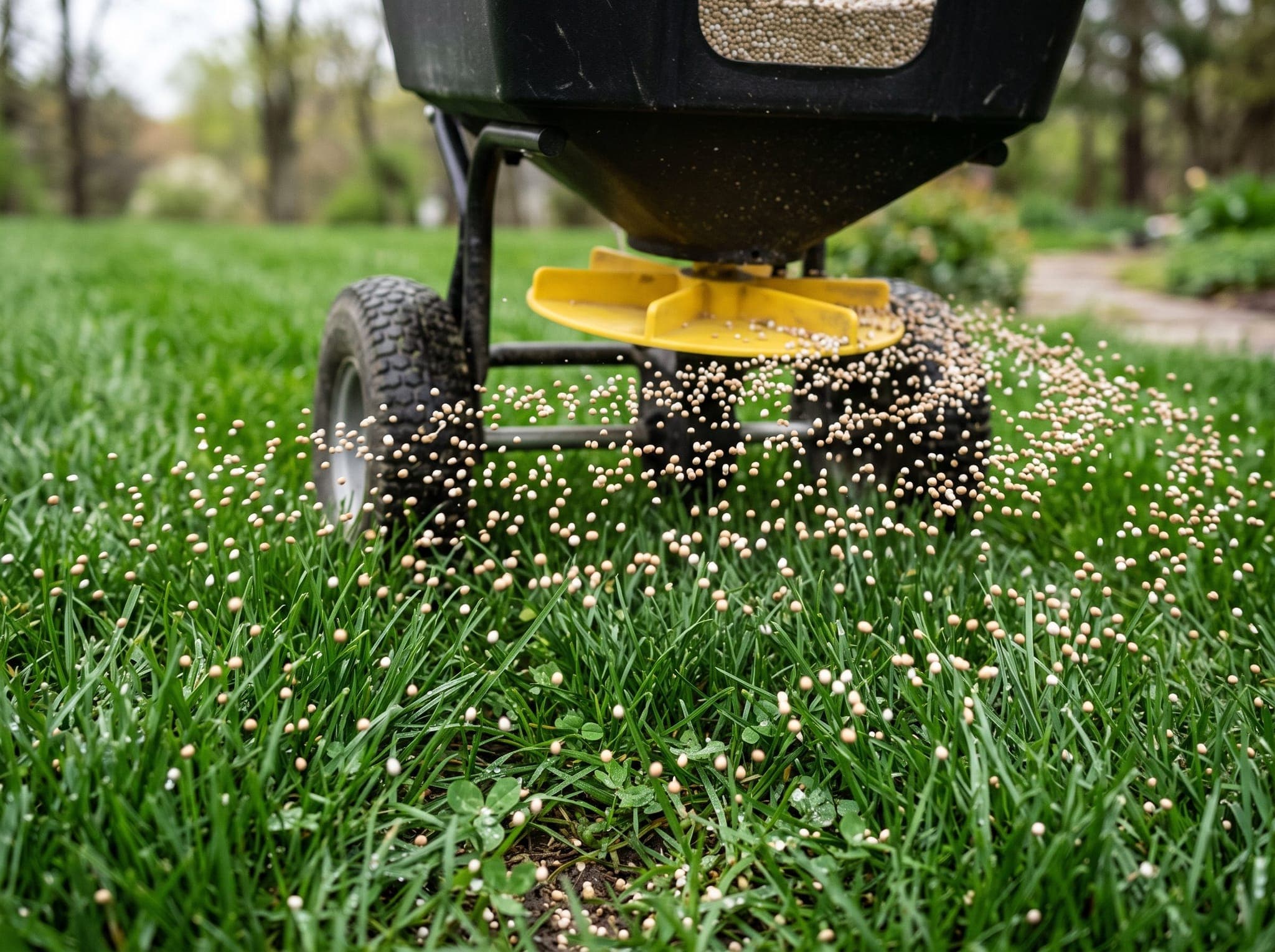
Buy for a high first number and a low or zero middle number. The three numbers on every fertilizer bag are the guaranteed analysis: nitrogen, phosphorus, and potassium, always in that order. A 24-0-6 bag is 24 percent nitrogen, 0 percent phosphorus, and 6 percent potassium by weight.
For established lawns, nitrogen is the nutrient that does nearly all the work. Purdue puts it plainly: of the three, nitrogen "has the most impact on established lawns." Phosphorus and potassium matter most when you are building a new lawn from seed or sod, not when you are maintaining one that has been there for years.
A few things worth knowing before you stand in the aisle:
- Skip general-purpose garden fertilizer: A bag of 12-12-12 is formulated for vegetable gardens, not turf. Purdue specifically advises using lawn fertilizers instead, which are built to feed mature grass without injuring it.
- Check the slow-release percentage: It is printed in the fine print under the analysis, not on the front of the bag. For the early fall feeding you want 25 to 50 percent slow release. For late fall you want close to none.
- The middle number should usually be zero: Unless a soil test says otherwise, your lawn does not need more phosphorus, and applying it anyway is the nutrient most likely to end up in a creek.
- Bag coverage claims are not rates: A bag that says it covers 5,000 square feet is telling you how the manufacturer chose to divide it, not how much nitrogen you are applying. Do the math yourself.
The Winterizer Myth
Winterizer is a marketing term, not an agronomic one. Bags labeled winterizer are often sold on the idea that a big dose of potassium prepares grass for cold, and many carry a high third number to match the story.
The research does not support buying on that basis. Purdue addresses it head on: "Many consumer publications suggest applying P and K in the fall to 'put the lawn to bed.' However, if a soil test indicates your soil has sufficient P and K, applying more is unnecessary." What genuinely helps a lawn through winter is late-season nitrogen in a form the plant can absorb quickly. Read the guaranteed analysis and the slow-release percentage, and let the name on the front of the bag be the last thing you consider.
How Much Fertilizer Do You Actually Need?
Divide your nitrogen target by the decimal form of the first number on the bag. That gives you pounds of product per 1,000 square feet, and it is the only calculation you need.
Say your target is 1 pound of nitrogen per 1,000 square feet and you bought a 24-0-6 product:
- Convert the nitrogen percentage to a decimal. 24 percent becomes 0.24.
- Divide the target by that decimal. 1 divided by 0.24 equals 4.2 pounds of product per 1,000 square feet.
- Divide your lawn area by 1,000. A 6,000 square foot lawn is 6.
- Multiply the two results. 4.2 times 6 equals about 25 pounds of product for the whole lawn.
If you would rather not do it by hand, the Purdue Turf Fertilizer Calculator runs the same math for granular and liquid products.
Two limits are worth committing to memory, because exceeding them is how lawns get striped and burned:
- Never apply more than 1.0 pound of water-soluble nitrogen per 1,000 square feet in a single application. This is the cap that matters most in late fall, when you are using quick-release products.
- Products that are more than 50 percent slow release can go up to 2.0 pounds per 1,000 square feet, because the nitrogen is metered out over weeks rather than delivered all at once.
That cap changes depending on which kind of nitrogen you bought, so it helps to know how the two behave differently:
| Characteristic | Quick release | Slow release |
|---|---|---|
| Common sources | Urea, ammonium sulfate | Coated urea, methylene urea, natural organics |
| Greening speed | Days | Weeks |
| Burn risk | Higher, water it in | Lower |
| Depends on soil temperature | No | Yes |
| Single-application cap | 1.0 lb N | 2.0 lb N |
| Best fall use | October into early December | Late August into September |
If you only make one change to your lawn program this year, add the late fall feeding. One pound of quick-release nitrogen per 1,000 square feet, applied after the last mowing while the grass is still green, does more for next spring's lawn than anything you can apply in April.
Does Your Lawn Need Phosphorus or Potassium?
Only a soil test can tell you, and on our soils you should be testing every two to three years. There is no reliable soil test for nitrogen needs, which is why nitrogen recommendations are based on how you want the lawn to look and perform. Phosphorus and potassium are different: a lab can measure exactly what is in your soil and tell you whether adding more would do anything at all.
Heavy clay is the dominant soil type around Newburgh and Evansville, and clay holds nutrients well. Purdue recommends testing fine-textured clay soils every two to three years, compared with every year for sandy soils. A test also reports pH, which quietly governs whether the nutrients already in your soil are available to the grass at all. You can find a certified lab through Purdue's turf soil testing resources.
Indiana does not have a statewide law restricting phosphorus on established lawns, so nothing stops you from buying a bag with a middle number. The case for skipping it is agronomic and environmental rather than legal. Phosphorus your lawn cannot use is phosphorus headed for the Ohio River watershed.
How Fall Feeding Fits With Aeration and Overseeding
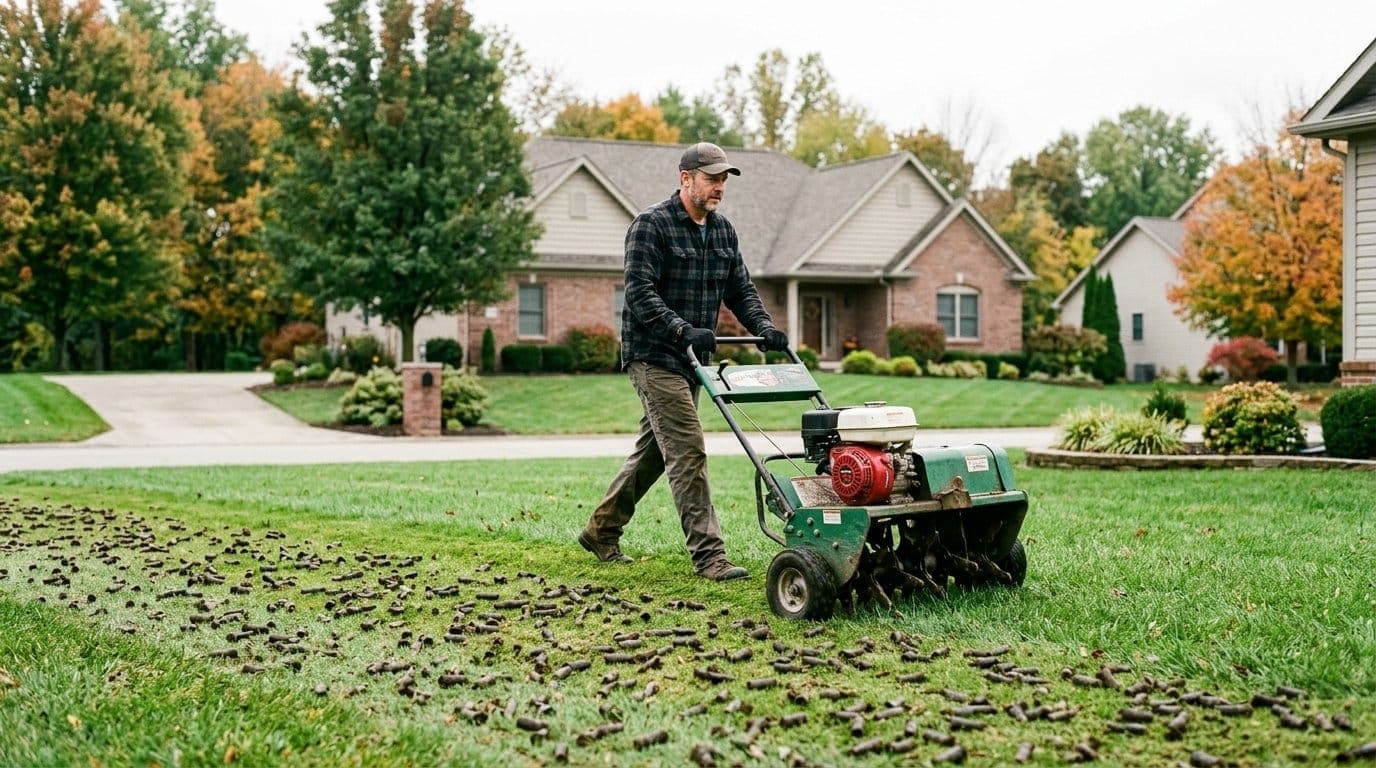
Keep the two jobs separate in your head, because they use different products. If you are aerating and overseeding this fall, that project has its own timing and its own starter fertilizer, and our guide to core aeration and overseeding walks through the full process.
The one rule that connects them: never put a weed-and-feed or pre-emergent product on newly seeded areas. The same chemistry that keeps crabgrass from germinating in spring will keep your new grass seed from germinating too. If you are seeding, use a starter fertilizer at seeding, then return to the schedule above for the late fall feeding several weeks later once the new grass has been mowed a few times.
For the same reason, if you are planning pre-emergent applications as part of your program, those decisions need to account for whether you seeded this fall.
Common Fall Fertilizing Mistakes
Most fall fertilizer problems come down to timing and rate rather than product choice. These are the ones we see most often on properties around the Tri-State area:
- Feeding a dormant or drought-stressed lawn: Grass that is browned out and not growing cannot use nitrogen. Wait for rain and green-up first, and if your lawn browns out every summer, a steadier summer watering routine keeps it from going dormant in the first place.
- Putting down everything at once: Splitting the fall total across two or three applications gives steadier growth and far less risk of burn than one heavy pass.
- Lowering the mowing height for the last cuts: Scalping the lawn in November removes the leaf area the plant needs to keep photosynthesizing. Purdue's maintenance calendar for Indiana lawns puts the range at 2.5 to 3.5 inches and says not to reduce the height for the last few mowings.
- Bagging every clipping: Returning clippings recycles real nitrogen back into the soil. If you remove clippings all season, plan on 25 to 50 percent more fertilizer annually to compensate.
- Leaving granules on hard surfaces: Fertilizer on the driveway or sidewalk washes straight into a storm drain. Sweep or blow it back onto the grass.
- Guessing at lawn size: Rates are per 1,000 square feet of actual turf. Measuring the whole lot instead of the grass is the most common reason a lawn gets underfed.
One more worth calling out separately: pushing heavy nitrogen during hot weather in July and August invites disease rather than preventing it. Brown patch in particular thrives on lush growth in humid heat, which is covered in our guide to common lawn diseases. The fall schedule works precisely because it feeds the grass when cooler air makes that growth sustainable.
When It Makes Sense to Hand It Off
A fall fertilizer program is genuinely doable yourself if you have a spreader, a tape measure, and a free Saturday in each window. What tends to trip homeowners up is not the first application, it is making all of them on time, at the right rate, with the right product for each window, in a season that also includes leaf cleanup and everything else.
If you would rather it just get done on schedule, our fertilization and weed control program handles the timing, the product selection, and the calibration across the full season, and pairs naturally with fall cleanup and regular mowing. Either way, the schedule above is the same one worth following. Reach out if you want us to take a look at what your lawn actually needs this fall.
The short version: feed once in early fall, feed again in late fall while the grass is still green, buy for the first number on the bag, and measure before you spread. Do those four things and you will spend a lot less time fixing the lawn come spring.
Sources: Purdue Extension, Fertilizing Established Cool-season Lawns (AY-22-W).