The best privacy trees for Southern Indiana are Green Giant arborvitae for speed, Emerald Green arborvitae for narrow spaces, Norway spruce for big properties, Nellie R. Stevens holly for a dense screen with winter color, and Eastern red cedar for tough, dry spots. Pick by the space you have, plant at the right spacing, and you can block a view in a few seasons instead of waiting a decade.
If you are reading this because a new house went up next door, or because you are tired of eating dinner in full view of the road, you are not alone. Privacy is one of the most common reasons people walk the tree rows at the garden center, and it is also where we see the most expensive mistakes: trees planted too close together, the wrong species for the soil, and screens that look great in year three and start dying in year eight.
This guide covers the trees that actually hold up across the Tri-State area of Southern Indiana, Southern Illinois, and Western Kentucky, how to space them, and the problems to plan for before you dig.
How to Choose the Right Privacy Tree
The right privacy tree is the one whose mature size fits your space. Before you look at a single tag, measure two things: how tall the screen needs to be to block the view, and how much width you have between your property line and anything you need to keep clear, like a driveway, a septic field, or a fence.
Then ask four questions:
- How tall does it need to get? A neighbor's second-story window needs a 20 foot screen or more. A patio sightline might need only 10.
- How wide can it get? A 40 foot tree that spreads 15 feet wide will swallow a narrow side yard. This is the single most common mismatch we see.
- What is the soil like? Most of the region sits on heavy clay that stays wet in spring. Some evergreens shrug that off, and some slowly decline in it.
- Do deer visit? If they do, it rules out a couple of the most popular choices.
Most of the Tri-State, including Evansville and Newburgh, falls in USDA Hardiness Zone 7a, so cold is rarely the problem. Summer heat, wet clay, and disease are what separate a screen that lasts from one that does not.
The Best Privacy Trees for Southern Indiana
These are the best trees for privacy in the region, the five we recommend most often, from fastest to toughest.
Green Giant Arborvitae
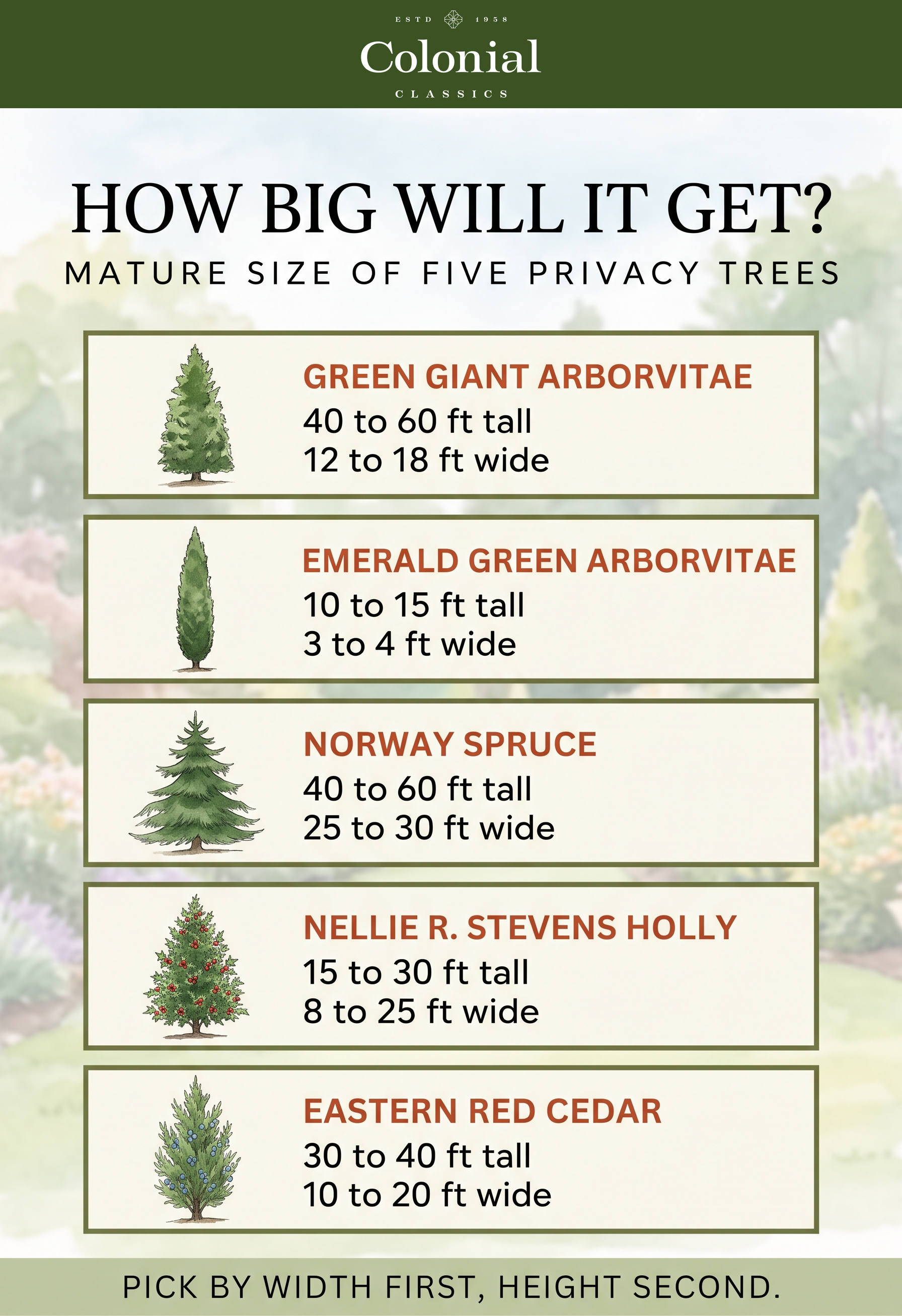
Green Giant arborvitae is the fastest privacy tree that stays healthy here. NC State Extension lists it at 3 to 4 feet of growth per year in good conditions, maturing at 40 to 60 feet tall and 12 to 18 feet wide. It tolerates clay and, in NC State's words, "resists most diseases, insects, periodic droughts, and deer."
It is not a small-yard tree. That 12 to 18 foot spread means it needs real room, and NC State notes it can get root rot in poorly drained soil, so avoid low spots where water stands after a rain. Give it full sun or light afternoon shade.
If you need tall privacy fast and you have the space, start here.
Emerald Green Arborvitae
Emerald Green arborvitae is the right choice for a narrow space. The University of Minnesota lists it at 10 to 15 feet tall and just 3 to 4 feet wide, with a tidy, narrow pyramid shape that fits between a driveway and a fence where nothing else will.
The tradeoffs are speed and deer. It grows far more slowly than Green Giant, so buy it as large as your budget allows. And it is a cultivar of American arborvitae, which Rutgers rates as "frequently severely damaged" by deer, their worst category. If deer come through your yard, expect them to strip it as high as they can reach unless you protect it every winter.
Norway Spruce
Norway spruce is the best big privacy tree for large properties. The Morton Arboretum lists it at 40 to 60 feet tall and 25 to 30 feet wide, and it is often used for windbreaks and screens, with weeping branches that block wind as well as views.
It earns a spot on this list because it holds up where blue spruce does not. Purdue Extension calls Norway spruce "highly resistant" to Rhizosphaera needle cast, the disease that thins out Colorado blue spruce from the bottom up across Indiana. We are near the warm end of its range, though, so plant it in well-drained soil and full sun rather than a hot, cramped corner, and give it the full width it needs.
Nellie R. Stevens Holly
Nellie R. Stevens holly is the best choice if you want a dense screen with winter color. NC State Extension's holly profile lists it as fast growing, maturing at 15 to 30 feet tall, with glossy evergreen leaves and bright red berries that hold into winter. It is also mildly deer resistant and tolerates some salt, which helps along a road.
Its height makes it a good fit when Green Giant would be too much tree, and its broad leaves give a screen texture that needled evergreens do not. Plant it in spring rather than fall. Broadleaf evergreens lose water through their leaves all winter, so they need a full season of root growth before their first cold snap.
Eastern Red Cedar
Eastern red cedar is the toughest privacy tree on this list. It is native to the eastern United States, and NC State Extension's red cedar profile says it "has the best drought resistance of any conifer native to the eastern United States." It grows in clay, rocky ground, and poor soil, is highly salt tolerant, and matures at 30 to 40 feet tall. Birds love its berry-like cones.
Two cautions. It grows at a medium pace, so it is a patience tree, not a quick fix. And it hosts cedar-apple rust, so keep it well away from apple or crabapple trees if you grow them.
Match the tree to your width first and your height second. Green Giant for tall and wide, Emerald Green for narrow, Norway spruce for big open lots, Nellie Stevens holly for a mid-size screen with color, and Eastern red cedar for hard, dry ground.
Privacy Trees at a Glance
Use this table to compare how each tree grows, how far apart to plant it, and what to watch for.
- Growth speed
- Very fast
- Plant this far apart
- 6 to 8 ft
- Deer
- Resistant
- Clay soil
- Tolerates
- Watch for
- Wet, poorly drained spots
- Growth speed
- Slow
- Plant this far apart
- 3 to 4 ft
- Deer
- Heavily browsed
- Clay soil
- Tolerates
- Watch for
- Deer, snow splaying
- Growth speed
- Fast
- Plant this far apart
- 12 to 15 ft
- Deer
- Seldom bothered
- Clay soil
- Needs drainage
- Watch for
- Too little room, hot sites
- Growth speed
- Fast
- Plant this far apart
- 6 to 8 ft
- Deer
- Mildly resistant
- Clay soil
- Tolerates
- Watch for
- Fall planting
- Growth speed
- Medium
- Plant this far apart
- 12 ft or more
- Deer
- Seldom bothered
- Clay soil
- Tolerates
- Watch for
- Cedar-apple rust near apples
Deer ratings follow Rutgers' deer damage ratings, except Green Giant, which NC State lists as deer resistant. Spacing figures are trunk-to-trunk distances for a single row. If you plant in two staggered rows, you can stretch the spacing within each row a little, because the second row covers the gaps.
Trees to Think Twice About
Three trees show up on almost every list of fast-growing privacy trees, and each one has a problem in our region.
Leyland Cypress
Leyland cypress grows about as fast as Green Giant, but it carries a risk that Green Giant does not. It is prone to Seiridium and Botryosphaeria cankers, branch diseases that kill sections of the tree. UGA Extension says fungicides "provide no control once an infection has taken place," and that the cankers grow up to three times faster on drought-stressed trees.
NC State's Alexander County Extension adds that homeowners usually plant Leylands too close, which stresses them further, and that the minimum spacing should be 10 to 15 feet. If you are weighing arborvitae vs. Leyland cypress for a long-term screen, Green Giant is the safer bet for the same speed.
Colorado Blue Spruce
Blue spruce is a poor choice for a privacy screen in Indiana. Purdue Extension explains that it struggles with heat, humidity, and heavy clay, and that Rhizosphaera needle cast starts low on the tree and climbs. Conifers cannot regrow needles on bare stems, so a screen that loses its lower branches stays see-through. Plant Norway spruce instead.
Eastern White Pine
White pine grows fast and looks soft and beautiful when young, but it often declines in our soil. Purdue's Landscape Report notes that white pines "often suffer from root damage and sudden decline when grown in clay soils common in most of Indiana." Purdue's white pine decline guide adds that trees "may thrive for several years in clay soils, but then decline rapidly following a year with frequent, heavy rainfall," and suggests Norway spruce for sites where white pine would struggle. Unless you have sandy, well-drained ground, choose something else.
How Far Apart Should You Plant Privacy Trees?
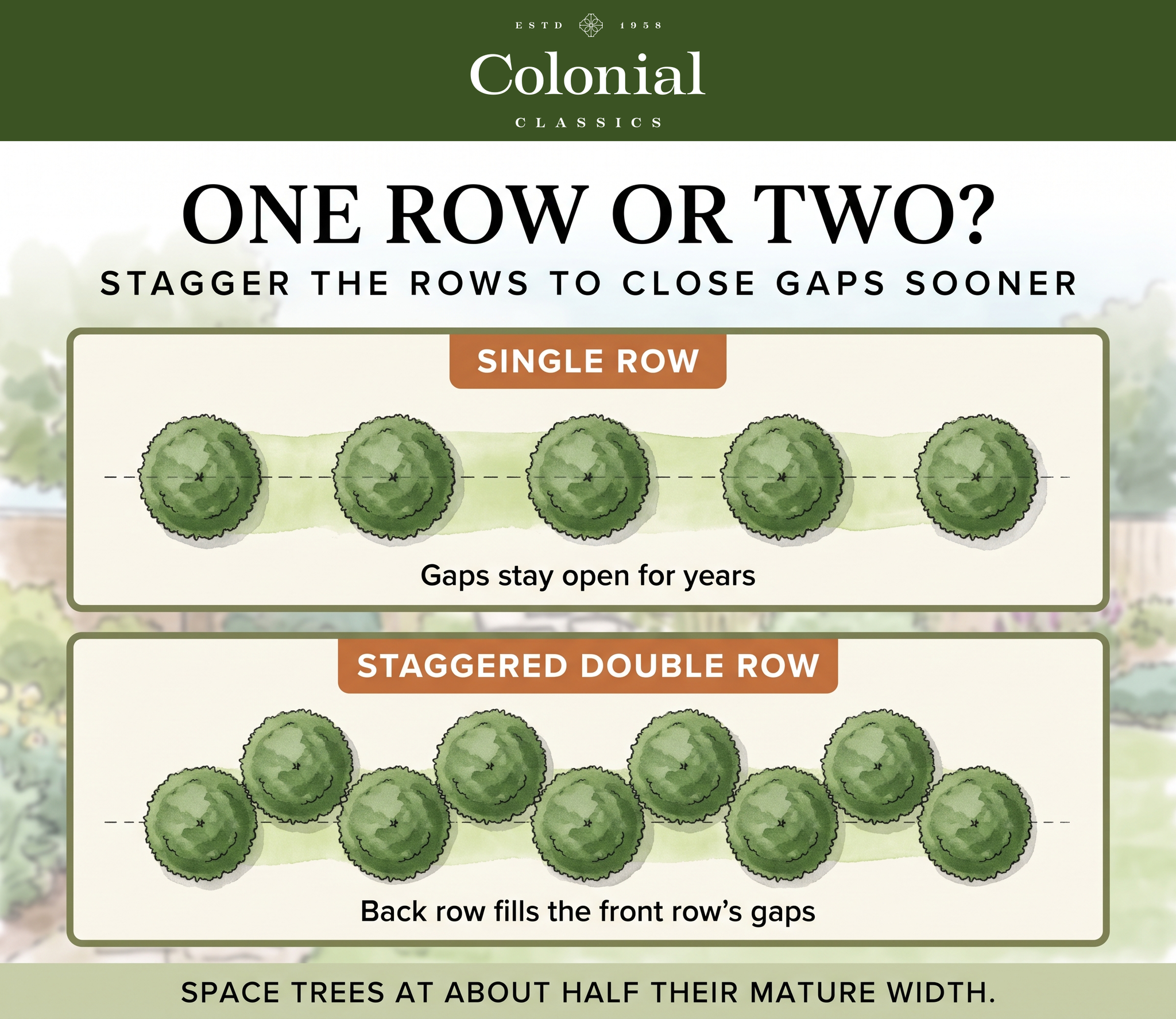
Plant privacy trees at roughly half their mature width, measured trunk to trunk. A Green Giant that spreads 12 to 18 feet goes in about 6 to 8 feet apart. A Norway spruce that spreads 25 to 30 feet needs 12 to 15 feet.
Planting closer looks fuller on day one, and that is exactly why it is tempting. But crowded trees compete for water and light, shade out each other's lower branches, and stay stressed, and stressed evergreens are the ones that get sick. NC State's Union County Extension warns that planting too close "means failing to give plants enough space at mature size."
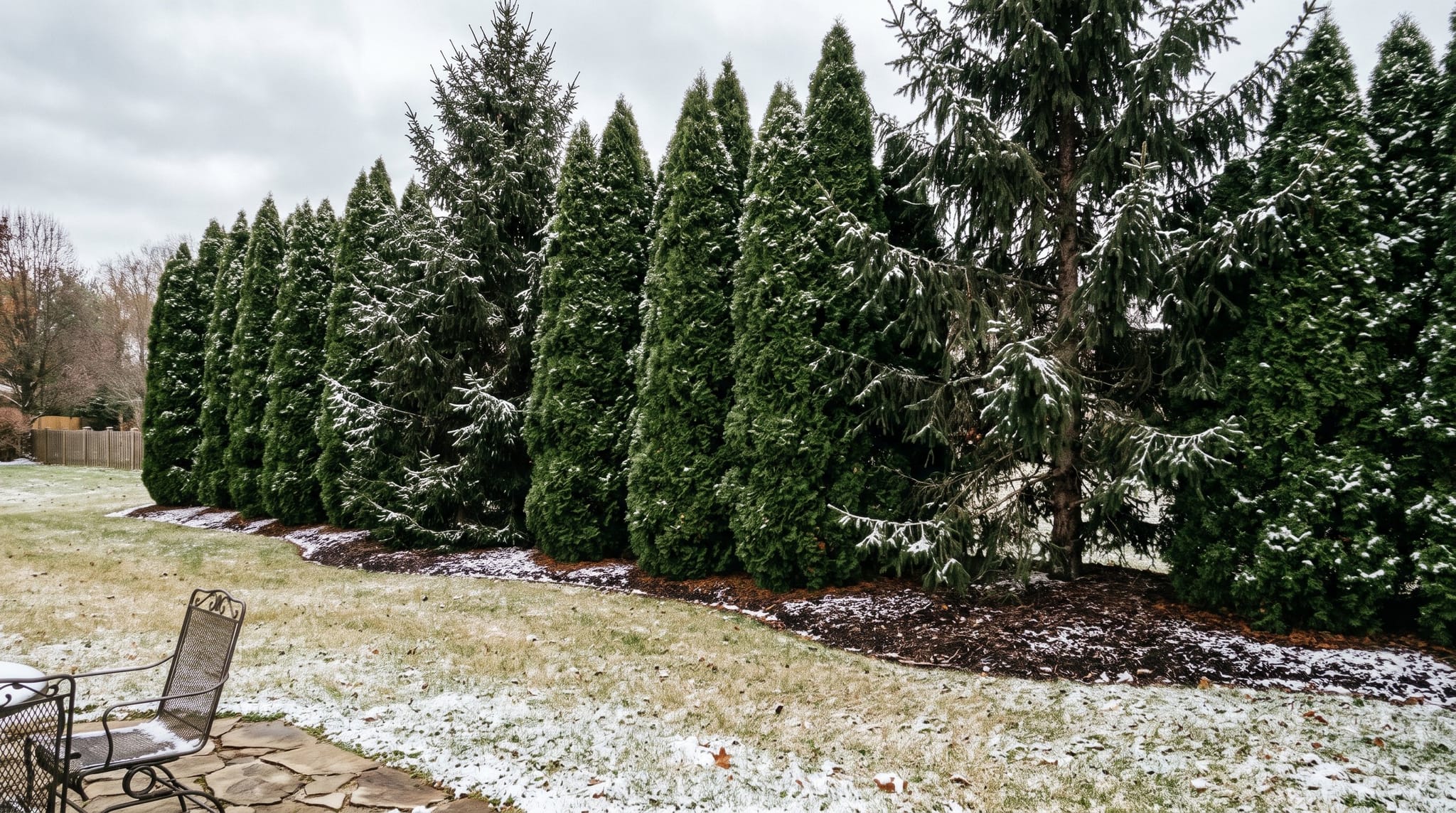
The better way to get privacy sooner is two rows instead of one. NC State recommends planting "staggered in two or even three rows," in a zigzag, so each tree in the back row fills a gap in the front row. You get coverage faster without cramming trees into a line.
Mix Your Species
A screen made of one kind of tree is one disease away from a gap. NC State's Union County Extension says "a good screen is a mix of species," because "a monoculture is more attractive to insect and disease pests." Pairing Green Giant with Norway spruce and a few hollies, for example, means a problem that hits one species does not take down the whole screen. It also looks more natural than a solid green wall.
How to Plant a Privacy Screen That Lasts
Most privacy screens that fail were planted too deep, planted too close, or left dry in their first two summers. Here is how to avoid all three.
- Measure the view. Stand where you sit and decide how tall and wide the screen needs to be.
- Call 811 first. Indiana 811 is free and required for all digging projects, and you need to request it at least two full working days before you dig. Illinois and Kentucky run their own 811 systems with their own notice rules, so check yours if you live across the river.
- Mark your spacing from the tree's mature width, using a staggered double row if you can. Set the row far enough inside your property line that the trees' mature width stays on your side.
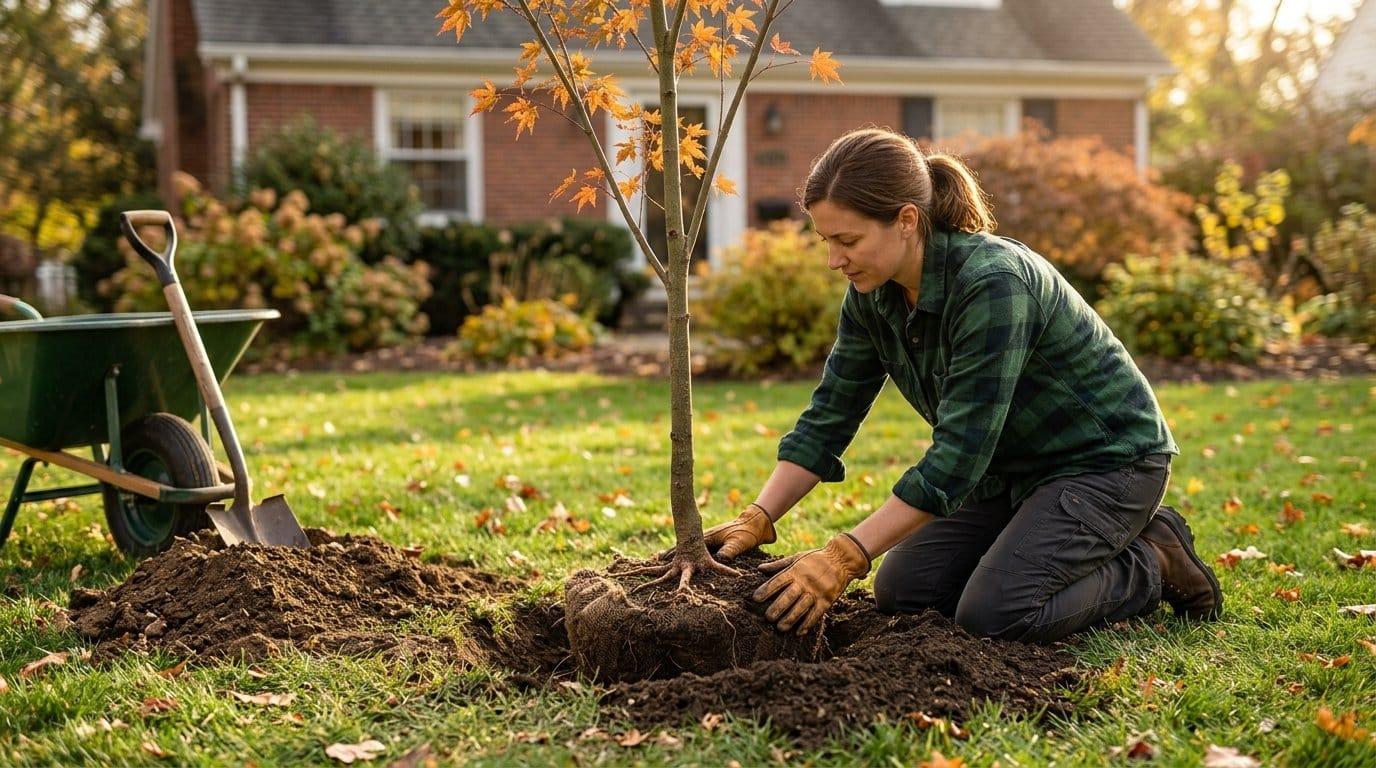
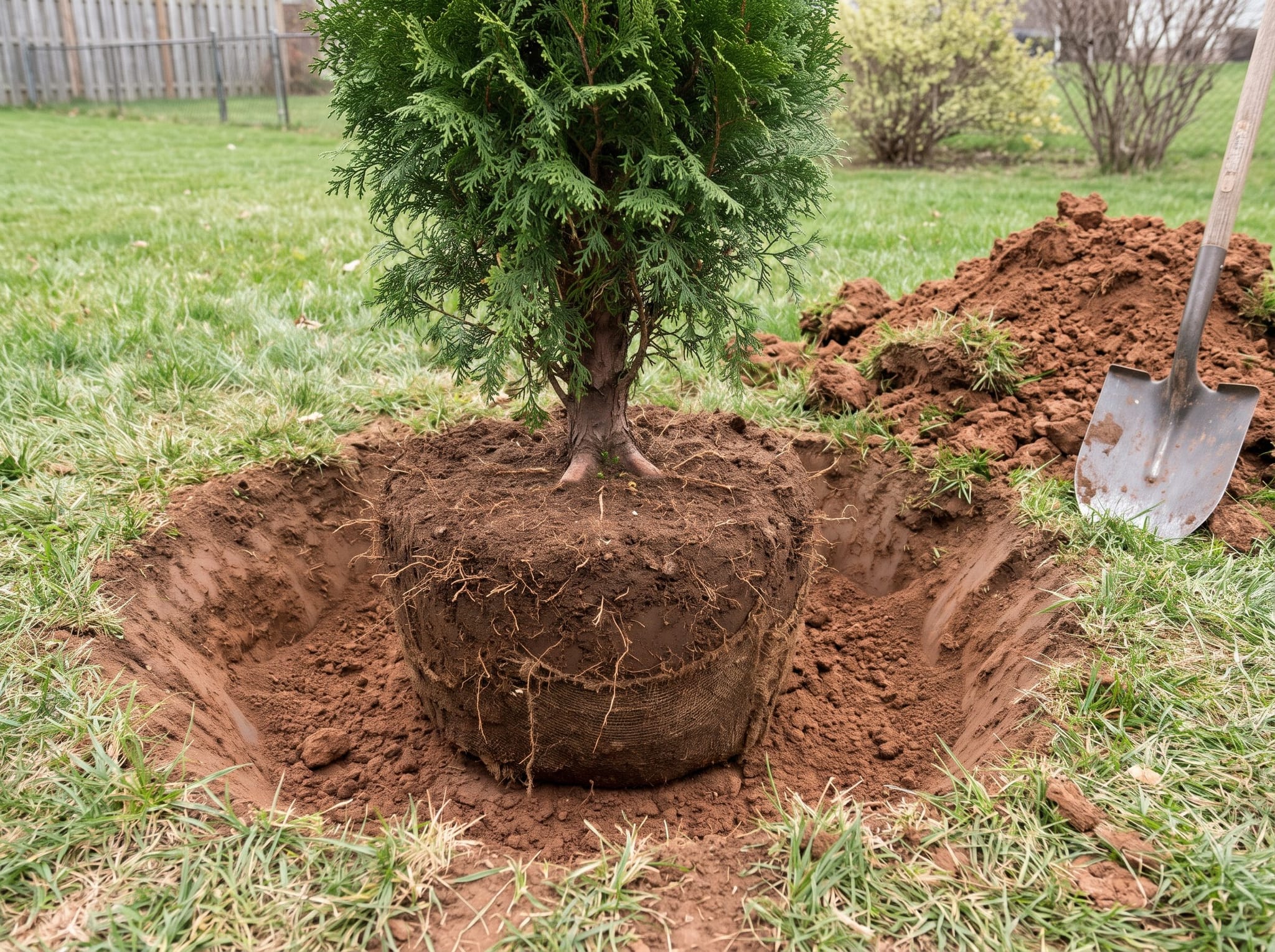
- Dig wide, not deep. Make the hole two to three times as wide as the root ball but no deeper than it is tall. Purdue calls planting depth "the most common reason for the slow decline of trees in the landscape." In heavy clay, set the root ball an inch or two high so water drains away from the trunk.
- Backfill with the native soil, water deeply, and spread 2 to 3 inches of mulch, keeping it off the trunk.
- Water through the first two summers. A slow soak once or twice a week in dry spells, and keep it up into late fall until the ground freezes.
For timing, early fall is the best season to plant arborvitae and spruce here, with spring as a good second choice. Our guide to the best time to plant trees covers the calendar in detail. If you are reading this in winter, it is the perfect time to measure, pick your trees, and plan for spring.
Buying big saves years. A 6 foot Green Giant closes a gap seasons sooner than a 3 foot one. Larger trees are heavy, so ask about delivery when you buy.
Problems to Watch For After Planting
Once a screen is in, two seasonal threats cause most of the damage we see: bagworms in summer and heavy snow in winter.
Bagworms
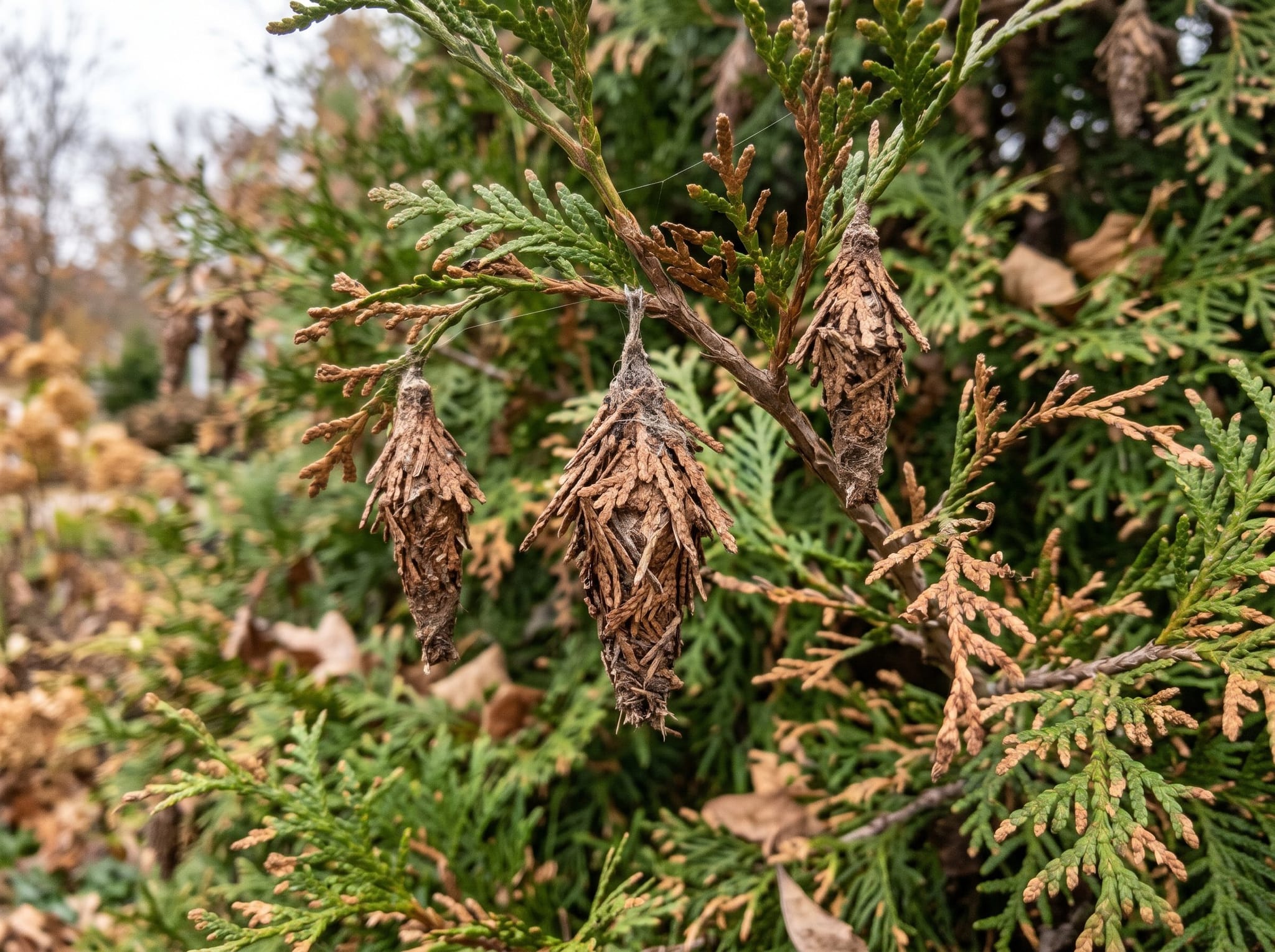
Bagworms are the insect to watch on arborvitae and red cedar. They build small, cone-shaped bags out of needles and hang from the branches like ornaments, and Purdue entomologists warn that they can defoliate arborvitae and junipers in July and August. Each female bag "can produce over 1000 bagworms," and the eggs overwinter inside the bag.
That makes the months before they hatch the easiest time to stop them. Purdue says hand-picking is "almost always the preferred method of control" late in the season, and recommends checking young trees in early spring and dropping any bags you find into a bucket of soapy water. If you miss some, spraying works in early to mid-June after the eggs have hatched. Once the caterpillars stop feeding, sprays do nothing.
Snow and Ice
Upright evergreens like arborvitae can splay open under heavy, wet snow, and the branches do not always spring back. Loosely spiraling soft twine around young trees before a big storm keeps them together. Our guide to protecting trees and shrubs in winter walks through how to do it without damaging the bark.
Deer
If deer are browsing your screen, especially Emerald Green, wrap the lower 5 or 6 feet in netting or burlap for the winter. For a full list of what they leave alone, see our guide to deer resistant plants.
Do You Need Trees, Shrubs, or Both?
Evergreen trees for privacy are the right tool when you need to block something more than 10 or 12 feet up. For lower screens along a patio or a fence line, a hedge of large shrubs often fits better and stays easier to manage. Our guide to the best bushes and shrubs for landscaping covers shrub options like arrowwood viburnum that work well at that scale. Many of the best screens layer both: tall evergreens in back, flowering shrubs in front.
If you are screening a pool, there are extra things to plan for, like keeping leaves and litter out of the skimmer and roots away from the deck. Our pool landscaping guide covers those.
Pick Your Trees in Person
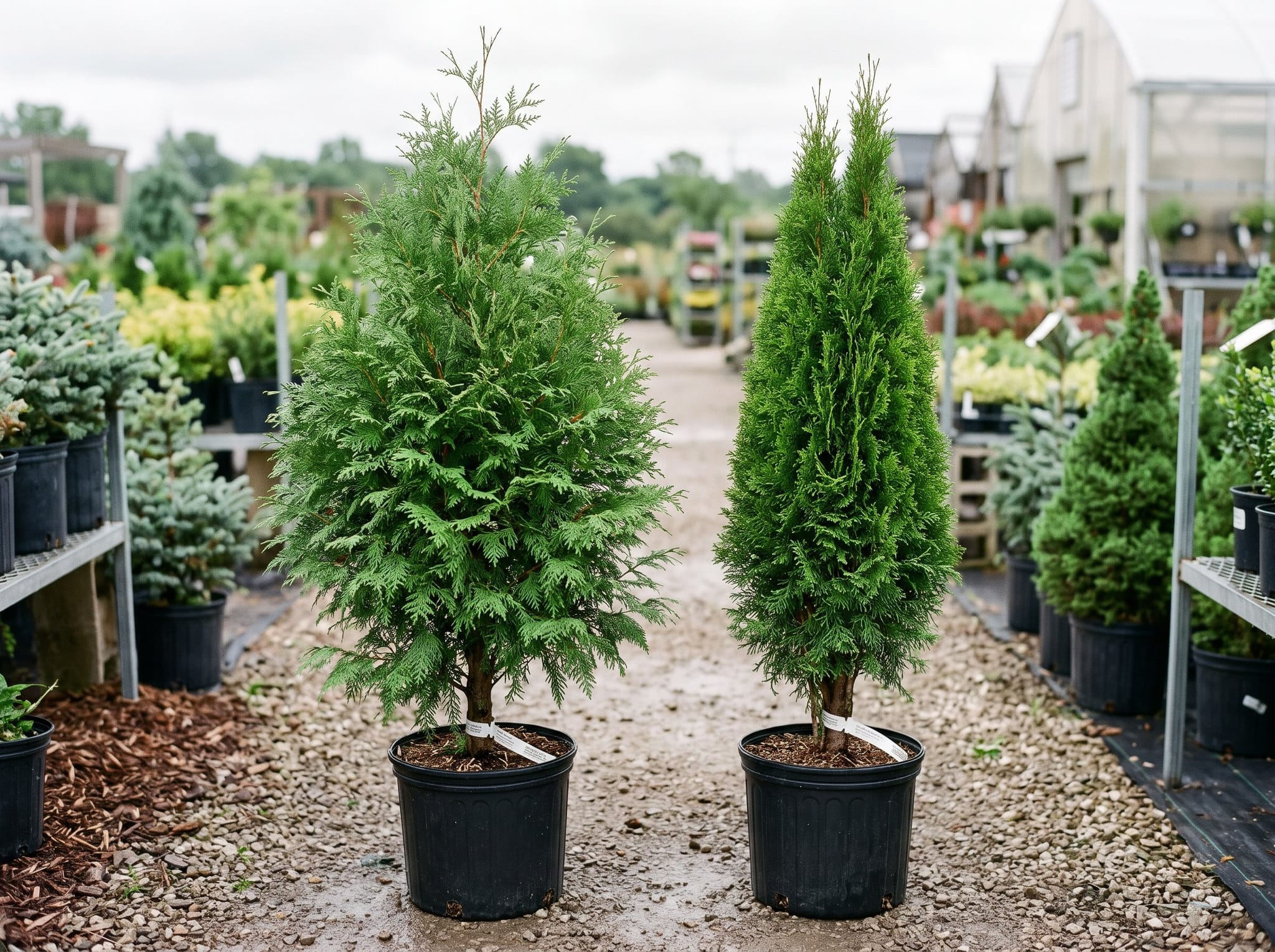
Privacy trees are a long-term investment, and the best way to choose one is to stand next to it. When you visit the trees and shrubs section at our Newburgh garden center, you can see the difference between a Green Giant and an Emerald Green for yourself, compare sizes, and talk with our specialists about your yard, your sun, and your neighbors. Bring your measurements and a photo or two of the spot so the team can picture it.
If you would like our crew to plant your trees, set it up with the team while you are there. Trees installed by our crew come with a planting warranty, and you can learn more about planting services before you come in.
Planning privacy as part of a bigger change to your property, like a new patio, a pool, or a full redesign? Our landscape design team can build screening into the plan from the start, so the trees, the hardscape, and the views all work together.