Sod vs. seed comes down to this. Sod gives you a finished lawn the day it goes down. Seed gives you the same lawn for a fraction of the price, if you can wait a season and hit a narrow planting window. That is the real tradeoff, and for most yards in the Tri-State area the deciding factor turns out to be the calendar rather than the budget.
The good news is that this is not a quality question. A well-installed sod lawn and a well-seeded lawn look the same in three years. What separates a lawn that thrives from one that fails is almost never which method you picked. It is whether the ground underneath got prepared properly and whether anyone watered it correctly for the first two weeks.
This guide covers what each method costs, when each one works, how to prepare the ground for either, and how to tell which one your yard actually needs. Timing here is written for Southern Indiana and the rest of the Tri-State area we serve across Indiana, Illinois, and Kentucky, all of which sits in USDA Zone 7a.
Every project is different. The pricing and timelines discussed here are general estimates based on typical projects in our area. Your actual costs and schedule will depend on your property, materials, scope of work, and other factors. Contact us for a personalized estimate.
Sod vs. Seed: The Short Answer
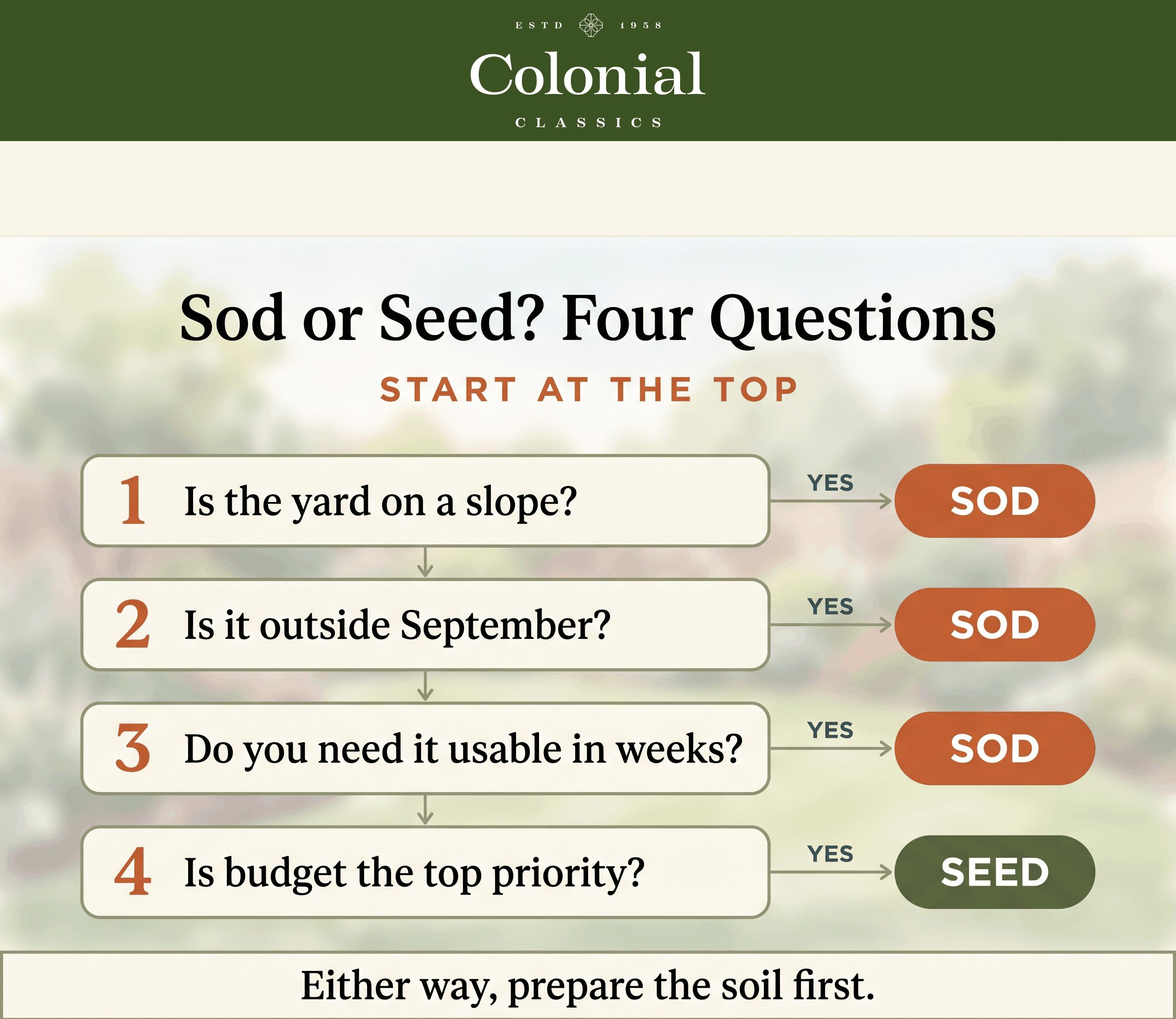
Choose sod when you need the lawn now, when the site has slope that would wash seed away, or when you have missed the seeding window. Choose seed when cost is the priority and you can accept a partial lawn for several months.
- Sod
- Several times more
- Seed
- The budget option
- Sod
- Same day, traffic in 3 to 4 weeks
- Seed
- Still establishing 2 to 3 months on
- Sod
- Nearly year-round, ground not frozen
- Seed
- Roughly one month in fall
- Sod
- Holds immediately
- Seed
- Washes without erosion control
- Sod
- Limited to what farms grow
- Seed
- Any blend you want
- Sod
- Comes in nearly weed free
- Seed
- Bare soil invites weeds
- Sod
- Daily for about 10 days
- Seed
- 2 to 4 times daily for weeks
Read down that table and one row does more work than the others. The planting window is the constraint you cannot negotiate with, and it is the reason plenty of homeowners who wanted to seed end up sodding instead.
When to Lay Sod and When to Sow Seed
Seed has one good month here. Sod has most of the year.
For cool-season grasses, Purdue and the University of Illinois put the optimum seeding window at September 1 to September 30 in the southern half of Indiana and Illinois, which runs about two weeks later than the August 15 to September 15 window they give for the northern half. Their guidance is emphatic about seeding as early in that window as possible: "waiting one week to seed may mean the stand will take 2 to 4 additional weeks to mature." That single line is why so many October seedings disappoint. The seed germinates, but the seedlings run out of warm weather before they can build the root system that carries them through winter.
Spring seeding is the fallback, not the plan. Purdue calls it "difficult and often unsuccessful," because seedlings started in April are competing with crabgrass and heading into summer heat with almost no roots. Summer seeding should be skipped entirely.
Sod plays by looser rules. Purdue's sod publication is direct about the advantage: sod "allows you to establish a lawn even when seeding conditions are not optimal." Fall is still the optimum time to install cool-season sod, since a fall planting gives roots time to develop before the next summer, but sod also goes down successfully in spring and summer with enough irrigation, and it can be installed any time the ground is not frozen.
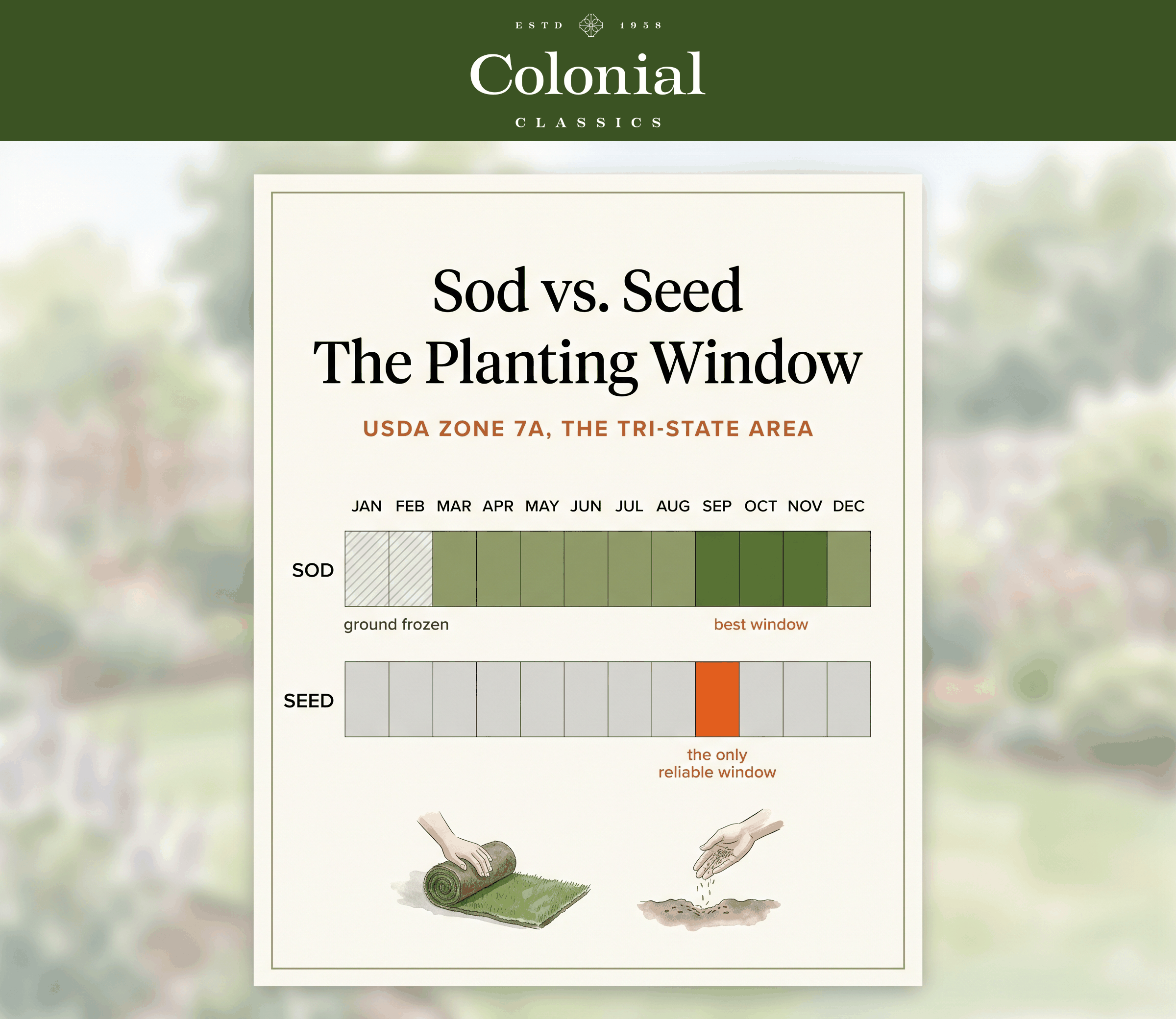
Winter installation, what the industry calls dormant sodding, is possible when a construction deadline demands it, but Purdue flags it as noticeably riskier than fall sodding because of winter desiccation and injury. If you go that route, the irrigation still matters. Purdue names lack of water as "the number one reason dormant sodding is unsuccessful," and you have to keep monitoring soil moisture through the winter until roots develop in early spring.
If it is already October and you want a lawn before spring, the decision has largely been made for you. Sod is the option that still works.
What Each One Costs
Sod costs several times what seed costs for the same square footage. That gap is the entire argument for seed, and it is a real one on a large property.
The figures below are national 2026 averages from LawnStarter's sod cost guide and lawn seeding cost guide, with the seed materials row worked out from their per-pound seed prices at the seeding rates Purdue publishes. They are a starting point for comparing the two methods, not a quote from us.
- Typical 2026 range
- About $10 to $55 per 1,000 sq ft
- On a 5,000 sq ft lawn
- $50 to $275
- Typical 2026 range
- $0.09 to $0.15 per sq ft
- On a 5,000 sq ft lawn
- $450 to $750
- Typical 2026 range
- $0.30 to $1.00 per sq ft, averaging $0.60
- On a 5,000 sq ft lawn
- $1,500 to $5,000
- Typical 2026 range
- $1.00 to $2.20 per sq ft, averaging $1.65
- On a 5,000 sq ft lawn
- $5,000 to $11,000
The seed materials row swings that widely because the seed itself does. Tall fescue runs about $2 to $6 a pound and gets sown at 6 to 9 pounds per 1,000 square feet, while Kentucky bluegrass costs $7 to $15 a pound but only takes 1.5 to 2 pounds over the same area. Buying seed for a 5,000 square foot lawn is a couple hundred dollars at most. Sodding it is a four figure job before anyone picks up a shovel.
A few things move those numbers more than most homeowners expect. Site preparation is the big one, and it is charged the same either way, so a yard that needs regrading, topsoil, or drainage work narrows the gap between the two methods considerably. Access matters too, since Purdue puts sod at roughly 35 to 40 pounds per square yard and someone has to carry all of it from the pallet to where it goes. A fenced back yard with a narrow gate costs more to sod than an open front yard of the same size.
If you are buying materials yourself, a pallet holds about 50 square yards, which is 450 square feet. Purdue recommends ordering about 10 percent more than your measured area to cover waste from cutting around curves, corners, and sprinkler heads. Our garden center carries sod along with bulk topsoil and soil amendments if you are handling the install yourself.
How Long Until You Actually Have a Lawn
Sod is a lawn immediately, and Purdue says to keep traffic off it for three to four weeks. Seed has no equivalent published traffic date, but Purdue's establishment program shows the scale of the wait: it calls for feeding a new seeding four to six weeks after germination and again eight to ten weeks after germination. A seeded lawn is still being managed as a new planting two to three months after it comes up.
The germination clock is only the first step, and it varies a lot by species. University of Tennessee Extension's turfgrass establishment guide puts the intervals at:
- Perennial ryegrass: 3 to 7 days, the fastest of the common cool-season grasses.
- Tall fescue: 6 to 12 days, quick because the seed is relatively large.
- Fine fescues: 6 to 14 days.
- Kentucky bluegrass: 14 to 21 days, the slowest, which is why it is often blended with ryegrass.
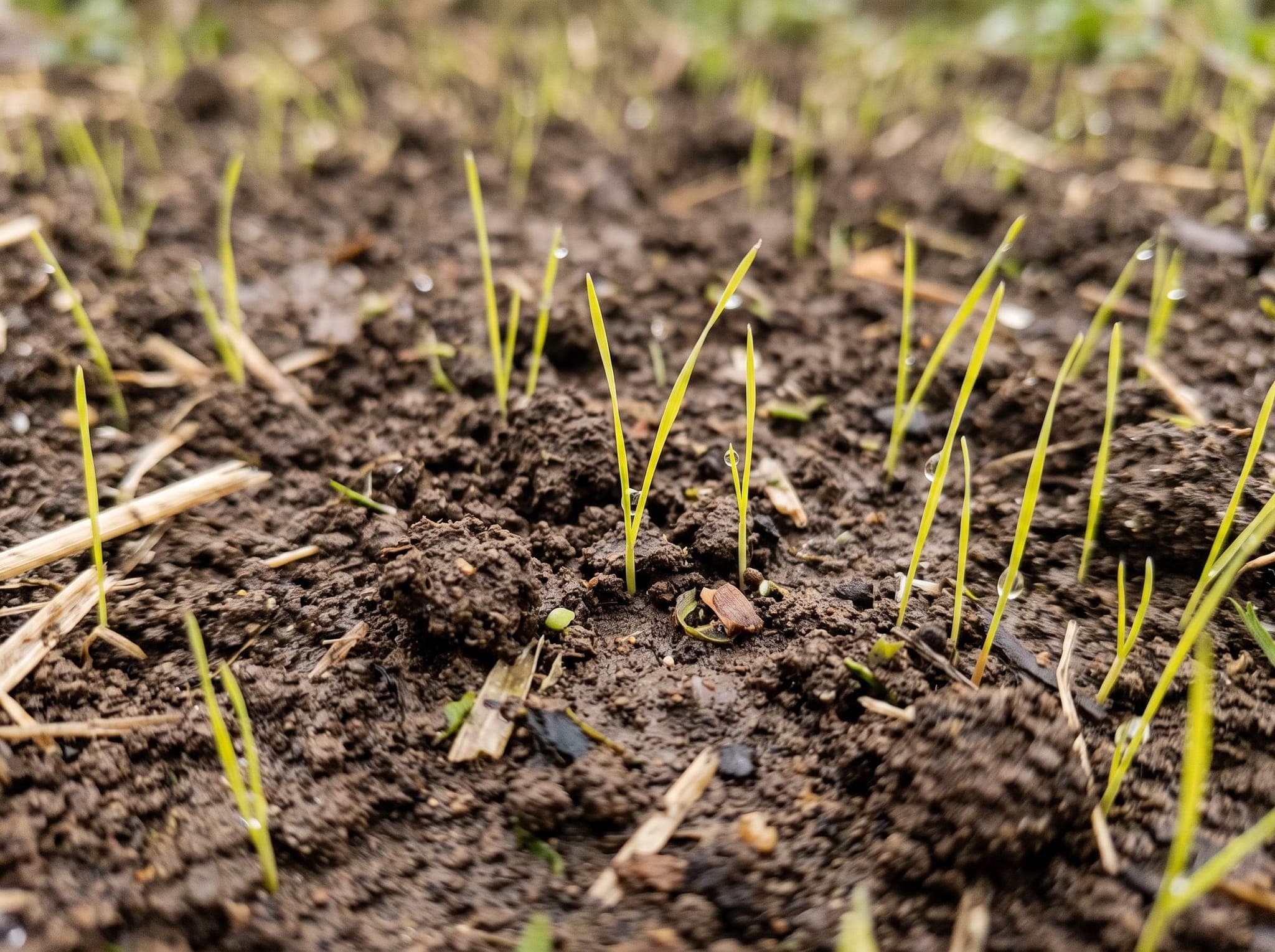
Germination is not establishment. After the seedlings emerge you are looking at several more weeks of thin, fragile turf that needs constant moisture and cannot be walked on, fertilized aggressively, or treated with most herbicides. Purdue's guidance is to hold off on broadleaf herbicides until seedlings have been mowed at least three times.
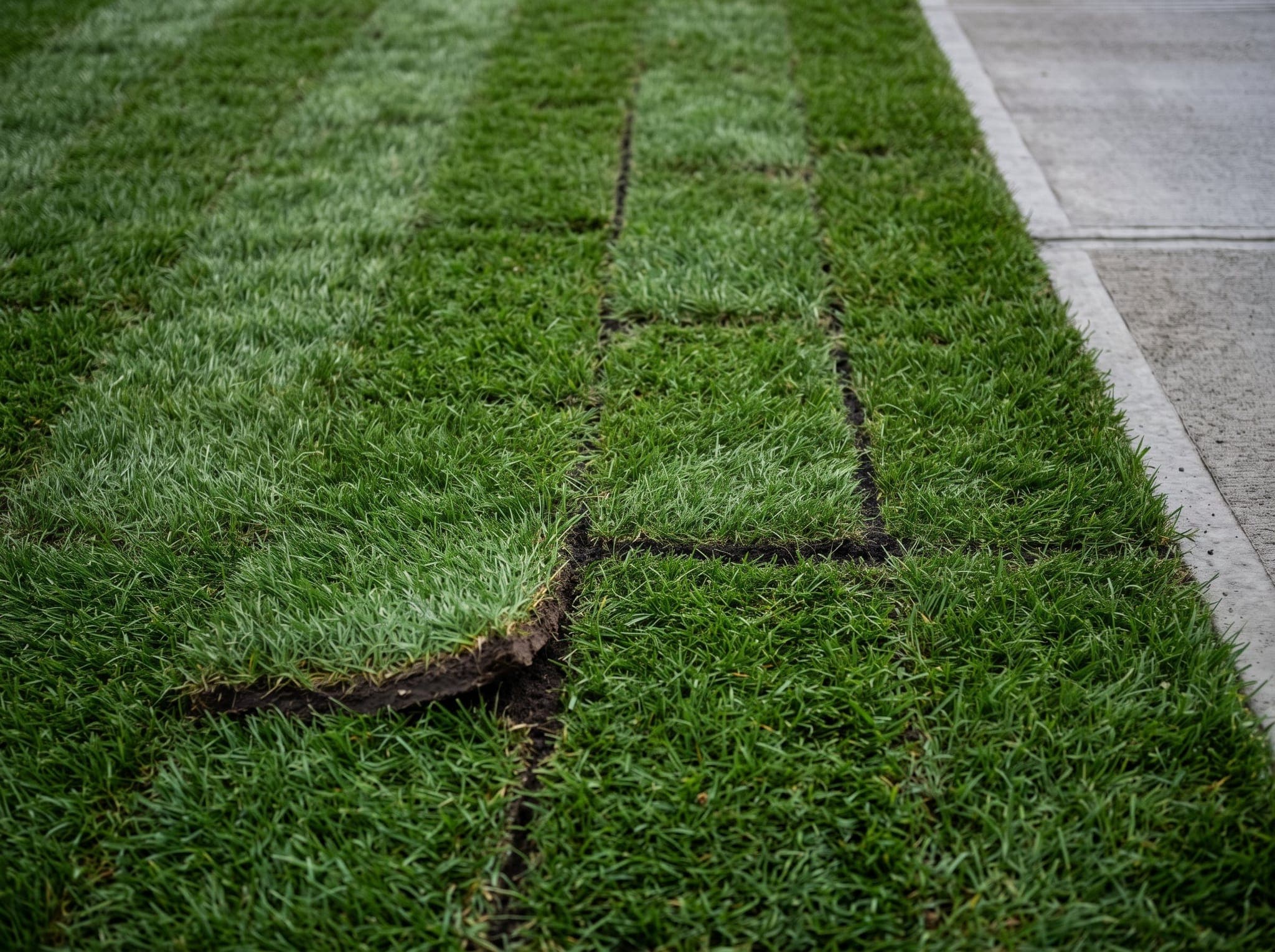
Sod moves through that phase in a different order. It arrives as mature turf and only has to root. Purdue reports that most grasses are "fairly well rooted within 10 to 14 days if temperatures are optimal and the sod is kept moist," and gives a simple field test: grab a corner and try to lift it. New roots are white, older roots are brown. Even so, keep people and pets off for three to four weeks, because allowing traffic too soon is on Purdue's list of the most common sod mistakes.
Prepare the Ground the Same Way for Both
This is the part that decides whether either method works, and it is identical for sod and seed. Skipping it is how a $9,000 sod job dies in August.
Both Purdue publications call for the same sequence: soil test, weed control, debris removal, grading, topsoil, amendments, and a firm final grade. A few of those steps deserve emphasis, because they are the ones most often rushed.
Test the soil a month early, not the week of. The test tells you pH and phosphorus, and both matter more at establishment than at any other point in a lawn's life. Purdue's target pH range for turf is 6.0 to 7.5. If lime is needed, it has to be tilled in before anything goes down, and lime is slow acting.
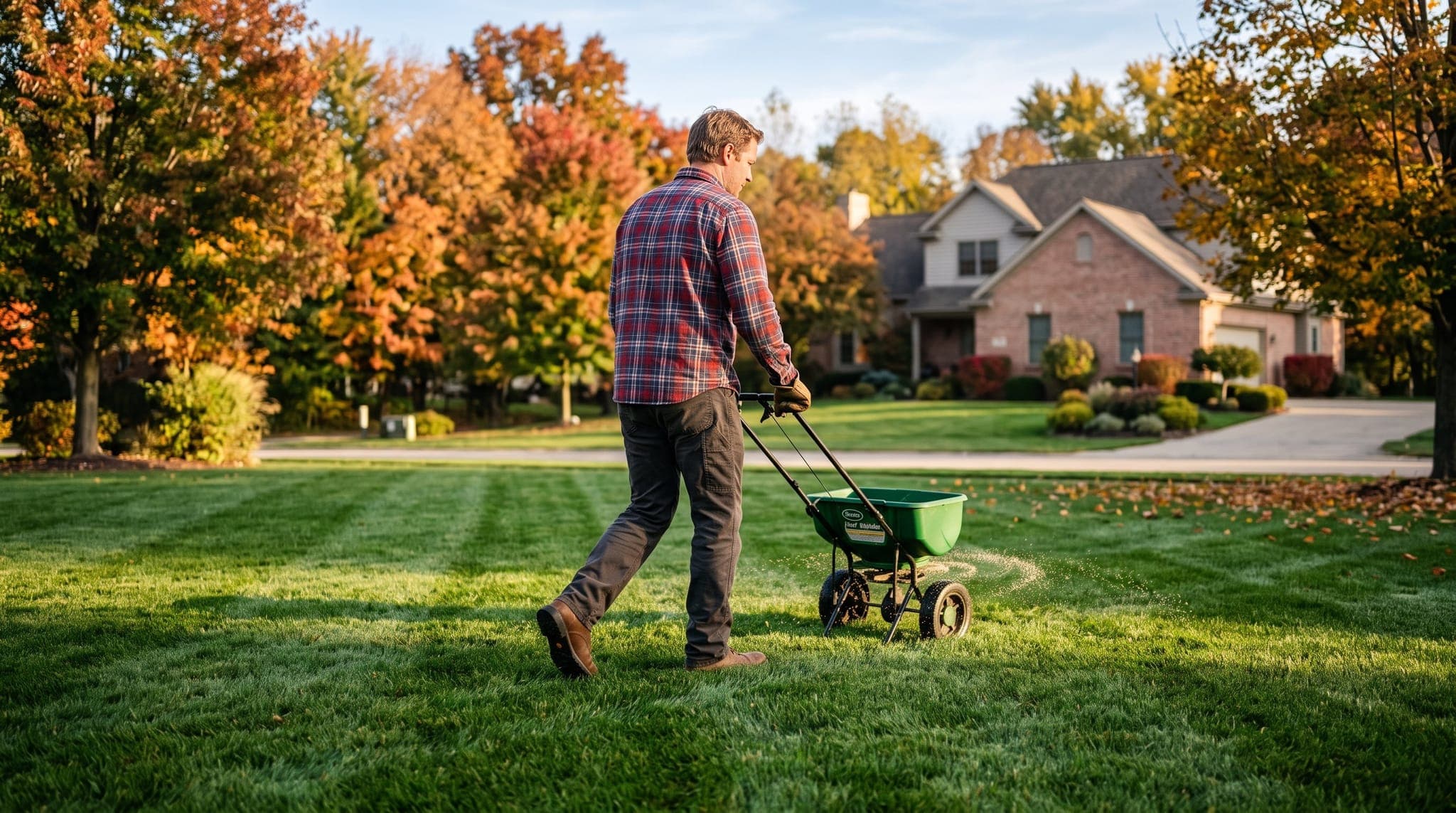
Use a starter fertilizer, and read the middle number. Purdue recommends about 0.5 to 1.0 pound of nitrogen and at least 1.0 pound of phosphate per 1,000 square feet at installation. Phosphorus is what drives initial root development, and it is the one nutrient that is genuinely hard to add later once turf is covering the soil. Nitrogen comes afterward: a follow-up application about a month after sod goes down, and again 30 to 60 days later.
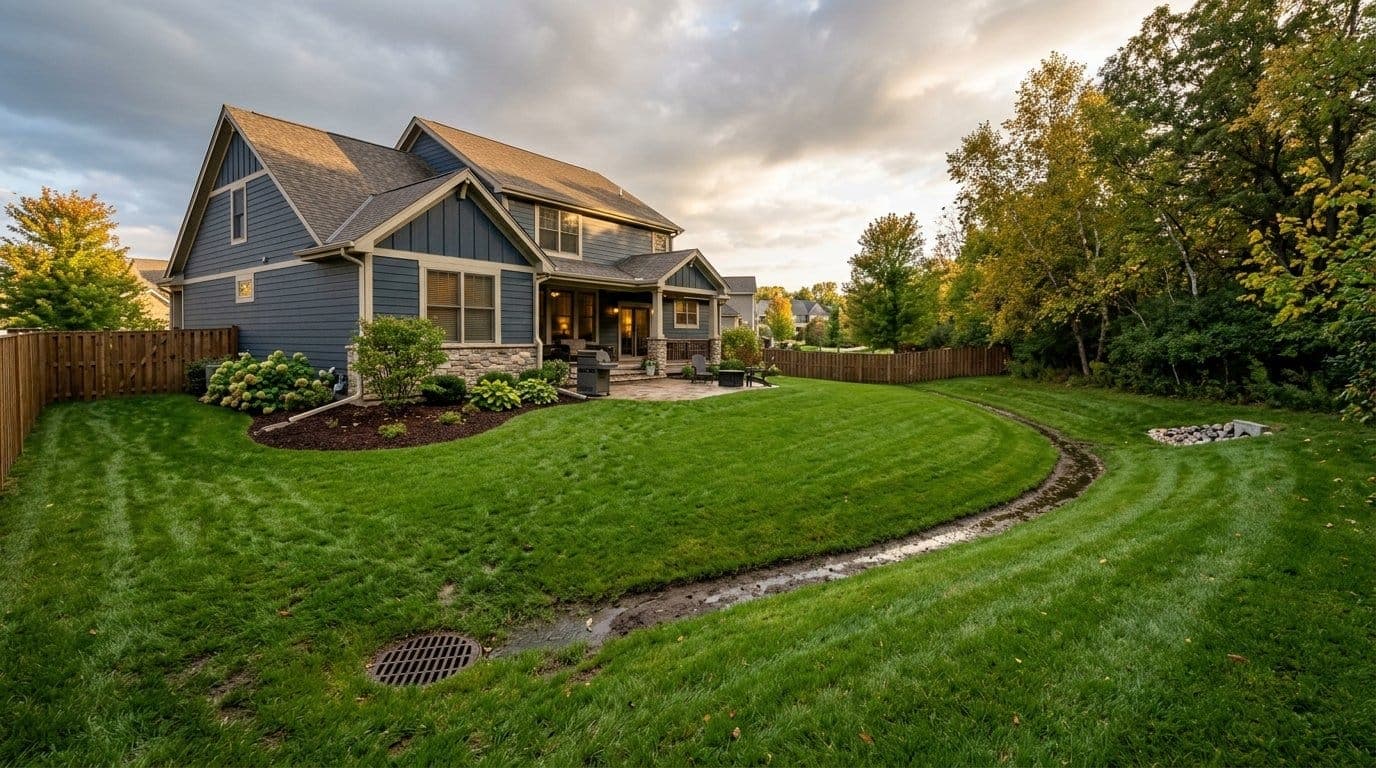
Get the grade right before anything green touches the ground. Slope away from the foundation at least 15 feet in every direction, aiming for roughly a 1-foot drop over 50 feet. Purdue warns that slopes steeper than a 1-foot drop every 4 feet create both mowing and erosion problems, and recommends terraces, retaining walls, or ground cover in those spots instead. If that is where your yard is headed, our guide to what a retaining wall costs covers the pricing before you plan around it. If your yard already holds water, fix that first. New turf will not solve it, and our guide to yard drainage problems covers what actually will.
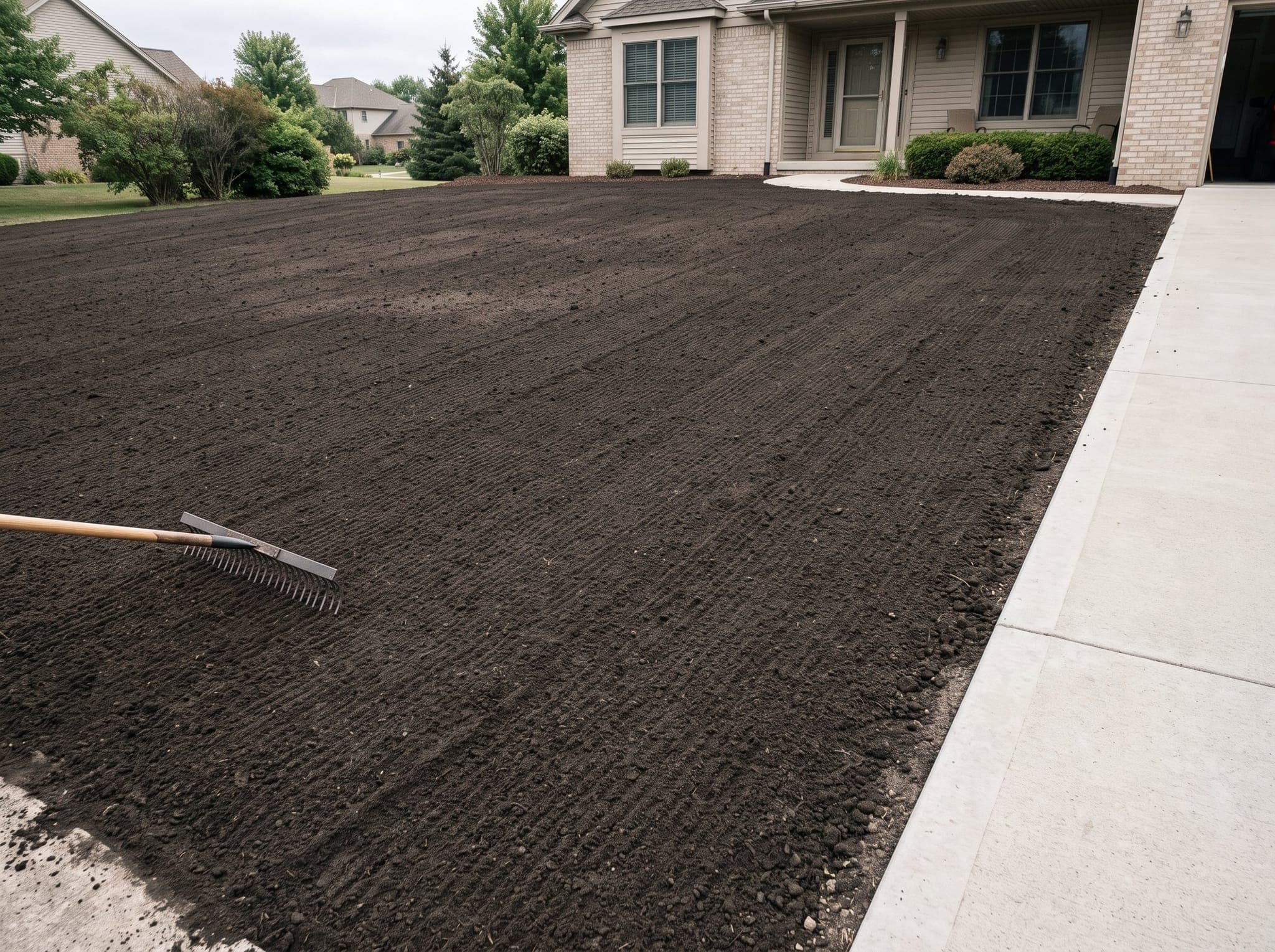
Do not till wet soil. Working saturated ground destroys soil structure and leaves clods you will be fighting for years. In our clay soils that damage is effectively permanent. Wait for the site to dry out, even if it costs you a week in the schedule.
Watering Is Where New Lawns Are Won and Lost
Insufficient water in the first two weeks is the number one cause of failure for both methods, and the schedules are completely different.
New sod needs daily morning watering until it roots, which is usually about 10 days. During warm, dry stretches Purdue notes it may need water multiple times a day, and the edges of the sodded area dry out first. Once it is rooted, shift to less frequent and deeper watering.
New seed needs more frequent, lighter water than sod. Purdue calls for irrigating two to four times daily, enough to keep the top half inch to one inch of soil moist without saturating it. Once seedlings reach about two inches tall, back off the frequency and water more deeply. After the third mowing you can move to the deep, infrequent schedule a mature lawn wants.
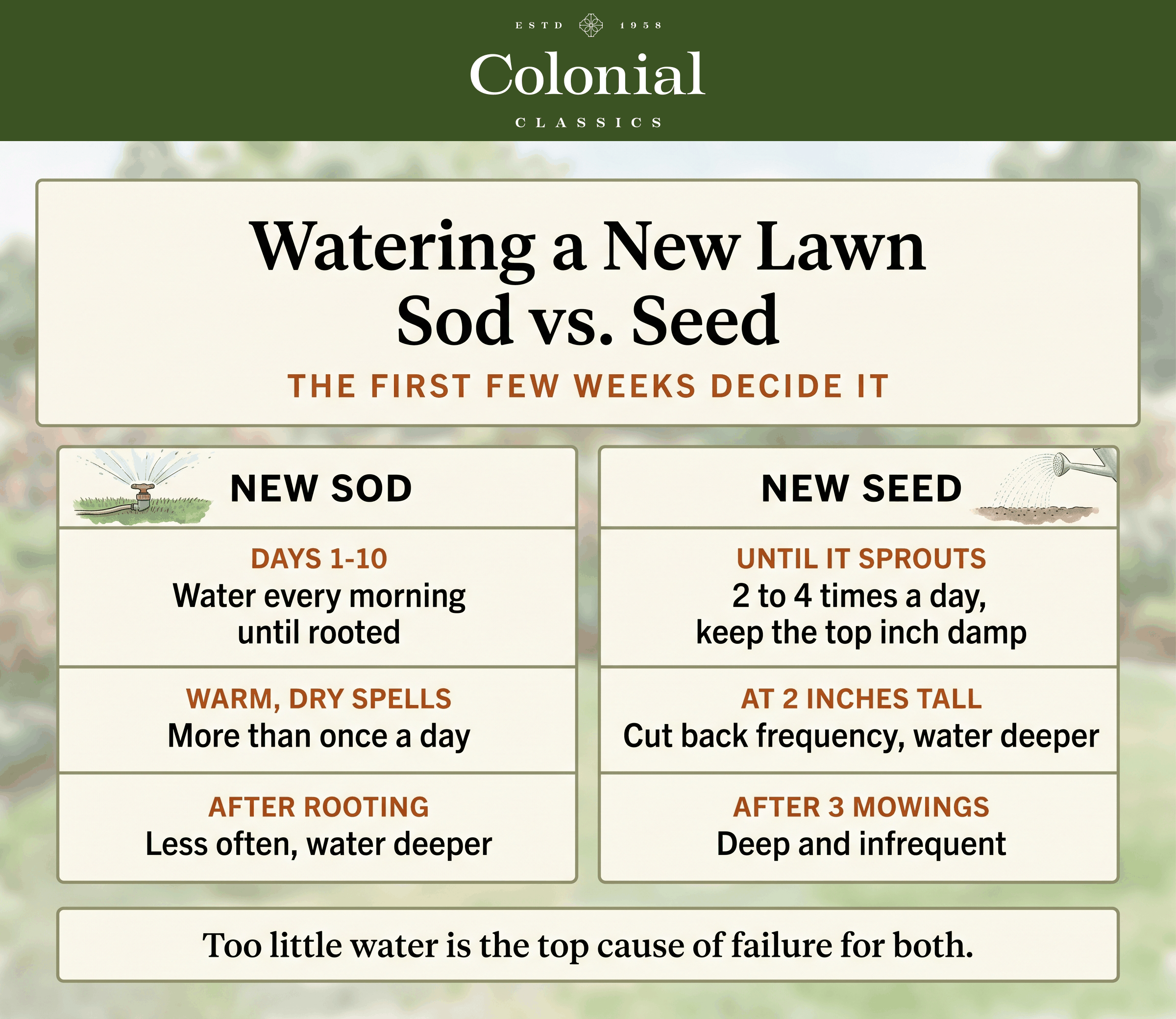
The distinction matters because the failure modes are opposite. Sod dies from drying out underneath while the top still looks green. Seed dies when the surface crusts over between waterings, even briefly, during germination. Once either lawn is established, our guide to watering a lawn in summer covers the schedule it needs from then on.
An irrigation system pays for itself here more than anywhere else. Hand watering a new lawn two to four times a day for three weeks in September is a real commitment, and one missed day during germination can cost you the whole seeding. If you are already installing irrigation, do it before the turf goes in, not after.
Which Grass Should You Plant Here
Turf-type tall fescue is the default for most Tri-State yards, and Purdue's turf program recommends it for Indiana lawns almost as often as Kentucky bluegrass. They note it is more heat resistant than bluegrass, which makes it a particularly good fit for southern Indiana, and that its deeper rooting keeps it green further into a drought while needing about half the nitrogen and far less irrigation. It is widely available as both seed and sod.
- Available as
- Seed and sod
- Best for
- Most yards here, sun or part shade
- Watch out for
- Sod often contains 10% bluegrass or netting to hold together
- Available as
- Seed and sod
- Best for
- Fine texture, self-repairing turf
- Watch out for
- Slowest to germinate at 14 to 21 days
- Available as
- Seed, usually in blends
- Best for
- Fast cover, erosion control
- Watch out for
- Rarely planted alone as a permanent lawn
- Available as
- Sod, cultivar 'Meyer'
- Best for
- Full sun, heat, low water
- Watch out for
- Tan and dormant much of the year, slow to root
Zoysia is the one worth a second look and a clear warning. Purdue considers it suitable for the southern half of Indiana, which includes our whole service area, and it handles June through August heat better than any cool-season grass. The catch is that it is a warm-season grass, so it greens up late in spring and goes tan after the first hard frost. Some homeowners love it. Others are surprised by how long the dormant season runs. It also roots slowly, and unlike cool-season sod, early summer is its best installation window rather than fall.
One technical detail worth knowing if you are buying sod: ask what soil it was grown on. Purdue flags soil layering as a serious problem when the sod's soil texture differs sharply from your site's, because the two layers impede water and air movement and slow rooting. If the colors are obviously different, plan on core aerating once the sod is securely rooted, which takes at least two months.
When Sod Is Clearly the Right Call
Some situations remove the choice entirely.
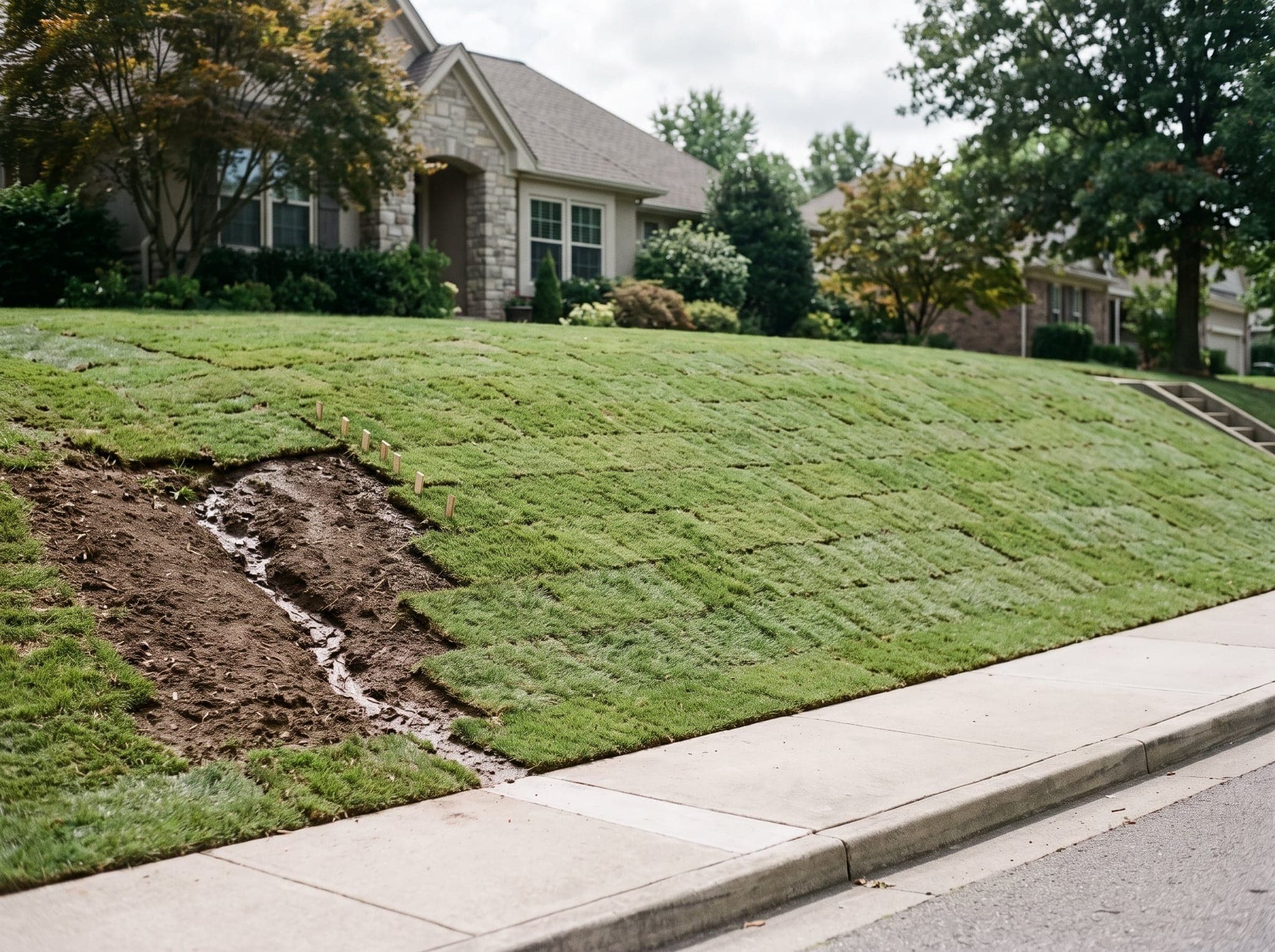
- Slopes and erosion: Sod holds soil the moment it goes down. Seed on a slope washes into the street with the first heavy rain unless you add straw, blankets, or hydromulch, and even then it is a gamble. Purdue specifically cites erosion control as a reason sod is popular.
- New construction: Bare graded dirt tracks into the house, erodes, and grows weeds. Sod stops all three immediately.
- You are outside the seeding window: October through August is a hard no for cool-season seed and a routine yes for sod.
- Kids and dogs who will not wait: Purdue's establishment feeding program for a new seeding still runs eight to ten weeks past germination, so you are protecting thin, fragile turf for the better part of a season. That is not realistic in most households.
- A dead or badly failed lawn: When more than about half the yard is gone, overseeding will not bring it back, and starting over with sod is usually faster than the multi-year renovation seed requires.
When Seed Makes More Sense
Seed wins on cost, selection, and low-pressure timelines.
- Large areas on a budget: The cost gap compounds with square footage. On an acre, the difference is life-changing rather than annoying.
- You want a specific blend: Sod farms grow what sells. Seed lets you choose exactly the cultivars and mix you want, including fine fescues for shade.
- It is early September and you are ready: If you are inside the window with prepared ground, seeding is the economical move.
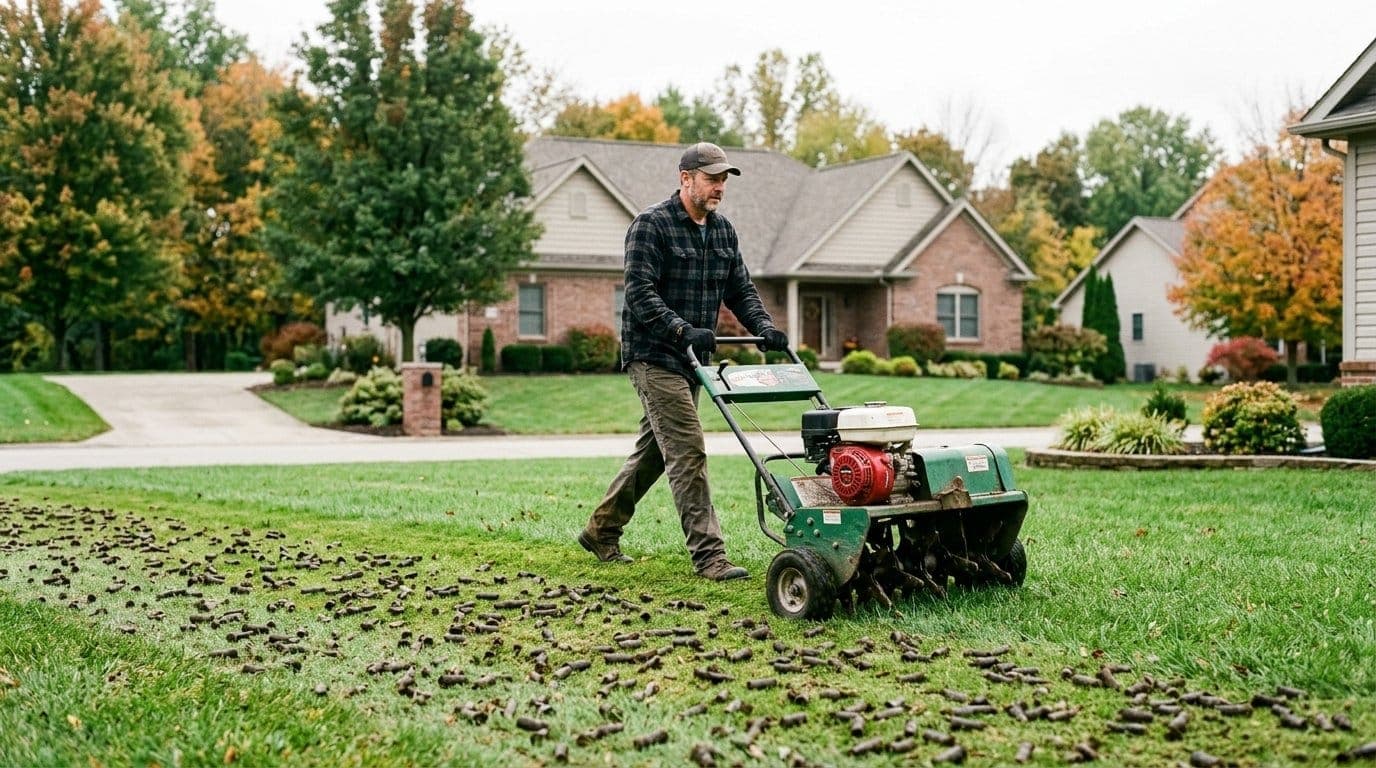
- You are improving an existing lawn, not replacing it: If the turf is thin rather than gone, you want core aeration and overseeding instead of either option here. That is a different job with a different process.
Common Mistakes With Both
Most new lawn failures trace back to a short list, and almost all of them happen before or just after installation.
- Underwatering in the first two weeks: This is the top failure cause for both methods. Sod edges and corners go first because they dry fastest.
- Laying sod on unprepared ground: Turf laid over compacted clay or construction fill roots poorly and thins out within a season.
- Letting sod sit on the pallet: Purdue says sod should be delivered and installed within 24 hours of harvest. Stacked pallets heat up and the turf deteriorates fast in warm weather.
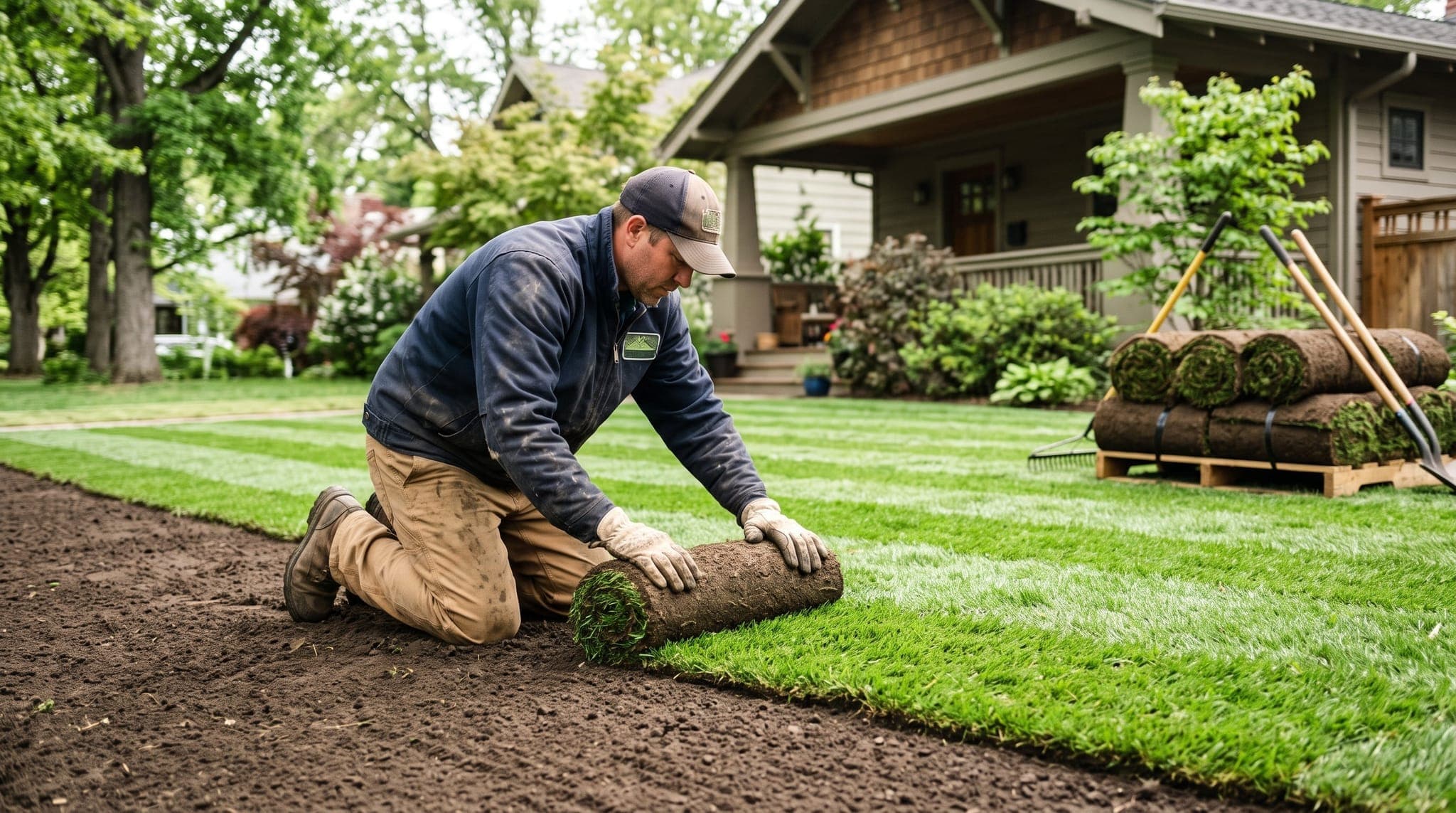
- Poor seam spacing: Butt the joints tight without overlapping, stagger them like brickwork, and skip pieces narrower than 9 inches or shorter than 18 inches, since small pieces dry out. On slopes, start at the bottom and peg each strip.
- Seeding too late: Every week past early September costs you two to four weeks of maturity, and there is a point where the math stops working.
- Walking on it too soon: Three to four weeks off the new lawn, both methods.
- Spraying herbicide too early: Wait 30 days after sodding for most selective broadleaf products, and until seedlings have been mowed three times on a seeded lawn. Preemergents wait longer still.
- Mowing too short at first: Set the deck higher than your target height for the first few cuts so you do not scalp an uneven new surface, and make sure the blade is sharp so it cuts rather than tears.
Getting It Done
Both methods are within reach for a homeowner on a small, flat, accessible lot. What pushes a project toward professional help is usually the ground rather than the grass: significant grading, imported topsoil, drainage that has to be corrected first, or a slope that needs retaining walls before turf makes sense. Sod adds a logistics problem on top of that, since pallets have to be delivered, positioned, and hand-carried across the site within a day of harvest.
Our sod installation crew handles soil preparation and grading, turf selection for your soil and sun exposure, installation, and the watering plan afterward, across Newburgh, Evansville, and the surrounding Tri-State area. If your lawn is thin rather than gone, aeration and overseeding is the less expensive place to start, and either way a new lawn needs to go straight onto a feeding program to hold what it gained. Our fall fertilizer schedule covers what to apply and when through the rest of the season.
The short version: if you are reading this in early September with prepared ground and a flat yard, seed is the economical choice and the window is open right now. Any other combination of slope, timing, or urgency points to sod. Reach out if you want someone to look at the site and tell you which one your yard actually needs.
Sources: Purdue Extension AY-28-W, Establishing a Lawn from Sod; Purdue University and University of Illinois AY-3-W, Establishing Turfgrass Areas From Seed; University of Tennessee Extension W160-B, Turfgrass Establishment Seeding; Purdue Turfgrass Science, Tall Fescue for Indiana Lawns. Cost ranges are national 2026 averages from LawnStarter's sod and lawn seeding cost guides, not Colonial Classics pricing.